

Bloggers to the Vatican....
(I kid.)
Universalis, your very own breviary in pixels...

Friday, 22 April 2011
Beauty Created for the Mass
The Church [holds] that the rituals of the Mass, or liturgy, puts participants in direct contact with Jesus, and that the beauty and preciousness of the objects and vestments used in the Mass help the spirit raise itself to the beauty and greatness of God.
I may not have gotten all that right, I am finding it harder and harder to read my own scribbled notes to myself, but that is the gist of a card at a museum exhibit called "Splendors of the Vatican" that I was fortunate enough to see.
I assume the words are by the curator, a Monsignor... okay, REALLY cant read it, but begins with a "Z," and ends with an "i."
I am a very fortunate person.
I may not have gotten all that right, I am finding it harder and harder to read my own scribbled notes to myself, but that is the gist of a card at a museum exhibit called "Splendors of the Vatican" that I was fortunate enough to see.
I assume the words are by the curator, a Monsignor... okay, REALLY cant read it, but begins with a "Z," and ends with an "i."
I am a very fortunate person.
Prayerful and Beautiful
I intended to post about this... oh, let's see -- Annunciation was a month ago, Scelata! --- previously, but when your home phone is cut off even dial-up is out of reach.
Anyway, we paid a visit to the Institute of Christ the King last night
They had Adoration until midnight -- how common is this, I wonder? One parish at which I sing keeps the church open for all of an hour after the Mass of the Lord's supper.
One hour... (so? all He said was "one hour")
The parish where I heard Mass last Holy Week had a stunning, heart-breaking liturgy and procession to the altar of Repose and then all devolved into chattering, photo-taking chaos as the bus tours arrived -- how common is THAT?
(I left more quickly than I would have wished, but like to think one of the priests subsequently, and SOON, appeared like an avenging angel to quash the irreverence.)
At the church the Institute is renovating all was heartfelt, (and, dare I say, active?) silence.
But I was reminded that I never praised the beautiful singing of the Rex Gloriae Schola on the occasion of the Annunciation, ( they were directed by Paul Wierzbowski, whom I know from CMAA activities,) and the Chicago Chorale., which provided the polyphony.
I was sorry not to hear Msgr Schmitz preach (I still wish I had the text of a homily he gave to a group of musicians a few years ago) but the homilist whose name I didn't catch was very good.
Anyway, we paid a visit to the Institute of Christ the King last night
They had Adoration until midnight -- how common is this, I wonder? One parish at which I sing keeps the church open for all of an hour after the Mass of the Lord's supper.
One hour... (so? all He said was "one hour")
The parish where I heard Mass last Holy Week had a stunning, heart-breaking liturgy and procession to the altar of Repose and then all devolved into chattering, photo-taking chaos as the bus tours arrived -- how common is THAT?
(I left more quickly than I would have wished, but like to think one of the priests subsequently, and SOON, appeared like an avenging angel to quash the irreverence.)
At the church the Institute is renovating all was heartfelt, (and, dare I say, active?) silence.
But I was reminded that I never praised the beautiful singing of the Rex Gloriae Schola on the occasion of the Annunciation, ( they were directed by Paul Wierzbowski, whom I know from CMAA activities,) and the Chicago Chorale., which provided the polyphony.
I was sorry not to hear Msgr Schmitz preach (I still wish I had the text of a homily he gave to a group of musicians a few years ago) but the homilist whose name I didn't catch was very good.
Thursday, 31 March 2011
An Enormous "Thank You"...
... to a person whose very existence I had never contemplated.
But of course, Catholic Hierarchy, the superbly useful and user-friendly website is a labor of love by one individual who chose to make a difference.
Gratitude and admiration, (and prayers,) are owed David Cheney.
But of course, Catholic Hierarchy, the superbly useful and user-friendly website is a labor of love by one individual who chose to make a difference.
Gratitude and admiration, (and prayers,) are owed David Cheney.
Wednesday, 23 March 2011
The Annunciation of the Lord
What shall you be doing for Annunciation?
(I've been p***ed off about my hometown parish's Faith Formation and general sloppiness in everything [except music] ever since I learned, as an adult, that this was one of two days when we are to genuflect during the Creed when we confess our belief in the Incarnation. Of course, how widespread is the honoring of the rubric to bow profoundly the rest of the year...) (Bitter much, G? Snap out of it.)
Doesn't this sound delightful? (I hope it doesn't make me out as too much of an aesthete to be drawn to the idea of a "harp orchestra" without any knowledge whatever of the parish's liturgical or theological rigor? (Where is Sherman Oaks, CA, I wonder...) (Oh, and does that peg my sensibilities as quaint or worse to have a soft spot for Gounod?)
And I admit that if I were in New York, I might look for a simple Catholic Mass and then attend Matins, and the organ recital and even "Mass" in the evening as executed by these good people, (Durufle? it almost hurts when I think that IF there's any music to add solemnity the the Solemnity at the local parish, it'd be Hail Mary Gentle Woman...)
St John Cantius is only having a low Mass, but that presumably is so that it is ended in time and dovetails with Stations of the Cross, a Lenten sermon, Compline and Benediction of the Most Blessed Sacrament, so it might be churlish to want more...splendor? But it IS a solemnity after all.
Also in the Chicago area, there is this which sounds wonderful, (bring a sweater, if you go... is there a draftier church? But Msgr Wach is a fine preacher, and the music promises to be wonderful.)
Anyone have any place else to recommend?
Oh, and just so' ya know, (a la Canon 1251,):
(I've been p***ed off about my hometown parish's Faith Formation and general sloppiness in everything [except music] ever since I learned, as an adult, that this was one of two days when we are to genuflect during the Creed when we confess our belief in the Incarnation. Of course, how widespread is the honoring of the rubric to bow profoundly the rest of the year...) (Bitter much, G? Snap out of it.)
Doesn't this sound delightful? (I hope it doesn't make me out as too much of an aesthete to be drawn to the idea of a "harp orchestra" without any knowledge whatever of the parish's liturgical or theological rigor? (Where is Sherman Oaks, CA, I wonder...) (Oh, and does that peg my sensibilities as quaint or worse to have a soft spot for Gounod?)
And I admit that if I were in New York, I might look for a simple Catholic Mass and then attend Matins, and the organ recital and even "Mass" in the evening as executed by these good people, (Durufle? it almost hurts when I think that IF there's any music to add solemnity the the Solemnity at the local parish, it'd be Hail Mary Gentle Woman...)
St John Cantius is only having a low Mass, but that presumably is so that it is ended in time and dovetails with Stations of the Cross, a Lenten sermon, Compline and Benediction of the Most Blessed Sacrament, so it might be churlish to want more...splendor? But it IS a solemnity after all.
Also in the Chicago area, there is this which sounds wonderful, (bring a sweater, if you go... is there a draftier church? But Msgr Wach is a fine preacher, and the music promises to be wonderful.)
Anyone have any place else to recommend?
Oh, and just so' ya know, (a la Canon 1251,):
Abstinence from meat, or from some other food as determined by the Episcopal Conference, is to be observed on all Fridays, unless a solemnity should fall on a Friday. {emphasis supplied] Abstinence and fasting are to be observed on Ash Wednesday and Good Friday.
Saturday, 19 March 2011
St Joseph's Day
A holy day very close to my heart.
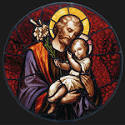
The wonderful and eloquent Fr Kirby of Vultus Christi give us a poem and this, a prayer of his own devising:

The wonderful and eloquent Fr Kirby of Vultus Christi give us a poem and this, a prayer of his own devising:
O glorious Saint Joseph,
who, on the word of the angel
speaking to you in the night,
put fear aside to take your Virgin Bride into your home,
show yourself today the advocate and protector of priests.
Protector of the Infant Christ,
defend them against every attack of the enemy,
preserve them from the dangers that surround them
on every side.
Remember Herod's threats against the Child,
the anguish of the flight into Egypt by night,
and the hardships of your exile.
Stand by the accused;
stretch out your hand to those who have fallen;
comfort the fearful;
forsake not the weak;
and visit the lonely.
Let all priests know that in you
God has given them a model
of faith in the night, obedience in adversity,
chastity in tenderness, and hope in uncertainty.
You are the terror of demons
and the healer of those wounded in spiritual combat.
Come to the defence of every priest in need;
overcome evil with good.
Where there are curses, put blessings,
where harm has been done, do good.
Let there be joy for the priests of the Church,
and peace for all under your gracious protection.
Amen.
Friday, 18 March 2011
Joyful Solemnity
I may have posted of this before, but a blog of Fr Z's recalled it to my mind, and it is a topic that bears repeating.
In his "Preface to Paradise Lost", C.S.Lewis discourses on that most useful Middle English word, solempne:
Oh, and in case you were confused, Awesome God? Not solempne.... and I hope I shan't have to suffer its annual hearing this year, (ah, the joys of unemployment!)
*Da, quaesumus, Domine, fidelibus tuis
observationi paschali convenienter aptari,
ut suscepta sollemniter castigatio corporalis
cunctis ad fructum proficiat animarum.
In his "Preface to Paradise Lost", C.S.Lewis discourses on that most useful Middle English word, solempne:
From its early association with the heroic court, there comes into Epic Poetry a quality ... which moderns find difficult to understand. It has been split up [now] so that we now have to represent it by piecing together what seem to us quite unconnected ideas, but are really fragments of that old unity.Today, Fr Z, in deconstructing a collect*, has this to say:
This quality will be understood by anyone who really understands the meaning of the Middle English word solempne. This means something different, but not quite different, from modern English solemn. Like solemn it implies the opposite of what is familiar, free and easy, or ordinary. But unlike solemn it does not suggest gloom, oppression, or austerity.
The Solempne is the festal which is also the stately and the ceremonial, the proper occasion for pomp — and the very fact that pompous is now used only in a bad sense measures the degree to which we have lost the old idea of “solemnity.” To recover it you must think of a court ball, or a coronation, or a victory march, as these things appear to people who enjoy them; in an age when every one puts on his oldest clothes to be happy in, you must re-awake the simpler state of mind in which people put on
gold and scarlet to be happy in.
Above all, you must be rid of the hideous idea, fruit of a widespread inferiority complex, that pomp, on the proper occasions, has any connexion with vanity or self-conceit. A celebrant approaching the altar, a princess led out by a king to dance a minuet, a general officer on a ceremonial parade, a major-domo preceding the boar’s head at a Christmas feast — all these wear unusual clothes and move with calculated dignity. This does not mean that they are vain, but that they are obedient; they are obeying the hoc age [lit. “do this”] which presides over every solemnity. The modern habit of doing ceremonial things unceremoniously is no proof of humility; rather, it proves the offender’s inability to forget himself in the rite, and his readiness to spoil for every one else the proper pleasure of ritual.
Sollemniter is a very cool word. It is an adverb from sollemnis. Sollemnis has to do with the sun, sol. Thus, sollemnis points to an annual event, something appointed to take place, such as a festival or sacrifice or games in honor of the gods. Thus it also signifies usual or customary religious ceremonies. Sollemniter has a deep religious overtone to it in which one needs to hear an echo of the earth whirling around the sun.Didn't know that connection with "sun." As he says, cool.
Oh, and in case you were confused, Awesome God? Not solempne.... and I hope I shan't have to suffer its annual hearing this year, (ah, the joys of unemployment!)
*Da, quaesumus, Domine, fidelibus tuis
observationi paschali convenienter aptari,
ut suscepta sollemniter castigatio corporalis
cunctis ad fructum proficiat animarum.
“The Bridegroom is coming!”
Prayers are asked for the soul of the beloved Sister "Ginger"
I could not imagine a more merry saint.
I could not imagine a more merry saint.
James MacMillan on EWTN
Just saw that there is an interview withthe always interesting and provocative James MacMillan on EWTN this afternoon.
One of the perks of couch potatohood...
(It may be a rerun, but since I have had no access to EWTN for nigh on half a year, it'll be new to me at any rate.)
One of the perks of couch potatohood...
(It may be a rerun, but since I have had no access to EWTN for nigh on half a year, it'll be new to me at any rate.)
Thursday, 17 March 2011
Did someone say "Gregorian chant"?
Giving half an ear to Letterman last night, I heard something like this:
Catholics dress up for Mass,
And listen to Gregorian chants,
While atheists just take a pass,
Watch football in their underpants.
Steve Martin and the Steep Canyon Rangers (?) sang a brilliant bit of white gospel, "atheists ain't got no songs."
Catholics dress up for Mass,
And listen to Gregorian chants,
While atheists just take a pass,
Watch football in their underpants.
Steve Martin and the Steep Canyon Rangers (?) sang a brilliant bit of white gospel, "atheists ain't got no songs."
Monday, 14 March 2011


Saturday, 26 February 2011
Chant and Becoming a Community
I heard a smidge of an NPR piece on a movie (new? old?), that I would very much like to see, Of Gods and Men.
The actor being interviewed was unfamiliar to me, (apparently famous as part of some big-budget, 'splosion franchise,) but he talked about how the actors "became" the seven (heroic,) French Trappists they were called upon to play.Hmm... monks work, they read, they eat, but we all do that, what do they do that makes them different?

And what they came up with was, "Monks chant."
And so, they chanted.
And by singing the chant, by singing together, (which, whether the actors knew it or not, whether they intended it or not, as long as they did not deliberately intend not to do so, was praying together,) they became a community.
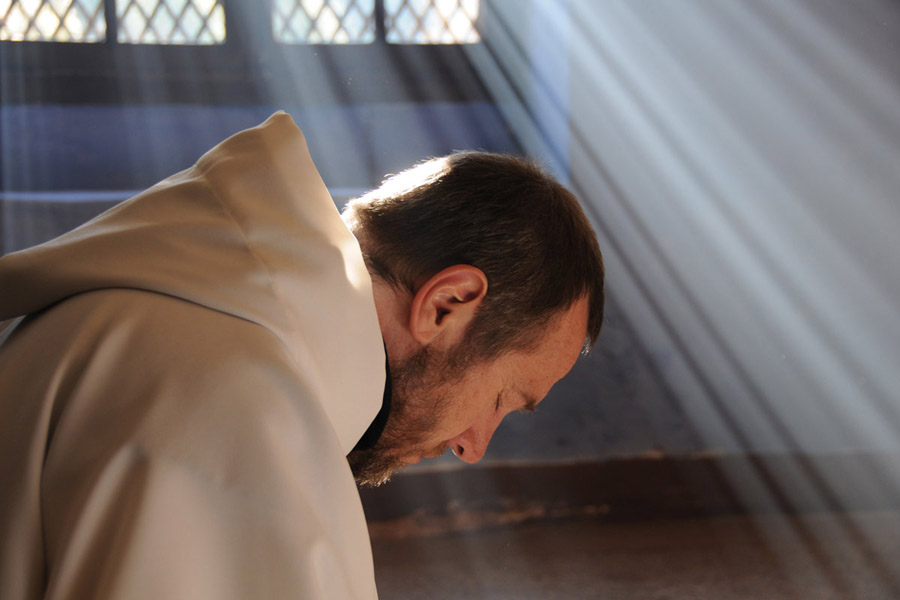
What a shame such a powerful tool is wasted in parishes across the country, no, around the world...
Anyone seen this?
Sunday, 13 February 2011
Caution, Tripping Hazard....
... is apparently the intended message of this sign.



I am not certain what it says about my state of mind that, every time I pass the uneven sidewalk where it is posted, I think, "Oh, how interesting, 'MONKEY Crossing'."
Is my life ever going to get back to normal?
I am not certain what it says about my state of mind that, every time I pass the uneven sidewalk where it is posted, I think, "Oh, how interesting, 'MONKEY Crossing'."
Is my life ever going to get back to normal?
Thursday, 6 January 2011
I know, I know...
I haven't posted in forever, and THAT was what I took what little time I had to do?
As we come to what SOME people insist is the end of the Christmas Season....
Am I the only one who had difficulty this Christmastide NOT hearing bad plays on words and visualizing, well, this:
 whenever the second verse of Hark the Herald Angels was sung?
Friday, 1 October 2010
St Hildegard
My sisters tell me that this movie is about to be released in this country.
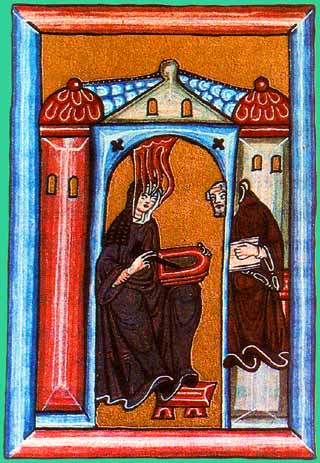
The chances that it will play anywhere that I can get to are slim to none, but I am fascinated by St Hildegarde. (I highly recommend for your consideration anything Pope Benedict says about her and anything Emma Kirkby sings by her.)
Love her.
Not to mention her cookies. (My sister the pastry-baking whiz makes these at Christmas, but surely she could be persuaded to get out her measuring spoons a little early this year?)
The movie looks like... a film.
But com'on, would you just LURVE to see Hyacinth play the role?

The chances that it will play anywhere that I can get to are slim to none, but I am fascinated by St Hildegarde. (I highly recommend for your consideration anything Pope Benedict says about her and anything Emma Kirkby sings by her.)
Love her.
Not to mention her cookies. (My sister the pastry-baking whiz makes these at Christmas, but surely she could be persuaded to get out her measuring spoons a little early this year?)
The movie looks like... a film.
But com'on, would you just LURVE to see Hyacinth play the role?


Thursday, 30 September 2010
Saddened, But Not Surprised
I was willing to accept what many said, that that hand wringing by the more Catholic Than Thou sect over much bruited about poll results, (were they Gallup?,) that were purported to prove that most Catholics don't believe in the Real presence was uncalled for, that the questions were so phrased that it was possible to have a very good, (if not very profound,) understanding of Eucharistic theology and have answered the survey question "wrong, that it was badly confusingly phrased.
Well, the Church in America can now breath a sigh of relief, it is NOT a majority of us who don't believe in the Real Presence.
It is only about 45%.
Atheists and agnostics, Jews and Mormons are among the highest-scoring groups on a new survey of religious knowledge, outperforming evangelical Protestants, mainline Protestants and Catholics on questions about the core teachings, history and leading figures of major world religions.(I would have flubbed the Jonathon Edwards question.)
On average, Americans correctly answer 16 of the 32 religious knowledge questions on the survey by the Pew Research Center's Forum on Religion & Public Life. Atheists and agnostics average 20.9 correct answers. Jews and Mormons do about as well, averaging 20.5 and 20.3 correct answers, respectively.
Protestants as a whole average 16 correct answers; Catholics as a whole, 14.7. Atheists and agnostics, Jews and Mormons perform better than other groups on the survey even after controlling for differing levels of education.
On questions about Christianity -- including a battery of questions about the Bible -- Mormons (7.9 out of 12 right on average) and white evangelical Protestants (7.3 correct on average) show the highest levels of knowledge.
Jews and atheists/agnostics stand out for their knowledge of other world religions, including Islam, Buddhism, Hinduism and Judaism; out of 11 such questions on the survey, Jews answer 7.9 correctly (nearly three better than the national average) and atheists/agnostics answer 7.5 correctly (2.5 better than the national average).
Atheists/agnostics and Jews also do particularly well on questions about the role of religion in public life, including a question about what the U.S. Constitution says about religion.
These are among the key findings of the U.S. Religious Knowledge Survey, a nationwide poll conducted from May 19 through June 6, 2010, among 3,412 Americans age 18 and older, on landlines and cell phones, in English and Spanish. Jews, Mormons and atheists/agnostics were oversampled to allow analysis of these relatively small groups.1
Previous surveys by the Pew Research Center have shown that America is among the most religious of the world's developed nations. Nearly six-in-ten U.S. adults say that religion is "very important" in their lives, and roughly four-in-ten say they attend worship services at least once a week.
But the U.S. Religious Knowledge Survey shows that large numbers of Americans are uninformed about the tenets, practices, history and leading figures of major faith traditions -- including their own. Many people also think the constitutional restrictions on religion in public schools are stricter than they really are.
More than four-in-ten Catholics in the United States (45%) do not know that their church teaches that the bread and wine used in Communion do not merely symbolize but actually become the body and blood of Christ.


Thursday, 16 September 2010
Although I Would Not Mind Seeing Msgr. Ganswein ...
... competing in gymnastics, swimming, diving, running, equestrian....
But no, Stephen Fry informs us that that the Vatican does not field a team, and apparently this is very significant, impinging as it does on whether or not the Holy Father should be making a "state visit."
And Mr Fry is a very intelligent individual, so it must be so.
(I have no means of seeing or hearing any of said visit, at least for a week or so, so I must content myself with such snarking.)
(Which may be a violation of a recently renewed resolve to detach myself from sin, it's certainly putting myself in harm's way.... well, I am who I am.)
(Hey, and I guess the conceit behind the whole post, or at least the title and explanation of the title is another occasion of sin.... well, see above.)
But no, Stephen Fry informs us that that the Vatican does not field a team, and apparently this is very significant, impinging as it does on whether or not the Holy Father should be making a "state visit."
And Mr Fry is a very intelligent individual, so it must be so.
(I have no means of seeing or hearing any of said visit, at least for a week or so, so I must content myself with such snarking.)
(Which may be a violation of a recently renewed resolve to detach myself from sin, it's certainly putting myself in harm's way.... well, I am who I am.)
(Hey, and I guess the conceit behind the whole post, or at least the title and explanation of the title is another occasion of sin.... well, see above.)
Sunday, 12 September 2010
I have just returned from Mass, (an aside, it scares me goofy to plan on attending a "last chance Mass", but we did arrive in plenty of time, and there was a Mass,) brimming with hope for the future of the Church.
If the Holy Sacrifice of the Mass is both the source and the summit of our Faith, it bodes well for us all when the Mass is this well celebrated.
It was in the Extraordinary Form.
This young priest apparently attended a training session of the Canons regular of St John Cantius half a continent away, and then, by studying DVDs, immersed himself in the EF sufficiently to celebrate it very beautifully and very precisely indeed.
(Do I say "indeed' too much?)
He subtly raises his voice exactly the right amount to prompt what I believe is called a
dialogue Mass."
What struck me was how well, how thoroughly this priest, (whom I have assisted at Masses in the OF in years past,) submits himself to the Liturgy, of either Form.
It is so utterly NOT about him.
And you must understand, he is a witty charmer.
But he disappears in the Mass.
Because he decreases, He increases.
Sheer chance, because of the day, his excellent homily was about humility, and the "safety" it affords us.
Marvelous coincidence.
God send us many holy priests!

.
If the Holy Sacrifice of the Mass is both the source and the summit of our Faith, it bodes well for us all when the Mass is this well celebrated.
It was in the Extraordinary Form.
This young priest apparently attended a training session of the Canons regular of St John Cantius half a continent away, and then, by studying DVDs, immersed himself in the EF sufficiently to celebrate it very beautifully and very precisely indeed.
(Do I say "indeed' too much?)
He subtly raises his voice exactly the right amount to prompt what I believe is called a
dialogue Mass."
What struck me was how well, how thoroughly this priest, (whom I have assisted at Masses in the OF in years past,) submits himself to the Liturgy, of either Form.
It is so utterly NOT about him.
And you must understand, he is a witty charmer.
But he disappears in the Mass.
Because he decreases, He increases.
Sheer chance, because of the day, his excellent homily was about humility, and the "safety" it affords us.
Marvelous coincidence.
God send us many holy priests!

This icon (egg tempera and gold leaf on wood panel, 28” x 22”) is “based on a fifteenth century Greek prototype; here Christ is shown in Latin Rite vestments with a gold pelican over His heart, the ancient symbol of self-sacrifice. The borders contain a winding grapevine and altar prepared for the celebration of the liturgy of the Mass; in the borders are smaller icons of Melchizedek and St. Jean-Baptiste Vianney.” Incidentally, it is St. John Vianney whom Pope Benedict XVI, with the announcement of this special year, has declared the Universal Patron of PriestCzarnecki explains: “I wrote the icon about seven years ago [for seminarians and priests] to be able to see Christ in themselves, and themselves in Christ. We often hear that the icon is called a window; in this case, it’s also meant to be a mirror.” The Good Shepherd reminds the priest that he is to “lay down his life for his sheep” (www.seraphicrestorations.com).
Only the Dead Can Not Change Their Minds
We, the quick, (well, I'm of the sloooow quick,) can learn and grow.
Interesting interview with a filmmaker
Interesting interview with a filmmaker
I indulged in a long rant one night at dinner during the Colloquium this June (I have always depended on the manners of strangers... how I impose!) Does NO one understand the difference between primary and secondary sources any more?!?#?$%? I whinged.The making of this film has been something of a voyage of discovery for me. I can’t be the only Catholic in the world who had major apprehensions on April 19 2005 as the conclave made its decisive choice to elect the first German pope since the 11th century (I don’t count Adrian VI, born in Utrecht in 1459, part of the Holy Roman Empire). I was worried about whether the former head of the Congregation for the Doctrine of the Faith might be just a little too polarising. I am no expert of conclave arithmetic, but my hunch was that he simply had too many doubters inside the College of Cardinals to get the required votes. Wrong. And I have been wrong about him, too. It is not that he has changed radically since taking up the papacy; it is simply that when you have to make a one-hour programme on one of the most clever and gifted people on the planet you have to look behind the headlines and the angry rants on the blogosphere. In short, you have to do justice to the man as best as you can.
Something similar is going on with Pope Benedict at the moment as has been occurring with John Henry Newman in recent months. Recognising the brilliant intellectual acumen of an individual often leads to wings, sections of the Church, staking their claim. They want to possess them as “their own”. I can understand why. But there are occasionally rare moments when these drives towards colonising the output of a gifted mind simply fail on account of the sheer dynamism and multi-facetedness of the individual concerned. So Pope Benedict’s uncompromising language on homosexuality, his disciplining of liberation theologians and 2007 Motu Proprio on the Old Rite of the Roman liturgy all have conservatives ticking their boxes and approving. But how then to deal with some rather contradictory evidence, not least of all his championing of workers’ rights in Caritas in Veritate and his uncompromising critique of neo-liberal economics?:
“I would like to remind everyone, especially everyone engaged in boosting the world’s economic and social assets, that the primary capital to be safeguarded and valued is man, the human person in his or her integrity” (italics from the text).
Similarly, those who complain of the betrayal of Vatican II and have this pontificate down as unreservedly restorationist and insular have some explaining to do. How is it that such a man commands the respect of a towering figure and atheist intellectual such as Jürgen Habermas, so much so that they are prepared to engage in a dialogue in public? How is it that such a man devotes his first encyclical to a profound discussion of human love and ponders on the potential for Eros and Agape to be a bridge between the human and the divine? Furthermore, how is it that this pope has taken every opportunity to emphasize that care from the environment is not some woolly-minded aspect of New Ageism, but an integral part of his theological outlook? So much so that in January His Holiness called in many of the ambassadors accredited to the Holy See and berated them for the “economic and political resistance” that resulted in the failure of last December’s climate summit in Copenhagen....
That Joseph Ratzinger has not quite lived up to his predictable billing is a point well understood by the Italian senator Marcello Pera, with whom Pope Benedict wrote a book on Europe and culture called Without Roots. When I met Pera in the heart of Rome earlier in the year he told me of the reaction of his fellow legislators.
“There was a huge prejudice,” Pera said. “Everyone was expecting the Rottweiler. I had invited him to address the Senate: this was the first time a cardinal had ever set foot inside the building and they were amazed. He really charmed them.” What exactly was Pera doing, as a godless man, engaging with the Vicar of Rome?
“I wanted these secularists to reflect. They talk about the absolutist nature of human rights, but they have no idea of the basis of where such an idea comes from – namely, that everyone is made in the image of God and deserves respect and has an integrity based on that.”
Pera makes a further point: “Let’s look at this question from a historical point of view. What happened to Europe, when it denied Christianity? We had Nazism, Fascism, Communism, anti-Semitism. That means that when Europe tried to avoid its own roots and so the culture of rights, specially the respect of the human person, Europe finds itself in dictatorship.”
Good for Pera. Can you imagine this from the archpriest of atheism, Richard Dawkins?
But the real delight for me has been in engaging with the writings of this 83-year-old man. The encyclicals have been given deserved space and attention. Yet you have to go back to 1968 for his classic, Introduction to Christianity, a work in which it becomes abundantly clear that, for this gentle and determined Bavarian, that man does not create his own truth through effort and endeavour, but, as he writes: “To believe as a Christian means in fact entrusting oneself to the meaning that upholds me and the world, taking it as the firm ground on which I can stand fearlessly… to believe as a Christian means understanding our existence as a response to the word, the logos, that upholds and maintains all things.”
But my pet peeve is warranted, I believe. How many of us in this country form our political opinions about someone based solely on what his enemies have said about him?
How often does someone want to operate based on the knowledge of a document which he has received from the "hand-out" given by a "facilitator" from a "workshop" -- rather from the easily accessed document?
How many hate the Church for what they just KNOW She believes --- and about which they are utterly mistaken? (Asbp Fulton Sheen had a famous thought on that...)
Excellent column in the paper a week or so back, (sorry, can't credit it,) warning us to beware of believing secondhand information that supports our prejudices and preconceptions.
Very wise words.
The sweet man who we are so blessed to have as pope right now has been a real victim of that sort of thinking.
Subscribe to:
Posts (Atom)