Universalis, your very own breviary in pixels...

Showing posts with label Rites and Rongs. Show all posts

Thursday, 13 April 2017

"The Thursday of Mysteries"

Isn't that a beautiful way to describe today?
I've only just learned it.

I appreciate that word "mysteries" used synonymously with "sacraments," very much.
At Eastern Rite liturgies I've always thrilled a bit at the phrase, "I will not reveal Your Mysteries to your enemies," as if we were suddenly plunged by the universality and sacred timeliness/timelessness of the Sacrifice into penal times, or the first century and were willing to die rather than betray the goings-on in the catacombs to the authorities.
One doesn't see it much in the West, although the sheet music from which I first learned the Bruckner Locus Iste translated sacramentum that way, IIRC.
This is, I promise you, not about aesthetic snobbery, but the music that will happen tonight at any of the Roman Catholic churches within reach will be so jarringly bad or inappropriate that I was casting about for an alternative, and my default Byzantine parish seems not to be having any liturgy tonight, can that be possible?
(Here, I can prove, at least to my own satisfaction that it's not snootiness on my part - if it were not a thousand miles away I would attend an Extraordinary Form Mass I used to hear with some regularity, where the propers that are not sung recto tono or to a psalm tone would be unrecognizable they would be rendered so badly, by a choir that included on singer with a voice like an electric cheese grater. The appropriate done badly by worshipers giving their best is more fitting than the inappropriate done well by worshipers giving their favorites.)
Anyway, I found a church, (of a rite that I don't know well at all,) whose bulletin gives a time for Liturgy of  Thursday of Mysteries.
(And between Holy Orders and Eucharist, and washing of the feet - do Easterners do that? dont know -  our evening will be filled with Mystery.)
Was this Father Hardon?
"A mystery is not a truth about which we can know nothing. It is a truth about which we cannot know everything."

Wednesday, 10 August 2016

Receiving Communion, and Personal Preference

Our priest obviously does not care to distribute the Body of Christ by placing It on the tongue of the communicant.
I've noticed it especially lately as he will, when I reach the head of the line, (I'm sorry, it's not a procession, it's just a line,) quite deliberately return a Host to the ciborium, and instead take up the more sizable portion created when the large Host was broken at the fraction rite, the wedge shape giving him, as it were, a handle.
When I realized his discomfort, I thought for a moment about receiving in the hand whenever he has Mass, and I am seated in the section where I will most probably be in "his" lane. Perhaps he had a legitimate reason for his eccentric ways.
I've known priests, and EMHCs, too, who were shaky, or had bad eyesight, or were extremely short, and the palm of my hand is a bigger "target," and I have more leeway on where I put it.

But then I recalled overhearing someone, several years ago, speaking of how discomfited she was by "Father". This is someone I knew always did receive in the hand, and she thought he recoiled a bit as he proffered the Body of Christ, lest he touch the communicant.
"He DROPS the host in my hand, like he thinks he's going to catch something!" (And this is a woman with the state of whose hands a surgical nurse would find no fault.)
The other women in the convo affirmed that, yes, that was how he did it.

So I decided there was no reason I should worry about his preference.

But more recently there was a youngish woman ministering, a bit of a high maintenance type, and I was, frankly, disgusted by her long nails as I received, (not a good distraction,) and I decided if I were to find myself in "her" line I would receive in the hand.
Well, she approached the altar during the agnus dei this morning and stood on the side of the church on which I was kneeling, so I whipped out the purell for my hands - you see, I don't much care to consume food I have touched (I have a skin disease, there's almost always some foul-tasting medicine on my hands, and between the time I leave home and communion there's been a zillion door knobs, grungy hymnals and unavoidable contacts of various sorts.)

So "disinfected" hands at the ready, I made my way up toward the sanctuary and then found that they'd changed the formation, and I would be receiving from the priest.

And so I received on the tongue.

And now I'm feeling a little sheepish, since I was willing, for my own comfort, to forgo the manner which I find is more powerfully ritualistic, and yes, reverent BECAUSE  IT  TAKES  A  TINY  BIT  MORE  EFFORT  AND  ATTENTION -- but not for his comfort.

And I admit, I don't know why her grungy nails were such a big deal to me, I'm not bat-guano squeamish, I've come to terms with the Host tasting of Acqua di Gio, and I have eaten the Body of Christ off the floor more than once...

I don't know.

Wednesday, 17 February 2016

Gee, If It Were an Inter-Denominational Service, the Lutherans Could Have Brought "Bars"

A funeral in Italy for the gentleman who invented the Moka, basically.... an elegant coffee pot.

Image result for bialetti funeral

Elegant enough for liturgical use? exemplifying "noble simplicity?"

Honestly, I don't know.
It wasn't to be funny, and it was meaningful to the family.
The Church now permits cremation, as long as it is not done to disparage belief in the Resurrection of the Body, and a container with sentimental significance to the family or the deceased is deemed appropriate by most people for the  grounds  remains.

Mmmmm.... bars.

I'd not heard that term, 'til Himself told me tales of touring small towns in the upper Midwest and parts of Canada, and the immense hospitality of the people.
But the concept is more than familiar to me. (I've subbed with Lutheran church choirs. There's this magic thing with butter and graham crackers.....)

Alas, I am Polish/Irish/Norman/Austrian-American Catholic, and I only bake anything of that sort at Christmass time.

Tuesday, 15 September 2015

The Glories of a Maximalist Approach to Liturgy

I am always surprised at liturgists who get sniffy about "minimalism," only seem to do so at not splashing around enough holy water, or niggardliness in the distribution of ashes, or horrors! the 'incomplete sign" of Communion offered under a single species.
The ones who, rightly decry those always seem to be in the "Bells? we don' need to rin'you no stinkin' bells" camp, and often mock incense and splendorous appointments and vestments.

Because of... I'm really not sure of what, perhaps the availability of a celebrant? because of whatever there have been several Eastern Rite Divine Liturgies I was fortunate enough to be able to attend because they were on weekdays.

The feast for the senses that even the tiniest Byzantine congregation is able to offer worshippers is something more Latin Rite parishes should take pointers from.

None of it depends on bigger amplifiers.

Fr Glen Pothier is a treasure. Such preaching! (He's bi-ritual, I believe I heard.)

And I hope this isn't sacrilegious, someone else at the Liturgy,  apparently not Eastern, murmured afterwards, that the Body and Blood of Our Lord Jesus Christ was, "so delicious!" and I'd have to concur.

My only cavil, is that the chrism they use, overwhelmingly fragant, and beautiful - maybe anointing isn't the time to be maximalist.

Chrism burns the holy bejebbies out of your eyes if it runs down your face.

Sunday, 24 May 2015

For Pentecost

Image result for red sequin bird
Get it?
We didn't.
No sequence, or sequins either, for that matter.

Business as usual at Our Lady of Liturgical Lacksadaisilaity.
(Madonna of Musical Mediocrity?Saint Slipshod SansSouci? the parish family community of The Holy Hummdrummery?)

But I hold to the Grinch Doctrine - you remember how the home invasion and burglary "HADN'T stopped Christmas from coming! IT CAME! Somehow or other, it came just the same"?

That's the Real Presence of Christ, the work of the Holy Spirit in response to the epiclesis.
God comes without chant, or incense, or wide-awake servers, or the silencing of chatter, or attentiveness to the liturgical books, or just about anything besides the intention of the ordained celebrant and the proper matter for the confection of the Eucharist and the words of institution.
"It came with out ribbons! It came without tags!"
"It came without packages, boxes or bags!"
That doesn't mean we shouldn't "bother" with them.

Thursday, 14 May 2015

Adventures In Progressive Solemnity, Long Form

I was fortunate enough to have the opportunity to attend a Mass in the Extraordinary Form recently.
Generally, although one is offered in my diocese every weekend, the distance and timing, and my own Sunday obligations are such that I instead seek a musicless Mass.

My husband, a late in life convert to Catholicism, was raised by a Mother who, Methodist or not, understood the concept of the "Sunday Obligation;" and at the time he and I arrived at an understanding, we usually attended two services every Sunday morning, (a Mass and whatever protestant church in the area gave promise of the best music,) so he was a very experienced church-goer by the time he was received into the Church.

The first time we attended a Mass with no singing or instrumental music whatsoever, he was taken aback, he had never before encountered any kind of Christian worship which did not include singing.
He hated it!
How could you praise God without bursting into song?
We continued in our nomadic life to seek musical excellence where we could find it, but gradually his hunger for the Eucharist eclipsed his musical preferences, and as he grew to understand the level to which liturgical music has sunk in many places, (Protestant as well as Catholic, I might add,) he embraced the quiet Mass.
We settled for a time in a parish that had a not too bad music program.
When I became involved in a "liturgy committee", (mea culpa,) they were in the process of trying to introduce music into the single quiet Mass in the entire town of five Catholic churches, and the congregants were fighting them tooth and nail.
The PIPs, for the most part, refused to pick up hymnals, and kept their jaws clenched.
Someone on the committee bemoaned the fact, and I repeated the complaint I had heard regarding the choice of hymns, which were puerile, to put it mildly; TPTB had supposed that what was needed as an ice-breaker were "easy" songs, so with no change from week to week, they were asking people to sing the stuff programmed at school Masses.
Over and over.
They knew whom I was quoting, so obviously the PIPs were trying to, forgive the paradox, make their voices heard.
I suggested instead of inserting fairly arbitrary songs, they start with the dialogues and the Our Father, maybe the alleluia before the Gospel.
Blank looks.
You know, (I had probably just learned this phrase,) “progressive solemnity.”
More blank looks.
Like it suggests in Musicam Sacram? A document of Vatican Council?
Oh, well, maybe, they all agreed, even the priests, that that might be the way to go - until they realized that "dialogue" meant singing initiated by the celebrant or other minister.
Nope, they just wanted the people to sing more.
Mind you, all of our priests had fine voices and could either read music very well, (including square-note, I later learned,) or were very good natural musicians who could pick up anything by ear.
But having drunk deeply of the spirits of Vatican, Too, they, (with the agreement or even insistence of their lay colleagues,) were intent upon getting the people to "do" more, not altering their own approach to celebrating Mass.
Eventually I was offered a music/choir director position.
(I had had one years before, while I was still in school, but this was so long ago that it was in the period when the job was picking out 4 hymns that used some of the same words as the readings and posting the numbers. The less said about it, the better.)
In this new position I tried to steer things toward a less preference-centric choice of music, but the deeply-ingrained, three generation long, choir culture; competing ethnic and language needs; and the power structure of rectory/school/religious ed office required constant negotiations.
Returned for a visit after we moved, discovered that some practices I had pressed for for years unsuccessfully had finally been adopted, ( singing the verbum Domini dialogues,) others which I had instituted had been discarded, (the Exultet as written, sung Sequences when called for,) and others which only began under my short tenure, not without push-back, were acknowledged as "the way we've always done it,"(singing the Lectionary psalm.)
The parish where I now find myself has a well-meaning but slap-dash approach to liturgical music and liturgy in general.
I have found other ways to contribute, and enjoy the lowest and earliest of Sunday
Since I am no longer responsible, or even much effected by any musical planning, for over three years I have thought of myself as taking R & R from the front lines of the Liturgy Police Action, (it's not a war!)
.............................
When I've worked in a parish setting, TPTB were always slightly Latin-phobic, so obviously only Ordinary Form for Mass or LotH. Convincing them that what they wanted to sing, or were accustomed to sing weren't necessarily the most important things to sing, and that the Church actually gave us guidance on this, (apart from what our diocesan OoW put out,) was like pulling teeth.
Instead of Progressive Solemnity, we were fortunate to even be able to achieve a sort of Regressive Triviality.
I have taken part in Extraordinary Form Masses with great joy, at Colloquia and when I have found myself in the environs of St John Cantius, or had the opportunity to attend one for which Jenny Donelson's schola sang; and I have even been happy to have the chance to hear the traditional Mass when neither the priest nor the musicians, nor we faithful in the pews seemed very sure of who should do what when.
I even accidentally attended Mass at a schismatic chapel, before I knew there were such people and places, and I give thanks for, and "enjoyed" that.

I have never had any musical responsibilities at these, (other than singing as told at CMAA functions,) so never thought much about what is supposed to be done.
I generally position myself near someone who seem confident of his postures and gestures, whose hand missal looks well-loved, and copy him.
But I have realized that there is very little consistency from place to place.
(The first clue that I had was the PBC notation about "IF the confiteor is said again, turn to pg 25," or some such.)
Some places one priest reads the Lesson and Gospel in English while another reads them quietly in Latin, others the vernacular follows the "real" scripture. Some places the PIPs kneel for the entire time except the Gospel and homily. Some everyone recites the Gloria along with the celebrant. One priest stopped in mid-Pater noster to silence the people who were singing along with him, another practically conducted us to sing along.
I was given to understand that this is all because, in the day, there really were no rubrics for the people.
But the rubrics for the musicians are pretty clear, I had thought, especially the distinctions between solemn, sung and read Mass, a la Musica Sacra.
But even these seem to be a source of confusion.
The organist at one parish told me she and her choir "just do what Father wants," and there are four different "Fathers" who might show up on a moments notice.

The Mass I attended Sunday was lovely, and profoundly prayerful.
I found myself entering into it such that I was saved from playing Liturgy Scorekeeper, (a more passive role that Liturgy Police,) no ticking off boxes, wondering why so and so did such and such.
It was only after Mass that I thought, hmmm, 2 Latin motets and one English anthem, or that was nice, that little organ filler, sounds like Rossini, and then repeat the anthem, or, gee, only one voice to a part, none of them very strong but sweet polyphony, or wait a minute, they only sang some of the Gregorian Ordinary, and we all spoke the rest together, didn't we?
It all seemed, it felt appropriate.
Were they, perhaps, applying principles of progressive solemnity from Musicam Sacram to the EF, taken advantage of the provision for varying "degrees" of sung Mass?
And why shouldn't they?
That might sound flip, or combative, but it's really not.
IRL I have no access to anyone particularly knowledgeable about this, and I thank God every day for Those InterWebs.
But the internet is full of Facts that Everybody Knows - that aren't true.
And there often seem to be differences of opinion as to what pronouncements are descriptive and what prescriptive.
I thought I had learned that Musicam Sacram does not apply to the EF, (though of course there are some who try to insist it doesn't apply to the Novus Ordo... who, pray tell, would they be?)
I was startled to learn, (but I am ignorant - people who keep up on these things also seemed startled to learn,) in the comment box of this several month old thread at New Liturgical Movement, which addresses these very questions, that a book of rubrics for the old Mass is available online. The date of publication is 1960, but would it be in effect for the 1962 Missal?
A lot of the conversation there of course is simply opinion - leaned, informed opinion, but not really helpful for those who might be preparing sing half take baby steps in preparing music for liturgy.
It doesn't matter to me right now so much what the Church should have asked of us as what She does ask.
I want to know what's what, and what ought to be, and what ought not -- because I have a premonition, or at least a hope, that I might need to know.
What “legitimate diversity” is there in the Extraordinary Form?

Wednesday, 6 May 2015

High Dudgeon... High Dadgum?.... High Dogdom!

I have warned a few people recently when they seemed to have forgotten that the fact that they "read it somewhere on the internet" says nothing one way or t'other about its veracity.
(At one time, I thought its having been read on Those Interwebs made it somewhat less likely to be true, but it's about 50/50, I now believe.)
That said, the Onion, Eye of the Tiber, Kimmel, Letterman, they all have to work harder now, don't they, when real life has become so absurd that it defies parody?
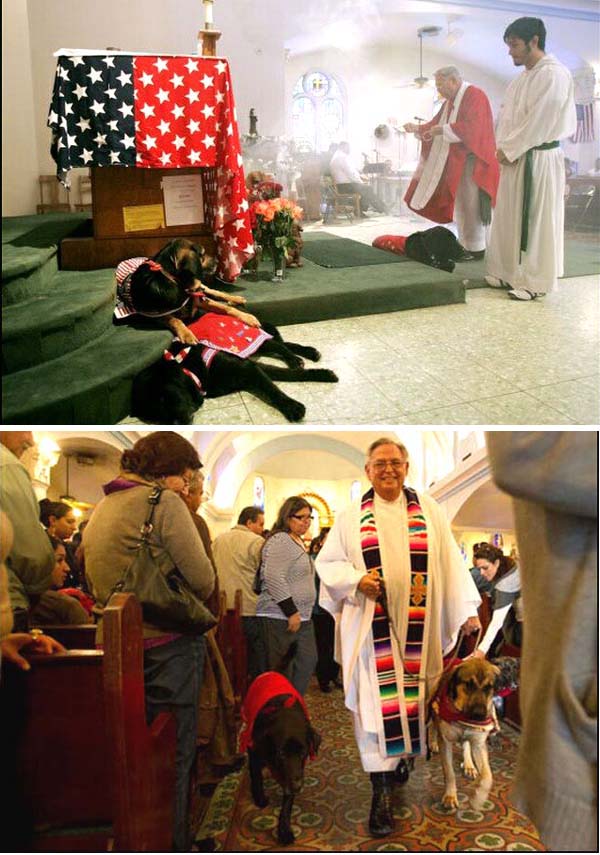
I came across a Trad in mediumish dudgeon regarding some stupidity perpetrated upon the Holy Sacrifice of the Mass, and clicked on a link to another purported sacrilege.
The pictures were so sheerly stupid, I assumed it was staged, maybe an EotT story mistaken for real news, (or at least what tries to be, there's plenty good Faux News to be found.)

And I don't know, the guy could suffer from PTSP, perhaps he needs a companion animal to keep him on a steady keel? or a service dog to keep him from tripping, walking into traffic...
But no, I did a little surfing - the story accompanying the headline "The altar dogs of Texas" is essentially true, a little mistake on the name of the loon responsible aside.
Altar dogs 02

I won't correct it, nor will I link to more accurate info, nor will I name his bishop, (in the hopes that after the publicity the doofus received, his bishop has already quietly corrected him.)

By the way, how's THIS for liturgical music? (Make ya appreciate GIA, huh?)
You know I like my chicken fried
Cold beer on a Friday night
A pair of jeans that fit just right
And the radio up
Well I was raised up beneath the shade of a Georgia pine
And that's home you know
With sweet tea, pecan pie and homemade wine
Where the peaches grow
And my house it's not much to talk about
But it's filled with love that's grown in southern ground
And a little bit of chicken fried
Cold beer on a Friday night
A pair of jeans that fit just right
And the radio up
Well I've seen the sunrise
See the love in my woman's eyes
Feel the touch of a precious child
And know a mother's love
And its funny how it's the little things in life that mean the most
Not where you live, what you drive or the price tag on your clothes
There's no dollar sign on a piece of mind; this I've come to know
So if you agree have a drink with me
Raise your glasses for a toast
To a little bit of chicken fried
Cold beer on a Friday night
A pair of jeans that fit just right
And the radio up
Well I've seen the sunrise
See the love in my woman's eyes
Feel the touch of a precious child
And know a mother's love
I thank god for my life
And for the stars and stripes
May freedom forever fly, let it ring.
Salute the ones who died
And the ones that gave their lives so we don't have to sacrifice
All the things we love
Like our chicken fried
Cold beer on a Friday night
A pair of jeans that fit just right
And the radio up
Well I've seen the sunrise
See the love in my woman's eyes
Feel the touch of a precious child
And know a mother's love
You know I like my chicken fried
Cold beer on a Friday night
A pair of jeans that fit just right
And the radio up
Well I've seen the sunrise
See the love in my woman's eyes
Feel the touch of a precious child
And know a mother's love

Monday, 13 April 2015

Well, to quote Spock...

... only Nixon could go to China.
I am not as sanguine about the chances of Pope Francis reconciling with break-away traditionalist groups as Fr Z seems to be, but there's always hope.
 

Friday, 6 March 2015

The Distracted Communicant

Oh, good, I like this priest, gee he seems tired, well he's getting old, maybe I'll go to confession after Mass, wonder if he's hearing them, I should stop at Shop-rite and get some yogurt, forgot to ask Himself if it was all out, if the pastor were here he would have found a way to shorten the readings, I was amazed that none of the kids in class knew the story of Joseph, oh except that little one who's obviously very theatrical, wonder if a career is on the horizon, did I remember to pay the health insurance premium, what am I going to do with the kids on Sunday they were soooo disengaged last week, I'm afraid I was crabby, well it's good that I can go to confession, can't believe how badly that insurance site is set up,.......... excellent sermon, why didn't I take the label out of the back of this shirt it's scratching my neck something fierce, oh, that's the guy who doesn't like to put the kneeler down, okay, don't need it, I suppose it's not a matter of preference, it's his age and his knes and whatever................. how are the lines going? is this the ExMin who gets nervous if I signal that I will receive on the tongue?............really, the 17th c.? very modern seeming reflection in Magnificat, what a beautiful artwork, isn't it odd how different the violets of the chasuble and the tabernacle veil are?

Oh, wait, - "Thanks be to God" - it's over?

I think I do my best, but sometimes it's really not good enough.

Thursday, 5 March 2015

The Our Father and the "Orans" Gesture

On his "In the light of the Law" blog, canonist Edward Peters treats the subject of posture during the Lord's Prayer,   the weird and contradictory, (my words, not his,) situation that now obtains, and the obvious fix.
Oddly, I have noticed at my parish, one lay reader who is a religious scholar of some sort seems to be the only one, (besides Himself and me,) who does not take the orans posture or hold hands - EXCEPT THE PRIEST.
No, our pastor already prays the Our Father with his hands clasped... er, in prayer.

Wednesday, 4 March 2015

"Triumphalist"?

I seldom disagree with Fr Hunwicke, so I am  hoping this is facetious.
I was surprised to get back home to my computer to discover that in Rome there is going to be a special Mass to commemorate fifty years since the first Mass entirely in the Italian Language. Surely, this sort of rather Renaissance triumphalist crowing is both in bad taste, and sadly divisive?
After all, we would not likewise accuse those who offered or attended Masses of thanksgiving on the anniversaries of Summorum Pontificum of triumphalist crowing, I am certain.

Me, I mourn on the anniversary... I am still stuck in the Rite of Makingitupasyougoalong at St. Thewaywedoithere's.

L'shana haba'ah..., she muttered hopefully. 

Saturday, 21 February 2015

"Feast of the Enunciation"

Let's add this to the calendar, shall we? a day to laud the patron saint of lay readers, whoever that might be, when we can all celebrate those who actually differentiate between "immorality" and "immortality."
We had several lay readers the past few weeks who obviously don't much look at the lectionary reading ahead of time?
So everything is a bit of a surprise?
Blow the trumpet?
A humble, content [sic] heart?
And everything sounds like a question?
Praise to You, Lord Jesus Christ? (that one, I think. actually may have been a question in the mind of one reader, but lent often comes as a surprise...)

Wednesday, 11 February 2015

Kyrie? No Kyrie?

Well, at least now I know why there is such confusion about the communion services at the nursing home, or wherever, and what  ought to be being done....

ZENIT is really a valuable resource.
I even have come to appreciate that its writers are such "homers."

Saturday, 7 February 2015

Himself Always Refers to Football as "The National Religion"

He thinks he's being funny, engaging in hyperbole for comic effect.
If only.....

Saturday, 22 November 2014

Do-it-yourself Mysterium Fidei?

After I had been at my last parish for some time, a choir member asked why we never sang the "Mystery of Faith" that he liked.

I tried to use all of the (then four) "official" ones in English, (Latin was a no-go,) and used the settings from the (mostly horrible,) Ordinairies in the parish rep when I had to, and those from Mass settings I was teaching them when I could.

So I asked, which one is that?

He hummed a tune, with some garbled words and in the combination I eventually recognized the Lucien Deiss "Keep In Mind."

I just said we could certainly use the piece sometime as the Fearsome 4th (option,) but not in  place of one of the prescribed texts there, and thought no more of it.
Can't recall if I ever programmed it in some other capacity.
This parish had a lot of silly habits, wasn't sure where they came from, and no one could ever tell me where they were authorized. (There's a reason "parochial" means what it does....)

Listening to a Mass on EWTN from the Archdiocese of Miami today, and whaddya know?
They sang the Deiss K in M instead of any of the, (now different,) "official"versions of mysterium fidei.

Was this a common liturgical.... prank? (It doesn't rise to the level of an abuse, I suppose.)

Or was there some kind of allowance made to sing other songs, or insert other acclamations at that point either by our national conference, or universally?

Tuesday, 18 November 2014

"Say the Black, Do the Red"

I forget, sometimes, how insular I, how insular my interests can be.

Himself was admiring our deacon's ars celebrandi, and was informed that it was hard come by, that in seminary the liturgical training had pretty much consisted of being told to say the black and do the red.


Himself thought that was one of the wittiest, most original aphorisms he'd ever heard.

Wednesday, 12 November 2014

Not "Heresy" But "Kerlessy"

I'm not the Temple Police, honest, I don't go to Mass to nit-pick or play gotcha.

So I don't think it is my fault when I am jolted or distracted by even honest mistakes when they are large enough, or loud enough.

Seriously, I don't know if there ever was a time when this was licit, a devotee of the Mass of 1962 might tell me, but at least since 1969 the Credo is said EVERY SUNDAY MASS UNLESS IT IS REPLACED BY SOMETHING ELSE, SUCH AS BAPTISMAL PROMISES.
But I've gotten used to its omission with certain celebrants, I try not to fixate on it.

My word it was noisy in the nave this morning.

And I remembered that on Saturday, the Feast of the Lateran Basilica, I had gone to church with the notion,, well, no, but at least pretending to myself that given the opportunity to do so undetected, it would be a fine day to go through all the Gather's and tear out #736.*
Well, what does the homilist up and proclaim, but that a church is "only a church when we come together there to pray."
Standing six feet from the consecrated altar,  and maybe ten from a well-placed, -designed, -elevated, and -lit tabernacle containing the Body and Blood of the Lord Jesus, he, in effect, tells us that we are the ones who make this place holy!

I think what troubles me most is the failure of so many to look at the Church's troubles, (and She has many of them now, does She not? One might almost say they are.... legion,)  holistically.

The preacher whose careless wording in an explication of Catholic theology regarding the, well, reality of the Real Presence cannot see that he is directly or indirectly responsible for the irreverent behavior of the hens cackling about traffic and shoe sales as people gather for Mass and try to enter prayerfully into the Liturgy.

The celebrant who can't be bothered following rubrics about vesting properly cannot see that he is directly or indirectly  responsible for the 20 year old who vaguely thinks of himself as Catholic but can't be bothered following the precept about obligatory mass attendance.

The catechist who founds all his instruction on his and our feelings cannot see that he is directly or indirectly responsible for the rise of the church of St. WhatDoesItMatterAsLongAsYou'reANicePerson.

The strikingly long and strikingly repetitive 119th Psalm doesn't go on and on about precepts, and laws, and statutes, and commands because rules are the highest value of the psalmist.

He sings as he does because 1.) he knows that our right behavior and right belief are best fostered by attention and obedience to the laws of God and of the Church that He left us to guide us; and 2.) he knows that those laws are not random and arbitrary, but the way we can best be led to accept and understand the great truths behind them. 
(Here might be a good place to take to task those who enjoy mocking wearers of red shoes or cappae magnae rather than acknowledging the meaning liturgical garbs has and honoring those with the humility to don it in obedience to rubrics that intend to express those meanings. But I won't, because "not judging lest" and stuff.)
 Sebastian: ‘My sister Cordelia’s last report said that she was not only the worst girl in the school, but the worst there had ever been in the memory of the oldest nun.’ 
Cordelia: ‘That’s because I refused to be an Enfant de Marie. Reverend Mother said that if I didn’t keep my room tidier I couldn’t be one one, so I said, well, I won’t be one, and I don’t believe our Blessed Lady cares two hoots whether I put my gym shoes on the left or the right of my dancing shoes. Reverend Mother was livid.  
Bridey:  ‘Our Lady cares about obedience.’
Now I know that Bridey is a dope,  and that because of this it has been said by some that we are meant to take everything he says, including this, with a least a few grains of salt.
But I think it is a hallmark of Catholic literature,  that truth is often proclaimed by characters who are broken, young, outsiders, sinful, or, as in the case, somewhat dim.
................................................

* In Ed Schaefer's excellent Catholic Music Through the Ages: Balancing the Needs of a Worshipping Church, we read that one of Huub Oosterhuis's worst songs was an inspiration for one of Marty Haugen's worst... interesting and enlightening. 
Even more striking is a quote from Haugen in which he acknowledges that some people have problems with his text. 
Good for you, well done, sir! I may have to--
But then he reveals that it's the people who object to using  the words "blind" and "lame" he feels bad about.
Ah.

Wednesday, 22 October 2014

No Official English Version of the Rite of Exorcism?

There are a few liturgical matters on the USCCB's fall meeting agenda.
The bishops will vote on a revision of the current (1989) translation of the rite of dedication of a church and altar, vote on the first-ever official translation of the current rite of exorcism, and discuss modifications to the Revised Grail Psalms, which are eventually expected to be used in a revised English translation of the Liturgy of the Hours.
In addition, the bishops will consider a new supplement to the Liturgy of the Hours, which would take into account saints canonized in the last three decades, and discuss ministry to those with Celiac disease.
I remember how much work it was to put together orders for completely sung LotHs for the Triduum at my old parish.
There were differences of opinion as to what versions of the psalms and canticles I should be setting, and what were the easiest tones for a congregation, and whether the psalm prayers needed to be there, and finding proper hymns...

Liturgical wasteland in which I now reside, I didn't appreciate that parish enough at the time....

But enough -- really? there was no English exorcism option?

No wonder nobody does'em....

Tuesday, 21 October 2014

Sealed With a Kiss

Adoremus Magazine has the USCCB's CDW's explanatory note about the Circular Letter  from its Vatican counterpart trying to rein in the silliness that pervades the exchange of peace at too many parishes.
The history is interesting to me.
Full disclosure, my current parish generally omits the Peace, but it is in the interest of shaving 15 seconds off the time the pastor spends in church rather than for any theological or liturgical leanings.
Fuller disclosure, I HAAAAAAAAAAAAAAATE the Exchange of Peace, but again, not for any actual theological or liturgical reasons, but for the circus it has almost always been in my experience. If every place performed the gesture with the attitude I experienced at a monastery, once, and once only, I would be leading the charge to get my pastor to instate the practice, with proper catechesis.
But the level of reverence and the depth of religious fervour and the gist of most vocalization by the participants is about the same as all those things as they are performed at the K of C Pancake Breakfast that might follow.
There is no religious ritual enacted, there is no prayer being made
School Mass, IME, are the worst, but Sundays, when the ritual dialogue is likely to be, Hey, how are ya? see you at the scramble next Saturday, got a foursome already? is not much better.

But apart from its typical practice, what is the reason it is so despised by those who line up on the more formal side of the liturgical and cultural divide?
And apart from the chance to stick it to those people, what is the reason it is so championed by those who line up on the other side of the liturgical and cultural divide?

It strikes me as so much in political conflict does, positions chosen to maintain party lines, not for any real principle. (Else, why would you have people who think the government impinges on ones freedom by regulating business practices, but not by regulating sexual practices? And vice versa?)

There're a lot of cases of, Well, if HE likes it, I'm ag'in' it! going around.

Sometimes, the same seems to go for the placement of the Pax - there is one school of progressive liturgical thought that seems to despise any practice in which the Latin Church might be like Her more So this caught my eye:
Among early Christians (e.g., Tertullian), the kiss of peace was seen as a seal placed on prayer. This gesture became a stable element of the liturgies of the early Christian world, including in the city of Rome. At Rome, it may have initially occurred after the Prayer of the Faithful which concluded the Lit-urgy of the Word. In such a position, the kiss of peace was viewed as a sign of mutual love before offering sacrifice (Mt 5:23-24). The Eastern liturgical families retained this placement and adopted this perspective.
For reasons not entirely clear to liturgical scholars, the exchange of peace in the Roman Rite developed along different lines and with a different theological emphasis. In North Africa, Saint Augustine was already familiar with the practice of exchanging peace after the Eucharistic Prayer. In a letter written in the year 416, Pope Saint Innocent I, responding to a list of liturgical queries from Bishop Decentius of Gubbio, writes that in the Roman liturgy, the only proper moment for the exchange of peace is after the Eucharistic Prayer and before Communion. Instead of the emphasis on reconciliation as found in the Eastern liturgies, St. Innocent justifies this placement as an expression of the assembly’s consent to what the priest has just prayed in the Eucharistic Prayer, and the community’s “seal” on the priest’s sacred actions — an embodied extension of the Great Amen (cf. Epistola 25 Decentio Augubino 1, 4).
(Speaking of Adoremus, r.i.p., Helen Hull Hitchcock, what an enormous, enormous service she performed for the Church in America. May the Lord reward her!)

Sunday, 22 June 2014

"Ecce Panis Angelorum!"

Behold, the Bread of Angels!

What a delightful surprise, a priest notable for taking the shortest option the rubrics allow, (and sometimes ones they actually don't....) had us do the optional sequence this morning.

Spoken, not sung, but even so.... and the entire poem, not the short version.

Two weeks ago we omitted Veni Sancte Spiritus, (required!) and I assumed as pastor that was his choice, but it seems it may have been the visiting celebrant.

And a wonderful homily.

(I think the chant for the verse that begins "Ecce..." is one of the most haunting of the entire Gregorian repertoire. Who know, maybe one day we'll chant it here?)