Universalis, your very own breviary in pixels...

Showing posts with label Liturgical Musicians. Show all posts

Tuesday, 11 April 2017

"The Passion of Our Lord Jesus Christ, According to Saint...."

Notice, the reader* never says, "according to our beloved music director, Gary 'Gonzo' Garryman," or even, "according to the greatest composer of sacred music who ever lived, and one heck of a producer of talented and multitudinous off-spring, Mr. J. S. Bach."

I had to write this for a friend whose parish musicians decided that an ominous, drum roll or cadence like that used for military funerals might be a swell thing to add to the reading of the Passion on Sunday.
He was hoping to persuade someone in charge to read it prior to this Friday's performance.
Maybe it will be of use to someone else.
...................
In Chapter V of the General Instruction Of The Roman Missal, (GIRM, it will be in the front of the Missal in the sacristy, the big red book that used to be called the Sacramentary until the newer translation finally came out,) paragraph 313 is very explicit:
313. The organ and other lawfully approved musical instruments should be placed in a suitable place so that they can sustain the singing of both the choir and the people and be heard with ease by everybody if they are played alone. It is appropriate that before being put into liturgical use, the organ be blessed according to the rite described in the Roman Ritual.[123]In Advent the use of the organ and other musical instruments should be marked by a moderation suited to the character of this time of year, without expressing in anticipation the full joy of the Nativity of the Lord.In Lent the playing of the organ and musical instruments is allowed only in order to support the singing. [emphasis supplied] Exceptions, however, are Laetare Sunday (Fourth Sunday of Lent), Solemnities, and Feasts.
Using a drum during the reading of the Passion (this is me talking now,) not only violates that in letter and in spirit, it is tacky and cheesy in the extreme, it is the equivalent of adding sound effect, or dum-dum-DUM fanfares like for Youtube squirrels.
"Gee, maybe next year, every time Judas' name is mentioned, let's have Villain's-Entrance-Music, like from a silent movie!!!!!!!"
The Passion at Mass or at Good Friday liturgy is not a performance.It does not call for creativity.It calls for reverence and obedience.Anyone who would do anything that tacky would probably add water sound effects for the Washing of the Feet, in the Mandatum.
*I said "reader" instead of "deacon or priest," because for the Passion, it is uniquely possible that a lay reader will licitly do this.

Friday, 20 January 2017

"Harvey, Pray For Us"???!?@??#?$???%?^???!?????

I imagine everybody could use a laugh right about now, even if it's a mirthless one.
The choice of some putters of notes and words on paper in a manner that those putters (and presumably their editors, [though it should be said that they themselves often are on the editorial boards which deem their putting of notes and words worthy,] and publishers,) believe to be suitable for use in Liturgy as recipients of an award was met with some amusement, some ridicule and some outrage on the Book of Faces.
One of those outraged linked to his blog
He linked to a post I would have thought Eye of the Tiber material, the gist of which was this award recipient's veneration (in the religious sense,) of a tragically, and senselessly murdered gay man, who seems to have been a generally nice guy all of whose stances were politically correct.
And IT links to... well, it turns out their is a dealer in "religious" goods who actually sells this "icon."
The artist, allegedly a Franciscan brother, gives halos to a remarkable range of... persons, and also includes many actual saints and blesseds. (Also, some truly lovely and holy depictions of our Blessed Mother, and of Christ Himself with characteristics and coloring of ethnic minorities.) Einstein with a halo. Ss Pepertua and Felicity posed for a Benettons ad. Merlin, (yes, THAT merlin.)
And the Aboriginal American cross-dresser, We'wha, (I believe that is also the spelling for the way they young folks nowadays pronounce, pitch and inflect, "Wait... whaaat?"
Well, SOMEBODY pray for us...

Monday, 13 June 2016

And the Lord Replied, "What Else Have I Been Doing?"

I cannot be the only one who mused fondly on some less-than-competent liturgical music programs from ones past or present this morning during the Responsorial Psalm, and thought, hmm.... good thing we don't often sing much of the Mass on weekdays.
Lord, listen to my groaning.

St Anthony, find us the Lost Chord?

Thursday, 14 April 2016

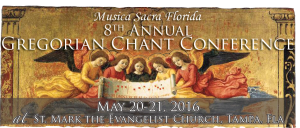
Sacred Music Conference Opportunity, (Yeah, had to really check myself not to do a "chance"/"chants" play on words, there)

Anyone in Florida, or really, just the south-east US, or anyone who would enjoy a jaunt to one of the more interesting cities on the gulf coast, ought to look into this. I highly recommend the personnel, the prayer, and the sheer.... well, I hate to use this word because it makes it sound frivolous, but.... fun of it. (Seriously, a great time with great people.)
I can't make it this year, alas, (lots of hatching, matching and, sadly, dispatching amongst family and close friends.)
MSF 2016 Web Banner 

Image result for st mark the evangelist tampa

Thursday, 31 March 2016

Scelata said to him, “Can anything good come out of Michigan?” Jeffrey said to her, “Come and see.”

Good from Michigan? Well, there is the Tuba Museum, and Frankenmuth, and the antique ring from the Wooden Skate with which our troth was plighted, and those signs that say, "Beware, Entering Waffle Country," and Greek Town in Detroit, and...
Okay, lots that's good comes from Michigan.
That said, I was just making a joke, and I really am grateful to the folks at CCWatershed for this article.
Since I've no control over anything, sometimes it's less painful to pay no attention to what is going on, or should be going on, so, yeah, notice of the goings on in Marquette escaped me, this instuction is from January.
But sing  Te Deum and Non Nobis in thanksgiving for the Lord's Providence in granting his people a shepherd like Bishop John Doerfler!
Image result for bishop john doerfler
1. All parishes and schools will learn to chant the Ordinary parts of the Mass in English that are found in the Roman Missal, and they will be sung by the congregation some of the time throughout the year.
2. All parishes and schools will learn to chant the KYRIE, SANCTUS and AGNUS DEI from the Missa lubilate Deo, and they will be sung by the congregation some of the time throughout the year.
3. All parishes and schools will learn to chant the Communion Antiphon in English to a very simple tone that everyone can sing, and the Communion Antiphon will be sung at every Sunday Mass. A hymn may be sung after the Communion Antiphon while the congregation is receiving the Blessed Sacrament.
4. A Diocesan Hymnal will be used to ensure the musical quality and doctrinal integrity of the Sacred Music. The hymnal will include a broad repertoire of hymns from classical to contemporary. 
5. The Diocesan Director of Sacred Music will provide annual, regional workshops for parish musicians to assist them in the implementation of these directives. He will also assist music teachers in Catholic schools to implement Sacred Music in the school curriculum and at school Masses. Finally, he stands at the service of parishes upon request to help implement Sacred Music in other ways.
The directive about the hymnal is actually longer, so read it there if it interests you.
It seems to me that such a hymnal, assuming the standards are well set, is something that could be of immense value to the Catholics of the nation as a whole - The  Petrus Hymnal, perhaps, after the diocesan patronal saint?
And the amzaing thing, if only the NPM types would understand it, is that, withe the exception of creating a hymnal, (which is something on which someone else is doing the heavy lifting, so it is no burden on them,) these directives are EASY.
Do-able by anyone, in any parish, with any resources.

We have a guest priest just now, so, no authority to implement any long lasting change, no ability to direct employees, and yet in less than two weeks great changes have been wrought, changes for the good, tiny and yet remarkable. It is a reminder, if one were needed, how much depends on the priest -  
God send us priests; God, send us many, holy priests!
By the way, since I do enough complaining, let me say that I know how blest I am - my dear pastor may make me crazy, so wedded to liturgical convenience is he, but I never, never need have any qualms about validity, and I am very grateful to him.

Monday, 5 October 2015

Eff-Crap

EffCap is the pronunciation of an acronym for what is, essentially, the way every Christian is called upon to react to Liturgy, his duty, when it comes down to it.

F. C. A. P. He must, yes, MUST, try to engage in -F-ull, -C-onscious, and -A-ctive -P-articipation.

None of this needs to be perceptible to anyone but God, it must be said. He does not owe the song leader decibels, nor the celebrant visible attention as indicated by gaze locked upon him.

The "action" is most importantly, interior.

But do not neglect the way one may aid ones fellow in the pew by strong singing when called for, how one can teach children and neophytes in the vicinity by modeling postures and gestures!

Sadly, I have lately had recourse to a newer term and acronym - "EffCrap." The "r" is for "raucous."

Full Conscious Raucous Active Participation? NEVER called for!

But alas, it is ubiquitous.

I always enjoy Colin Mawby's "Vivace" newsletter. If you don't subscribe to the newsletter? so do it already!

Anyway, the latest issue recounts this horror-
In some churches it has become fashionable to applaud the musicians at the conclusion of a service. ... I write as a liturgical musician, but I question whether this is right.
The main purpose of liturgy is the worship of God. ...
One of the problems of the liturgical reforms is that many services have become man-centred rather than God-centred and applause underlines this approach.
Does a congregation ever applaud God or the Word of God? I have never experienced this although I recall a church where after the Consecration the priest called out: “Three cheers for God: hip, hip!”
Can you even?
I can't....

Monday, 31 August 2015

There is Nothing New Under the Sun, My Fellow Liturgical Musicians

Wait...  here we are with a new book treating of beloved characters from an old book... hmm, I shall have to consider the paradox.
Let us exchange the previous axiomatic cliche ['zat redundant?] for "plus ça change, plus c'est la même chose."

I don't read novels anymore, literally, none.
About twelve years ago I went from voracious consumption mostly of literary novels and classics, never fewer than a half dozen stacked up on the floor on my side of the bed, didn't matter as long as they were light enough, (literally, of a low enough weight, so as not to strain wrists or eyesight in bed,) several a week, (when is the new AN Wilson coming out, I must know!!!!!!!! and oh, look I never read this Charlotte Bronte novel, PLEASE let it be as good as Villette!!!!!) to zero.
 I still read tons, but just, somehow, not novels, and I can't figure it out.

But that's really not my point.

Himself is crazy for his Kindle, and is reading Go Set... and made me read a passage that had me in stitches.
From the time of Jean Louise’s earliest ecclesiastical recollection, Maycomb had sung the Doxology in one way and in one way only:

Praise—God—from—whom—all—blessings—flow,

a rendition as much a tradition of Southern Methodism as Pounding the Preacher. That Sunday, Jean Louise and the congregation were in all innocence clearing their throats to drag it accordingly when out of a cloudless sky Mrs. Clyde Haskins crashed down on the organ

PraiseGodfromwhomall Bles—sings—Flo—w

PraiseHimallcreatures He—re Bee—low

PraiseHimaboveye Heav’n—ly Ho—st

PraiseFatherSonand Ho—ly Gho—st!

In the confusion that followed, if the Archbishop of Canterbury had materialized in full regalia Jean Louise would not have been in the least surprised: the congregation had failed to notice any change in Mrs. Haskins’s lifelong interpretation, and they intoned the Doxology to its bitter end as they had been reared to do, while Mrs. Haskins romped madly ahead like something out of Salisbury Cathedral.
Jean Louise’s first thought was that Herbert Jemson had lost his mind. Herbert Jemson had been music director of the Maycomb Methodist Church for as long as she could remember. .... He had devoted thirty years’ spare time to his church, and his church had recently rewarded him with a trip to a Methodist music camp in South Carolina.
Jean Louise’s second impulse was to blame it on the minister. He was a young man, a Mr. Stone by name...
Mr. Stone had long been suspected of liberal tendencies; he was too friendly, some thought, with his Yankee brethren; he had recently emerged partially damaged from a controversy over the Apostles’ Creed... [but he] was tone deaf.
Unruffled by Herbert Jemson’s breach of allegiance, because he had not heard it, Mr. Stone rose and walked to the pulpit with Bible in hand.
[Jean Louise] felt amusement turning into indignant displeasure and she stared straight at Herbert Jemson throughout the service. How dare he change it? Was he trying to lead them back to the Mother Church? Had she allowed reason to rule, she would have realized that Herbert Jemson was Methodist of the whole cloth: he was notoriously short on theology and a mile long on good works.
The Doxology’s gone, they’ll be having incense next—orthodoxy’s my doxy. ...
Mr. Stone had pronounced the benediction and was on his way to the front door when she went down the aisle to corner Herbert, who had remained behind to shut the windows. Dr. Finch was faster on the draw:
“—shouldn’t sing it like that, Herbert,” he was saying. “We are Methodists after all, D.V.”
“Don’t look at me, Dr. Finch.” Herbert threw up his hands as if to ward off whatever was coming. “It’s the way they told us to sing it at Camp Charles Wesley....The music instructor... taught a course in what was wrong with Southern church music. He was from New Jersey,” said Herbert....
“He said we might as well be singing ‘Stick your snout under the spout where the Gospel comes out’ as most of the hymns we sing. Said they ought to ban Fanny Crosby by church law and that Rock of Ages was an abomination unto the Lord....He said we ought to pep up the Doxology.”
“Pep it up? How?”
“Like we sang it today.”...
“Apparently,” [Dr Finch] said, “apparently our brethren in the Northland are not content merely with the Supreme Court’s activities. They are now trying to change our hymns on us.”
Herbert said, “He told us we ought to get rid of the Southern hymns and learn some other ones. I don’t like it—ones he thought were pretty don’t even have tunes.”
Dr. Finch’s “Hah!” was crisper than usual, a sure sign that his temper was going. He retrieved it sufficiently to say, “Southern hymns, Herbert? Southern hymns?”....
“Now, Herbert,” he said, “let us sit quietly in this sanctuary and analyze this calmly. I believe your man wishes us to sing the Doxology down the line with nothing less than the Church of England, yet he reverses himself—reverses himself—and wants to throw out … Abide with Me?....What about When I Survey the Wondrous Cross?”
“That’s another one,” said Herbert. “He gave us a list.”
“Gave you a list, did he? I suppose Onward, Christian Soldiers is on it?”
“At the top.”
“Hur!” said Dr. Finch. “H. F. Lyte, Isaac Watts, Sabine Baring-Gould.”
Dr. Finch rolled out the last name in Maycomb County accents: long a’s, i’s, and a pause between syllables.
“Every one an Englishman, Herbert, good and true,” he said. “Wants to throw them out, yet tries to make us sing the Doxology like we were all in Westminster Abbey, does he? Well, let me tell you something.... your man’s a snob, Herbert, and that’s a fact.”
“He was sort of a sissy,” said Herbert.

Friday, 31 July 2015

A Once Thought Endangered[?] Species, Rising Like the Phoenix

No, nothing to do with poor Cecil.... though it is Cecilian, after a fashion.

I am not a subscriber, but Church Times, (British and Anglican church, that is,) has a piece on the resurgence of plainchant, (the "oldest continuously sung repertoire in Western Europe." Was the qualifier of "Europe" necessary?)  that others may wish to, and have the means to, read.
It is in reference to Christopher Hodkinson reflecting on the publication by the RSCM of a guide to plainchant, and a revision of a work by Dr Mary Berry, .(all bow.. eh, Scott? :oD) whose current successor Mr Hodkinson is (not sure how many others in the years intervening...).
He also had this to say, about a Mass in Barking, (a place name I admit to having always loved) -
There are rare moments in life when we are privileged to see the world not merely as it is, but as it could be.
One such was a rainy Sunday morning a few months ago, when I was able to attend Mass in a parish I hadn’t visited before. By the time Mass began the church was packed full, with close to three hundred people present, including many families with children (fifty of the younger ones went out to the Sunday School during the Liturgy of the Word). A team of about eight boys processed with the priest to the altar, carrying candles and incense.
During the Introit, as at the Offertory and Communion, the small choir chanted the Proper texts of the day in English using Adam Bartlett’s Simple English Propers with light organ accompaniment. The music for the antiphon was provided to the congregation so that they could join in, but there was also time at each of these points to sing good, time-honoured hymns. As Mass continued, the priest sang his words to the tunes in the Roman Missal, and the congregation responded confidently. The Ordinary of the Mass was sung in Latin chant: Mass XI (Orbis factor) rather than the more widely-known Missa de Angelis. The strength of the congregational singing suggested deep familiarity with the Gregorian melodies, and this was demonstrated in stunning fashion at the Alleluia, where the whole congregation joined the choir in singing one of the authentic Gregorian Alleluia tones, complete with its melismatic jubilus.
Considered from an artistic point of view, the Mass demonstrated a pleasing aesthetic unity: a happy marriage of English and Latin chants and with some familiar hymns interspersed. In other words, the music served the liturgy, and was for the most part an integral part of it, so that the aesthetic experience was also a liturgical experience. The essential key to achieving this was the priest singing of his parts: the sung dialogue between priest and congregation impressing silently upon us that music was the medium by which the words of the liturgy became the praise of Almighty God.
Where, you might wonder, was this remarkable parish, this model of good liturgical praxis? This was a typical Sunday at St Mary and St Ethelburga, Barking.
At first sight Barking might seem like an unlikely venue for the scene I have described. The church is a modest brick building constructed in the 1970’s, with pews on three sides of the altar and a leaky roof. The congregation I saw was as diverse as any in the country; people who might be described as ‘White, British’ were certainly a minority, and the parish could hardly be described as wealthy. The choir consisted of a handful of faithful volunteers, led by an organist who helps out playing sacred music on Sunday mornings even though his real métier is jazz piano on Saturday nights. Perhaps the only indisputably excellent feature of the church is its small pipe organ, a chamber instrument with a lovely tone which was donated to the church some years ago.
If you are familiar with English parish life you will already realise—it could hardly be otherwise—that the liturgical achievements of the parish are largely due to the tireless work over many years of the parish priest, Fr William Young. Possessed of few resources and largely self-taught, he has nevertheless achieved a genuine realisation of the spirit of the liturgy in his parish; a celebration that is at once genuinely inclusive, culturally rooted and faithful to the practice of the Church.
If this can be achieved in Barking, it is hard to see why it cannot be achieved everywhere.
Also, word of a workshop
Ealing workshop advertisement

Sunday, 26 July 2015

The Evangelical Power of Beauty

This is just far too lovely a story not to share every way possible.
It's titled "What it's all about", (and I'll give you a clue, it ain't the bass,) and it comes from a musician on the CMAA forum called Hugh:
We said farewell today to a wonderful young man who is about to return to France after a year's study here in Melbourne (Australia). As I said goodbye, he reminded me of another French student he had brought along in Holy Week to listen to our choir at Tenebrae (Victoria Responses, Allegri Miserere, chant).

That young man, already back in Paris, rang my friend recently to say he was now receiving instruction and will be baptized in a couple of weeks!

My friend put it beautifully: "He came for the music. He left with the Faith." 

Monday, 20 July 2015

Advice from the Experts

There have been a number of parting of the ways, ("partings of the way"? "partings of the ways"?) between Catholic liturgical musicians and their mortal bosses come of late, some of high profile musicians, others of unsung, (and no doubt underpaid,) toilers in the vineyard.

Pilgrim musicians for a pilgrim Church, huh? always be prepared for change in this line of endeavor, the only certainty is uncertainty, right?
Someone mentioned that part of the reason is that making music, singing, and passing judgement on whether one "likes" a particular piece of music and it is therefore "good" are not seen as requiring any particular skill  - by those who have no skills.
Anyone could manage a sort of religious karaoke, you get accompaniment tracks and just sing along to them, right? It's not like there are rules about music for Mass, huh? isn't it all a matter of taste when you get down to it?

And everyone has a voice, so singing certainly doesn't require any expertise. So forget your degree and experience and work keeping up with relevant liturgical documents and experience with this particular acoustical environment and knowledge of what vocal demands should be made septuagenarians of an early wintry morning, I want it faster/slower/lower/higher/louder/stronger/peppy/not so scary/more majory!
(The last three are real incidents, IM own, personal, actual E.)

Any road, it reminded me of an old thread at the forum.
my husband (who is an organist,) had his pastor come up to him and tell him to "add more sharps" to a song, so it would be more "energetic."
'Nuff said.

(By the way, I am well aware that this predicament is not peculiar to church musicians, virtually everyone in every line of endeavor serves at the pleasure of someone else. Two very good parish priests I know have been more or less cashiered recently for... let us just say, for less than "cause".)

Sacred Music Workshop in Georgia

A Summer Sacred Music Workshop, a collaborative effort between parishes in response to the pastoral plan of the Archdiocese of Atlanta, will be held at Our Lady of the Mountains Roman Catholic Church in Jasper, Georgia, on August 15, the Assumption.
Go to this page to register, sound excellent, wish I could attend.
Workshop Highlights:
  • Training in Gregorian Chant under professional church musicians, with choices of a chant class for beginners, and courses for advanced men or women.
  • Keynote lecture by Rev. David Carter, JCL, entitled: Re-discovery of the Church’s Sacred Tradition: II Kings 22
  • A panel discussion on the Liturgy and Sacred Music
  • Choral experience with one of the two choirs; a beginning polyphony choir or a choir for more experienced singers.
  • A Sung Mass in the Novus Ordo where you can apply what you learn.
  • A music packet including all the chants, motets and other helpful resources.

(A plea to the organizers, one that I always make at the CMAA Colloquium - any materials that are not copyrighted, hand-outs, texts of talks, etc - make them available on you web-site, please? Brick by brick, as they say, in this way you can nurture sacred music via persons in parishes that are not able to have someone in attendance.)
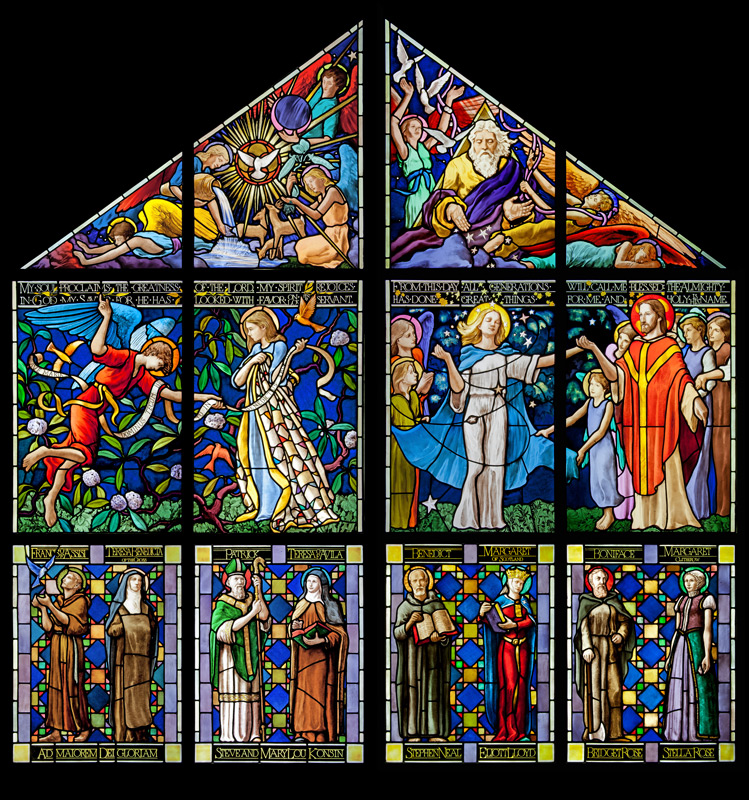
p.s. I'd go if possible just to gaze upon this, well done, Beyer Studio!!!!!!-

Sunday, 21 June 2015

Being "Pastoral" and Being Fatherly

It's Fathers' Day, so, listening to Wagner, in honour of...

Frankly, needed to take a shower, a bit muddy from the rabbit hole down which I took a tumble.
Oh, Internet - the things you get me to do!

The Internet, God's gift to conspiracy theorists and extremists of all kinds.
And remember, the social fabric has fringe on all sides...

Sad to say, most of the muck from which I'm trying to extricate myself is written by my co-religionists.
You know, the right-wingers who think the Church is in thrall to the Democratic party, the left wingers who think She's in bed with the Republicans... a shameful way to think about your Mother, isn't it guys?
And a lot of the thought I was examining was NOT of recent vintage. La plus ca.... how do I make that little mark under the "c"? No matter.
In reading about hierarchical skulduggery, and backroom presbyteral politicking, I was struck, (not for the first time, since it has been a talking point for most of the commentary on Pope Francis and his appointments,) how people like to say, "we need men who are 'pastoral', not...."

Not what?
What is the opposite of pastoral? What do we think "pastoral" mean?

As a musician I was accustomed to hearing the word used approvingly as one of the "three judgments," in selecting and preparing music for liturgy - well, more than approvingly.
It is a most lop-sided stool,  we musicians are asked to sit upon, one leg is always favored, isn't it?

Yes, musical excellence; yes, liturgical appropriateness; but above all, pastoral sensitivity!

The which, far too often, boiled down to "give the people what they want!" (and just as important, don't give them what they don't...)

But anyone who's serious about the task, in other words, not an NPM adherent but an NMLPM adherent, were there such an animal, knows it is not a zero sum game.

It's not just with musicians - I think there's a tendency when "being pastoral" is proclaimed as the sine qua non of episcopal eligibility to forget that there's a lot more to shepherding than keeping the wolves at bay.

I'd wager any crook wielded by a shepherd worth his salt makes a helluva lot more contact with wool than with wolf.

But I don't know, do I? I've never met a shepherd, good or bad, (though I have had way more contact than was good for me with a particular sheep, or rather, with a "little lamb"  - smelly, noisy creatures who won't let an ingenue get on with her business!)

And I doubt I am alone in this. (In the non-acquaintance with shepherds, not in doing musical numbers with livestock.)

But most of us do have a pretty good acquaintance with a father, good or bad, and are better equipped to say what made him so, (mine was spectacularly good and I shall miss him every day until I die,) so I think that's a metaphor we in the first world could probably utilise more effectively in speaking of our bishops.
You wanna go play in traffic? Oh, okay, I don't care what ya do, it's all good.... gee, I love ya, kiddo!
Gosh, dang, I'm afraid we might hafta move, I drank up my paycheck, and there went the rent, but lemme give ya a big hug!

Sorry I forgot to teach you right from wrong, but we sure had some great times fishin', huh, Sport?

Thursday, 14 May 2015

Adventures In Progressive Solemnity, Long Form

I was fortunate enough to have the opportunity to attend a Mass in the Extraordinary Form recently.
Generally, although one is offered in my diocese every weekend, the distance and timing, and my own Sunday obligations are such that I instead seek a musicless Mass.

My husband, a late in life convert to Catholicism, was raised by a Mother who, Methodist or not, understood the concept of the "Sunday Obligation;" and at the time he and I arrived at an understanding, we usually attended two services every Sunday morning, (a Mass and whatever protestant church in the area gave promise of the best music,) so he was a very experienced church-goer by the time he was received into the Church.

The first time we attended a Mass with no singing or instrumental music whatsoever, he was taken aback, he had never before encountered any kind of Christian worship which did not include singing.
He hated it!
How could you praise God without bursting into song?
We continued in our nomadic life to seek musical excellence where we could find it, but gradually his hunger for the Eucharist eclipsed his musical preferences, and as he grew to understand the level to which liturgical music has sunk in many places, (Protestant as well as Catholic, I might add,) he embraced the quiet Mass.
We settled for a time in a parish that had a not too bad music program.
When I became involved in a "liturgy committee", (mea culpa,) they were in the process of trying to introduce music into the single quiet Mass in the entire town of five Catholic churches, and the congregants were fighting them tooth and nail.
The PIPs, for the most part, refused to pick up hymnals, and kept their jaws clenched.
Someone on the committee bemoaned the fact, and I repeated the complaint I had heard regarding the choice of hymns, which were puerile, to put it mildly; TPTB had supposed that what was needed as an ice-breaker were "easy" songs, so with no change from week to week, they were asking people to sing the stuff programmed at school Masses.
Over and over.
They knew whom I was quoting, so obviously the PIPs were trying to, forgive the paradox, make their voices heard.
I suggested instead of inserting fairly arbitrary songs, they start with the dialogues and the Our Father, maybe the alleluia before the Gospel.
Blank looks.
You know, (I had probably just learned this phrase,) “progressive solemnity.”
More blank looks.
Like it suggests in Musicam Sacram? A document of Vatican Council?
Oh, well, maybe, they all agreed, even the priests, that that might be the way to go - until they realized that "dialogue" meant singing initiated by the celebrant or other minister.
Nope, they just wanted the people to sing more.
Mind you, all of our priests had fine voices and could either read music very well, (including square-note, I later learned,) or were very good natural musicians who could pick up anything by ear.
But having drunk deeply of the spirits of Vatican, Too, they, (with the agreement or even insistence of their lay colleagues,) were intent upon getting the people to "do" more, not altering their own approach to celebrating Mass.
Eventually I was offered a music/choir director position.
(I had had one years before, while I was still in school, but this was so long ago that it was in the period when the job was picking out 4 hymns that used some of the same words as the readings and posting the numbers. The less said about it, the better.)
In this new position I tried to steer things toward a less preference-centric choice of music, but the deeply-ingrained, three generation long, choir culture; competing ethnic and language needs; and the power structure of rectory/school/religious ed office required constant negotiations.
Returned for a visit after we moved, discovered that some practices I had pressed for for years unsuccessfully had finally been adopted, ( singing the verbum Domini dialogues,) others which I had instituted had been discarded, (the Exultet as written, sung Sequences when called for,) and others which only began under my short tenure, not without push-back, were acknowledged as "the way we've always done it,"(singing the Lectionary psalm.)
The parish where I now find myself has a well-meaning but slap-dash approach to liturgical music and liturgy in general.
I have found other ways to contribute, and enjoy the lowest and earliest of Sunday
Since I am no longer responsible, or even much effected by any musical planning, for over three years I have thought of myself as taking R & R from the front lines of the Liturgy Police Action, (it's not a war!)
.............................
When I've worked in a parish setting, TPTB were always slightly Latin-phobic, so obviously only Ordinary Form for Mass or LotH. Convincing them that what they wanted to sing, or were accustomed to sing weren't necessarily the most important things to sing, and that the Church actually gave us guidance on this, (apart from what our diocesan OoW put out,) was like pulling teeth.
Instead of Progressive Solemnity, we were fortunate to even be able to achieve a sort of Regressive Triviality.
I have taken part in Extraordinary Form Masses with great joy, at Colloquia and when I have found myself in the environs of St John Cantius, or had the opportunity to attend one for which Jenny Donelson's schola sang; and I have even been happy to have the chance to hear the traditional Mass when neither the priest nor the musicians, nor we faithful in the pews seemed very sure of who should do what when.
I even accidentally attended Mass at a schismatic chapel, before I knew there were such people and places, and I give thanks for, and "enjoyed" that.

I have never had any musical responsibilities at these, (other than singing as told at CMAA functions,) so never thought much about what is supposed to be done.
I generally position myself near someone who seem confident of his postures and gestures, whose hand missal looks well-loved, and copy him.
But I have realized that there is very little consistency from place to place.
(The first clue that I had was the PBC notation about "IF the confiteor is said again, turn to pg 25," or some such.)
Some places one priest reads the Lesson and Gospel in English while another reads them quietly in Latin, others the vernacular follows the "real" scripture. Some places the PIPs kneel for the entire time except the Gospel and homily. Some everyone recites the Gloria along with the celebrant. One priest stopped in mid-Pater noster to silence the people who were singing along with him, another practically conducted us to sing along.
I was given to understand that this is all because, in the day, there really were no rubrics for the people.
But the rubrics for the musicians are pretty clear, I had thought, especially the distinctions between solemn, sung and read Mass, a la Musica Sacra.
But even these seem to be a source of confusion.
The organist at one parish told me she and her choir "just do what Father wants," and there are four different "Fathers" who might show up on a moments notice.

The Mass I attended Sunday was lovely, and profoundly prayerful.
I found myself entering into it such that I was saved from playing Liturgy Scorekeeper, (a more passive role that Liturgy Police,) no ticking off boxes, wondering why so and so did such and such.
It was only after Mass that I thought, hmmm, 2 Latin motets and one English anthem, or that was nice, that little organ filler, sounds like Rossini, and then repeat the anthem, or, gee, only one voice to a part, none of them very strong but sweet polyphony, or wait a minute, they only sang some of the Gregorian Ordinary, and we all spoke the rest together, didn't we?
It all seemed, it felt appropriate.
Were they, perhaps, applying principles of progressive solemnity from Musicam Sacram to the EF, taken advantage of the provision for varying "degrees" of sung Mass?
And why shouldn't they?
That might sound flip, or combative, but it's really not.
IRL I have no access to anyone particularly knowledgeable about this, and I thank God every day for Those InterWebs.
But the internet is full of Facts that Everybody Knows - that aren't true.
And there often seem to be differences of opinion as to what pronouncements are descriptive and what prescriptive.
I thought I had learned that Musicam Sacram does not apply to the EF, (though of course there are some who try to insist it doesn't apply to the Novus Ordo... who, pray tell, would they be?)
I was startled to learn, (but I am ignorant - people who keep up on these things also seemed startled to learn,) in the comment box of this several month old thread at New Liturgical Movement, which addresses these very questions, that a book of rubrics for the old Mass is available online. The date of publication is 1960, but would it be in effect for the 1962 Missal?
A lot of the conversation there of course is simply opinion - leaned, informed opinion, but not really helpful for those who might be preparing sing half take baby steps in preparing music for liturgy.
It doesn't matter to me right now so much what the Church should have asked of us as what She does ask.
I want to know what's what, and what ought to be, and what ought not -- because I have a premonition, or at least a hope, that I might need to know.
What “legitimate diversity” is there in the Extraordinary Form?

Friday, 27 March 2015

"This is the Martha side of things"

Good column by Richard J Clark, five things liturgical musicians, (of which I am no longer one...)  need to keep in mind this week -- always, but especially in Holy Week.

But the reminder that every breath, every step up to the third story loft, every page turn in a prayer, is something that we do for God - that's the one.
Making that music, everything that goes into our "making" it is how liturgical musicians pray.

I had an ongoing conflict, (very amicable, I loved her,) with my former liturgist, that all the canvassing, the wheedling for more lay people to take on liturgical roles was simply wrong.
A larger choir is perhaps a good thing.
A larger corps of lay readers when each one is already only called upon to read every two month is not just silly, it's wrong - it is asking all the Mary's to give up the "better part" and start marthaing.

(And I won't even get into the insidious way that the practice of constantly recruiting "lay ministers" has given rise to the, "oh, I'm not going to Church this weekend, luckily I'm not 'doing antyhing' at Mass," mindset.)

Tuesday, 10 March 2015

A Princely Send-off

Twice in one week, I need to rethink my opinion of the Cardinal Archbishop of New York.
First, he has carraigeacha, calling out the IRA at the same time he puts ISIS on blast.

Second, at one of the biggest deal Catholic funerals in this country's since one that was a cross between a political convention and a canonization, one long eulogy, he reminded everyone that the guest of honor wasn't the guest of honor, the Lord was, and neither he nor He wanted an eulogies, (although there was one, of course.... but Dolan's homily was superb.)

The liturgy, thanks to scaffolding and the "blended" music style that is nearly inescapable in Catholic churches in this nation and age, had feeling of cobbling, but all things considered, was excellently done.
(I wish Cdl Dolan could be persuaded not to stand at the door or on the steps glad-handing everyone like mine host, but whaddya gonna do?)

Someone -- the EWTN techs? the cathedral techs? SOMEONE knows how to mic' cantors in a way they should teach to whoever takes care of such things at the National Basilica.

And speaking of cantors.

John Des Marais

Not absolutely sure this is the correct John Des Marais, (hope it was, he has facial hair now,)  but whoever was the psalmist/cantor, he was perfection.
Gorgeous tone, perfect diction, prayerful affect, and admirable diffidence - the minimal, almost apologetic, I-know-you-all-probably-know-when-to-make-your-vocal-entrance-but-it's-my-duty-to-make-this-slight-motion-for-those-that-don't gesture was such a nice change from the flight attendant inspired, Your exits are here, here and here giant arm swoops from local singers who are thrilled to be on tv.
Lord, but I hope he's a practicing Catholic!
And speaking of singers possessed of gorgeous tone, perfect diction, prayerful affect, and admirable diffidence - why couldn't Matthew Polenzani have been Cdl Egan's favorite singer?
Image result for matthew polenzani cantor "st. patrick's"
No ugly interpolated high notes from him, and again, the prayerful affect that does not say Get a load of how I am acting the heck out of this aria, lieder prayer, yeah that's it, prayer.

Dr Pascual, (sp?) is really to be commended, as are the MCs.

And does anone know what that first hymn? folk song? from the pipers was?

Tuesday, 13 January 2015

Are We On The Verge of an Abyss?

CCWatershed has a piece by Aurelio Porfiri that seeks to describe the perilous state of liturgical music in the Catholic Church.
Why should we care about this person's opinion?
Because he is the composer of this.

So yeah, that is someone worth listening to on the subject of Catholic liturgical music.
Unlike those referenced herein:
Today everyone can rule over those who are unfortunate [enough] to take church music seriously: every catechist, every priest, every nun can teach you what they don’t know. 
All of these people usually have something in common that is very important: they are completely ignorant about liturgical music, but feel encouraged (from a mysterious spirit) to use their ignorance for the greater glory of God and the edification of the faithful.
Seriously, does that not ring true for every musician who has ever made music in the Church?  Maybe not in your current situation, surely not of all those people, but I would be shocked if every one of us had encountered a person of similar ignorance and similar certitude that what they were doing was right.
And sometimes, this person of ignorance and certitude is someone one really, really likes, even loves!
It is not easy.
AUTEM, (and it's a big "autem,")...
I think the natural state of all liturgical endeavours, perhaps all matters of the Faith, is to be on the brink.
And thus, the natural position of all those who engage in them, (and this includes the ignorant,) is one of careful, and prone to upset in the blink of an eye, balance.

As Christians, we are all on the verge of the abyss at all times.

If we are not either striving, reaching precariously for the Summit, or carefully picking our way through the surprisingly slippery surround of the Font, can we claim to be a disciple of Christ?

Is it, should it, ever be easy? settled?

The enemy doesn't sleep any more than rust does.

Monday, 5 January 2015

A Tidbit from the Fine Liturgical Composer, oh heck, leave out "liturgical", Fine COMPOSER, period, Colin Mawby

From Mr. Mawby's recnet newsletter, (you ought to subscribe):
Q I recently attend a Requiem Mass at which all the traditional plainchant was sung and the Celebrant wore black vestments. The atmosphere was awe-inspiring. Do you feel that the Catholic Church has suffered in trying to make its Requiem liturgy “user-friendly”?   JT, Italy

A Indeed I do. The old Requiem Mass was incomparable. It had dignity and a deep sense of prayer – one felt in touch with the next world. We should try and re-introduce these noble qualities into the contemporary funeral service.

Thursday, 20 November 2014

Archbishop Cupich's Installation Mass

The program for the liturgies for the new Bishop of Chicago was made available on the archdiocesan website, but I just got around to watching the dvr..
Shame about the insane cold.
I suppose it is inevitable that these "big" Masses have the flavor, liturgically and musically speaking, of a parish potluck, wherein one is thrilled that Mrs. S concocts, (and will always bring,) a world class pineapple upside-down cake, pleased that decent pieroghi will abound and good swedish meatballs will probably make an appearance courtesy of Mr. K, and shuddering in anticipation of that bizarre gelatin salad the F. family always brings.

In that light, the Windy City Mass did not disappoint.

But let's hear it for that magnificent, and  laudably diffident cantatrix with a voice as glorious as her hair!

(A note, I am in no way impugning the delectibility, dare I say, the charms? of good jello salad.... I may even try to create on for Thanksgiving. Do you suppose the other family members will think i am being ironic?)

Saturday, 18 October 2014

"And the family would like...."

At the CMAA forum they are discussing a miscommunication regarding providing the music sung prayer at a funeral amongst family/music director/parish offic/funeral home.

I had one where two people showed up in the loft at about the half hour mark, one had been asked to sing, "by her brother and she specifically wanted Hail Mary Gentle Woman,"  and the other, "by her son and she especially wanted the Schubert Ave Maria, and Somewhere Over the Rainbow, but I told her you probably wouldn't."

Both soloists were known to me, so it would have been touchy working it out, and I honestly don't remember how we did so.

But I don't think anyone stopped talking to me forever that day.....