Jean Langlais, Lord, Your Glory in Christ (Dieu, nous avons vu)
Willan, Behold the Lamb of God
Englert, O Faithful Cross
Englert, He is Risen (leave out the narrations at the beginning)
Biery, O Sacrum Convivium
Webbe, W. Y. Cor Jesu, Dulcis
Vincent, Lines Written in Her Breviary
Schalk, Before the Marvel of This Night
Hovhaness, Ave Maria
Gouzes, Let All Who Thirst
Hurd,D Now, Lord, You Let Your Servant Go in Peace
Hurd,D. Christ Mighty Savior
Alstott, There is One Lord
Kenneth Smith/Neale, Come and Let Us Drink of That New River
MortenLauridsen, O Magnum Mysterium
Paul Manz, E'en So, Lord Jesus
Proulx, Canticle from I Peter (By Your wounds...)
Rutter, What Sweeter Music
Schalk/Vajda, Now the Silence
Saint Michael the Archangel, defend us in battle. Be our protection against the wickedness and snares of the devil. May God rebuke him, we humbly pray; and do Thou, O Prince of the Heavenly Host - by the Power of God - thrust into hell, Satan and all the evil spirits, who prowl throughout the world seeking the ruin of souls.
I imagine everybody could use a laugh right about now, even if it's a mirthless one.
The choice of some putters of notes and words on paper in a manner that those putters (and presumably their editors, [though it should be said that they themselves often are on the editorial boards which deem their putting of notes and words worthy,] and publishers,) believe to be suitable for use in Liturgy as recipients of an award was met with some amusement, some ridicule and some outrage on the Book of Faces.
One of those outraged linked to his blog
He linked to a post I would have thought Eye of the Tiber material, the gist of which was this award recipient's veneration (in the religious sense,) of a tragically, and senselessly murdered gay man, who seems to have been a generally nice guy all of whose stances were politically correct.
And IT links to... well, it turns out their is a dealer in "religious" goods who actually sells this "icon."
The artist, allegedly a Franciscan brother, gives halos to a remarkable range of... persons, and also includes many actual saints and blesseds. (Also, some truly lovely and holy depictions of our Blessed Mother, and of Christ Himself with characteristics and coloring of ethnic minorities.) Einstein with a halo. Ss Pepertua and Felicity posed for a Benettons ad. Merlin, (yes, THAT merlin.)
And the Aboriginal American cross-dresser, We'wha, (I believe that is also the spelling for the way they young folks nowadays pronounce, pitch and inflect, "Wait... whaaat?"
I wish I liked new music more.
Should I say, "I wish I liked contemporary music more"?
"I wish I liked modern music more"?
One feels such a philistine.... it's like admitting to not liking poetry. Or Brando's "acting." Or sushi. Or goat cheese. (My shame on this account is no doubt exacerbated by my high school humanities field trips and the beginnings of my "free tickets with student I.D." days having coincided with the tail end of Boulez's [Boulezs'? Boulez'z?] tenure with the NY Philharmonic and subsequent lionization.)
Stipulating that serialism, at least, is a dead letter, there are other musical attempts at modernity to which i just do not take.
But I have learned that just as the mighty King of Instruments, (why isn't it the "Queen of Instruments?" a friend once suggested it was because a king usually takes a queen. I digress,) is a gateway to actually enjoying sonorous dissonance, the oboe produces so winsome a sound that it makes palatable that which would set my teeth on edge played by the finest violinist in the world.
There is a lot to love on Michele Fiala's The Light Wraps You: New Music for Oboe,
and Overheard, (I liked the Averill very much,)
and especially A Tree in Your Ear. (Give Stephen Caplan's "Miniatures" a listen.)
I have talked about this with my confessor more than once - I keep
score.
I keep it with those I love, I keep it with those I hate
am trying to learn to love because Christ demands it of me.
It's a really corrosive trait for ones relationships, and it
colors my opinions in really unhealthy ways, for I also keep track of
the score regarding people I don't even know.
I had a beef with Tom Hanks for taking home the Oscar that
rightfully belonged to Anthony Hopkins for Remains of the Day long
before he made those obscene and hateful movies where he played a
"symbologist." Hopkins' Mr Stevens was an achievement on
the order of Maria Falconetti's Joan, but besides being the kind of
flashy play-acting the Academy loves, Hanks' work was in the service
of a cause Hollywood loves, the lionization of those suffering with
the consequences, unjust or otherwise, of sexual license, so, of
course he won.
Oddly, the same year saw another of my Top Ten Oscar
Things-That-Make-You-Say-WHAAAAAAA?
Michael Nyman's brilliant, BRILLIANT score for The Piano? not even
nominated.
THAT SCORE WAS MORE IMPORTANT TO THAT FILM THAN ANY OTHER MOVIE
SCORE IN THE HISTORY OF MOTION PICTURES.
It was almost the plot of the film, a parallel screenplay in
another medium.
It was a character in the film.
(No grudge on my part against John Williams who won the award for
score, since Nyman received no nomination.)
Ennio Morricone's Mission score lost to Herbie Hancock's
for Round Midnight, and that inequity has ticked me off for
thirty years.
Anyway, because I don't watch the Oscars, other than the opening
if I think the host has promise, (Chris Rock's monologue was spot
on,) I did not learn until just now that the great Morricone has
finally received a competitive Oscar, (he did have an honorary.)
It's for a film I shall probably not see, (Tarentino movies can be
too skeevy,) but I feel a great deal of ....some emotion that sits
between joy and relief?
That kind of "all shall be well, and all shall..."
satisfaction that the world is going back toward being in balance.
And that's my problem in a nutshell.
I think things should be in balance.
I remember things. I remember slights, I remember favors.
I keep score, I take inventory, I measure things on a scale of my
own devising and find people either wanting or in desert of more.
Even when although I perceive some trespass but magnanimously forgo revenge
or even calling attention to What I'm Letting You Get Away With?
I'm still keeping score, that's right.
And I reward myself by giving myself
over to feelings of smug superiority.
Now, I say "I remember," but I must be honest, the one
matter I manage to forget as I sneak my thumb onto the scale?
God offers boundless mercy against my minute goodnesses,
prefect benevolence to my trivial good turns, abundance for my puny
deeds.
Balance things out? you, Scelata?
Don't make me laugh.
But God has no thumb on the scale, and for that I am grateful.
Morricone has a way with the oboe, huh?
And this was, no, is beautiful.
Although his music is neo-romantic, it functions, as I believe movies scores most often should, in the way classical, as opposed to romantic art does - not to provoke and manipulate the viewer's emotions but to evoke the emotions one already has, to put one in touch with what is already there, to remind one of what hopefully lurks just below the surface, to resonate with memories of ones better self.
.... you know, physical beauty or dance ability.
(Intonation? Nah, fuggedaboudit, we got auto-tune for that.)
Take a look at this, Andrew Balio's indictment of the standard-free education in the arts that is being pushed by some, (well, objective standards, anyway, are being thrown to the wind.)
He writes from the POV of musicians, but the plastic arts are leading the way.
Music conservatories have until now largely resisted the impulses
that have transformed our art schools. But art schools long ago
succumbed to the delusion that sets creativity and originality ahead of
discipline. They long ago embraced the widespread cultural rebellion
against tradition in all its forms; generations ago they rejected the
practice of “teaching as it was taught to me.” They have effectively
broken with the past. They’re even wildly successful at turning out
entrepreneurs: modern artists are now rolling their “art” off of
assembly lines straight into museums. A 2011 Wall Street Journal article by Stan Sesser, “The Art Assembly Line” described this phenomenon:
Alexander Gorlizki is an up-and-coming artist…[whose] work has been
displayed at the Victoria & Albert Museum in London, the Denver Art
Museum and Toronto's Royal Ontario Museum, among others, and sells for
up to $10,000. Mr. Gorlizki lives in New York City. The paintings are
done by seven artists who work for him in Jaipur, India. “I prefer not
to be involved in actually painting,” says Mr. Gorlizki, who adds that
it would take him 20 years to develop the skills of his chief Indian
painter, Riyaz Uddin. “It liberates me not being encumbered by the
technical proficiency,” he says.
We don’t have to squint to see where this road that our reformers are
rushing down ends. Indeed we are fortunate to have such an explicit
example to study. Before we bid our conservatories follow our art
schools into the great modern experiment, then, we ought to ask
ourselves—and consider carefully—whether or not the experiment has been
successful.
Movies and musicals are assembled by committees and focus groups, cuteness counts, and PR trumps beauty.
With Scrooge, I'll retire to Bedlam.
There is so much television, and I am so prone to become an utter potato if I don't fight my indolence, that I'm making quick decisions as to whether a series is worth the time to invest in it.
After 2 episodes, I'm pretty sure I will stick with "Home Fires" on PBS but i can't be sure it has anything to do with the stories, characters, period production values or actors, (though all of that is fine and intriguing.)
No, it is the bewitching music by Samuel Sim.
Usually when scoring strikes me this strongly, I recognize the name, but Mr Sim is new to me.
I'll read the rest later, but in asking if a great composer (James MacMillan,) can help a tone-deaf Church, Damian Thompson says of MacMillan's 4th Symphony,
The Fourth is a masterpiece; perhaps the first great symphony written by anyone since the death of Shostakovich.
Someone on Twitter had a link to a BBC performance of this, and following I found myself on a page which reminded me that I was, um, in America, and not to listen to the BBC page.
But, James MacMillan's Symphony No. 4 is available on the Tube of You, here.
Excellent, I thought.
I had only ever listened to his sacred and liturgical music before.
But I began to listen with some disappointment, that is not a tonal language I "like," oh, I can't understand that, and certainly not for 2/3 of an hour, what is he trying to do -- and then suddenly it burst into beauty.
Modern yet neo-Romantic, richly orchestrated, surprising...
I certainly don't entirely "get" it on first hearing - which is wonderful!
I intend to listen several more times in the next few days.
Well lookie, lookie. They can!
(Seriously, I have always thought that - even when I was a kid and didn't, AFAIK, have a single Satanist, Muslim, Wiccan, Hindu or Buddhist among my acquaintance, I wondered if the people who were still fighting the lost cause of "prayer in school" had considered how they would react if their children happened to be in the class of a devout person not of the Judeo-Christian persuasion who led the children in a prayer of which the parents might not approve.)
(I didn't put it like that, don't think I knew the phrase "Judeo-Christian heritage," my thought were actually more along the lines of, wow, what if Mrs. Abercrombie was a pagan and we prayed to Minerva? That would be cool!)
In a society that sometimes seems to be doing its damnedest, (word chosen with care,) to silence certain religious voices in public debate, it is nothing short of bizarre that anyone would seek to deny the expression and action -- perhaps that should read "expression IN action"? -- of a non-religious entity's voice.
Have we not all the right to act in accordance with our morals and ethics, whatever their source, to try to create a society that is moral and ethical, as we define those things?
Not necessarily to prevail, but certainly to call upon them in making our decisions as to what promotes the common good?
A federal judge on Monday sided with an anti-abortion group in its
challenge of a key birth control provision of the Obama administration's
health care overhaul. The decision from U.S. District Judge Richard Leon adds to the legal
debate surrounding the law's requirement that contraceptives for women
be included among a range of cost-free, preventive benefits offered to
employees. The 29-page opinion held that March for Life could be exempt from the
requirement, known as the contraceptive mandate, even though it is a
non-religious organization that opposes abortion on ethical grounds
rather than religious ones. March for Life, which holds annual anti-abortion marches in
Washington, was founded in 1973 following the Supreme Court's Roe v.
Wade opinion that established the legal right to abortion. The
organization contends that life begins at conception and opposes
coverage in its health insurance plans for methods of contraception that
it likens to abortion.
So legally you can be "not religious, but spiritual", (even if the hearer of such a statement is "not honest, but interested.")
Speaking of being interesting - I wonder how many of the individuals who make up that "non-religious entity" are very religious indeed. I'll bet a high percentage.
(Me, I often if not usually interpret"spiritual but not religious" to mean "I know what I really ought to do, but I prefer to do what I really want to do, and besides, I like to sleep in." Especially since most of the people from whom I happen to have heard it over the years are in professions in which any idiot knew you couldn't really do much of anything if you didn't, whaddya call it? .... oh, yeah, practice.)
Shakespeare seems to have meant sexual love when he described music as "the food of love," but there are so many more, and greater kinds of love, aren't there?
And there is music that can be, in a small way, source and summit for them.
There is no question that music can stir the emotions, (melt the heart, as Aquinas might say,) or that music, singing specially is the natural outpouring of the expression of these various loves.
True liturgical music must be our love song to God.
I was watching a movie on tv last weekend, didn't realize the entire thing would not be broadcast then and there, (going out, have to ask Himself to DVR the final part tonight.)
Knew nothing about this biopic of Padre Pio 'til I turned it on.
I am generally leery of foreign films on EWTN, they are sometimes rather cheesy, even second -rate, sorry to say, if it's a subject that interests me I'll stick it out, but...
And here's another matter, because of the way all but American films generally record sound, there's a real distancing that occurs, with me at any rate, I have trouble really engaging - the artificiality is more pronounced, the voices less "present" seem less real, and sometimes the dubbing is just plain bad either in acting or synchronicity.
At my most pretentious in artsy student days I probably saw more foreign films than I did Hollywood product, so I learned to usually disregard this, (the way I did static on the radio, or the sound of vinyl, or the fighting of my brothers three feet away while I was reading, ;oD) but it's still a thing.
Anyway, this started out pretty well done, I liked the gruffness of the actor in the title role, I liked the depiction of the dangers of cult of personality, I liked that for a, literal, hagiography it wasn't hagiographic, someone had put real effort into the voice casting.... and then the music welled up and I thought, "Well, A picture, A+ picture production values!"
And so it was - a quick check on IMDB revealed that the score was by none other than the peerless Ennio Morricone.
What a treasure this man is!
I have bemoaned for years and years, why doesn't HE write for the Church? why hasn't HE composed Masses and Vespers and Hymns? why won't HE...?
And now I learn that he has, at long last!
Thank you, Papa Francesco, thank you, Society of Jesus, for inspiring that!
Had a fiddler visiting, (most assuredly a fiddler, not a violinist,) delightful days, and now, after a number of years of appalling vocal laziness, (and I've chided Himself!) I want to study. I want to learn. I want to expand.
I want to know how to sing Sean-nós songs.
I never had enormous flexibility, despite the best intentions of several superb teachers to fashion me into a coloratura, (is there anything more useless than a soprano with a high E and no flexibility?)
So deliberate pursuit of the skill, (rather than yodelling along with other people in the shame-free environs of my den,) is not going to come easily, even if I do ferret out a way to learn the old style.
I've sung my share of Irish-ish songs, but they were of the Herbert Hughes "art song" variety and my technique, or at least my intention, was pointedly not folk.
In retrospect, I wonder? did we, (everyone at conservatory, prosperous non-American blacks singing spirituals, preppies getting in touch with their Irish roots, giant Slavic voices having a go at Russian folk tunes, etc.) sound as silly singing the art music versions of the Songs of Our People as when we helped out a friend by providing back-up vocals rehearsal tapes for a "rock musical"?
Beside the inauthenticity, you have to deal with the Using a Howitzer to Kill A Mosquito syndrome that opera singers often evince when they slum...
Well, age and inertia's effect on my chops should save me from that! Ha!
A remarkable story about a musical performance inspired by a remarkable story.
The Nazis had [taken] a medieval Czech fortress town and
convert[ed] it into a massive, horrifically overcrowded ghetto and transit
camp. From there the next stop was Auschwitz.
The response of the Jewish prisoners was nearly unique. They created a
rich cultural life for themselves, ... including “2,400
lectures, 16 performances of the Verdi Requiem, 38 performances of
[Smetana’s opera] ‘The Bartered Bride,’ 50 performances of [Czech
children’s opera] ‘Brundibár,’ and performances of ‘Tosca’ and ‘The
Magic Flute,’” as well as cabaret and jazz events.
One figure at the heart of their cultural efforts was Rafael Schächter,
a Romanian-born Czech conductor, composer and choral director, whose
promising career in opera was cut short when the Nazis invaded
Czechoslovakia and banned Jews from public life. Sidlin’s ...., his crowning
achievement in Terezin: 16 performances of Giuseppe Verdi’s Requiem
Mass.
The Jewish conductor at the heart of the story rightly describes Verdi's Requiem as "steeped in the Catholic liturgy," it isn't itself even vaguely liturgical - it is a great, great opera.
I don't actually know the details of Verdi's faith, his brand of Roman Catholicism - he was, IIRC, anti-clerical, anti-Papal states, no?
But the Manzoni Requiem radiates the splendour of truth.
I don't know how anyone can listen to Verdi's setting of ingemisco and not be certain, yes, of his own sinfulness but even more sure of the salvific power of God's mercy, in Christ.
Because I am constitutional incapable of "staying on task" as one urges little children nowadays, having finally gotten two packages mailed off, I set about arranging music for the caroling.
And carols lead me to folk music which lead me to Percy Grainger, which lead me to this, from his autobiography:
Altho she insisted she liked the personality of Christ, as a man, & altho she sometimes... said she had religious feelings, [Mother] was unwavering in her dislike of any portion of the Bible..."Be a good fellow & don't read to me from that awful depressing book." She was truly fond of Mrs McGee, & at times maybe somewhat influenced by Mrs McGee's Catholicism..."If I had to join any church, I think it would be easiest for me to join the Catholic church. I like the way Mrs. McGee is willing to sit in church beside any dirty old man.
I laughed the other day as Himself flipped through channels, a character on a program talked about his "Big Glory" moments, how the "theme music" he heard in his head at such moments, (this was, I think, the moment when you discover that the one you love loves you.)
Delightful, I wasn't sure there wasn't, but I didn't know that anyone else actually did that, you know, selected his own soundtrack.
I hear people talk about music they associate with certain moments or feelings, but that's usually because, as in films sometimes, it was "source" music, music that is actually and naturally occurring, rather than background added in.
So many people have "their song" because it was the first one to which they danced, or the thing that was playing on the Muzak in the waiting room while his child was born, or the hymn that will always be "Grandma's funeral"because that's what they heard at the funeral parlor.
But this character had chosen his soundtrack, consciously - I have done that, and I'm glad to know other people do. ("Other people do?" you wonder.... well, yes, I know the character isn't real, thank you very much, but a quirky trait or habit in a sitcom is almost always something from a writer or producer's own life or that of a friend.)
Oh, yeah, there are some tunes that were unbidden, Thompson Twins Doctor, Doctor, Phil Collin singing Somethin' in the Air Tonight, but mostly I lay down the tracks deliberately.
Having grown up in a noisier environment than any that Himself, for instance, and I'm sure many other people can imagine, I'm fairly good at shutting out other noise and hearing what I choose to hear instead.
And in moments of triumph, I hear the finale from the Sibelius Fifth. Oh, do I hear it. Sometimes I have actually played a recording at such times, but I don't need to, my brain's iPod or cassette deck or Victrola cranks up and out it pours.
Really, is there any music that speaks more of triumph after struggle? that better evokes that heart-swelling joy of success that if we are fortunate, we occasionally experience in our lives?
So what did I do? That's right, I not only heard it in my head, but played it on the computer, oh, a half dozen, oh, maybe TEN times before I was done that evening.
I had wondered if the great Passions were ever staged, or semi-staged. THIS sounds like a marvel.
Maybe I'll think about the DVD....
Passion propels more operas than almost any other human emotion;
however, many musical dramas have a very different sort of passion—the
final days of Jesus—as their subject. While most commonly performed in
concert halls or churches, this week the greatest of these, J. S. Bach’s
setting of the gospeler Matthew’s retelling, opened this season’s White
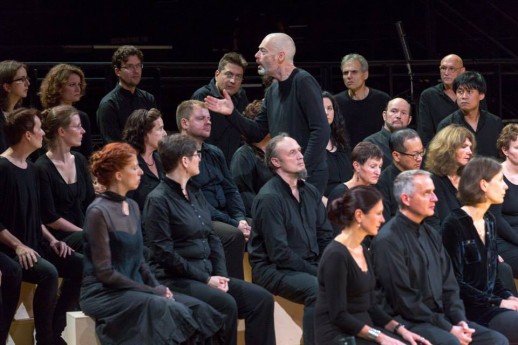
Light Festival in a grandly ambitious semi-staging by Peter Sellars at a strikingly transformed Park Avenue Armory. Featuring a group of (mostly) impressive soloists and accompanied by no less than the Berlin Philharmonic conducted by Sir Simon Rattle,
the two-performance run quickly sold out becoming this fall’s most
sought-after ticket. Although there may have been a few defections at
intermission, I didn’t see a single person leaving Wednesday’s
performance early, a testament to the power of Sellars’s deceptively
simple concept. Inspired by the uniquely enveloping design of the Philharmonie, the
orchestra’s home in Berlin, an awe-inspiring physical environment was
created for the event. Surrounded by high bleachers on all sides, a
small stage at the center of the Armory featured the Philharmonic
divided into two groups with an exemplary continuo band of
organ, cello, lute and bass set between them. The superb 66-member
Rundfunkchor Berlin was also split into halves with each choir member
sitting on a cube of blond wood on risers. Several other larger boxes,
one of which became both the table for the Last Supper, then Jesus’s
tomb, were the production’s only props.
Did opera director/doctor/wit Jonathan Miller really say that?
Been laid up, not leaving the house, so indulging myself with opera via Youtube and heretofore unwatched DVDs.
And yeah, having a few granny-reactions - WHAAAAA? did that Rhinemaiden really just....? I can't believe Don Giovanni would have ever....! I hope they paid those dancers enough for letting someone... and sometimes just ewwwwwwwwww!
So some of the carping I'd heard about regie, I just attributed to the carpers fundamentalism, lack of sophistication, want of artistic imagination...
But it seems that opera has more in common with pop culture than I'd known, coarse, sluttish and degrading behavior really is the order of the day.
But when I came across that quote from Miller, (some of whose work I very much admired,) it disturbed me. (I haven't read it anywhere than in that article, and others that reference it, so perhaps it's not quite what he said? I can hope.)
Beauty is beside the point?
No wonder the world is in such a state when intelligent, talented and influential individuals can say such a thing.
Yeah, #!@$% the transcendentals....
The sad thing is, by disdaining beauty, by neglecting goodness, the purveyors of evil ugliness deny themselves the chance of ever actually achieving truth, the one value they putatively pursue, the one value they claim to rank above all else.
Every time there is a fracas about some "raunchy" performance on TV, or complaint about a hit song with "obscene" lyrics, or hand-wringing about the "indecent" clothes won by someone, my initial reaction is, or rather, WAS, that the person wailing and gnashing his teeth is being granny.
When will I learn?
You see, I've checked out a number of performances recently from concerts or awards shows on broadcast TV that were brought to my attention, and.... yup.
Filth.
I've glanced at at the slogans on T-shirts worn by little children......beyond crude; or the dresses worn by young women to weddings and even funerals...... shockingly suggestive.
I've been in a store or mall and suddenly been able to understand the lyrics of the background noise.... vile and coarse beyond belief.
I am, "behind the scenes," involved in the planning of several versions of Catholic funerary rites, in both cases the person with actual family authority knows nothing of the requirements and has enlisted my aid with the proviso that no one else knows I have been consulted.
In one case, to my great surprise, I learn that the decedent, a nun in the heady immediate post-VC II days would have wanted Gregorian chant, (I had always assumed she would have been a banjos and tambourine type,) indeed, the liturgical mess of the times may have played a part in her departure from the convent.
I had to explain to her godson that he might have a shot at getting the parish pastor and music director to agree to the propers in some form, but that the Dies Irae, which he was very keen on, was no longer an official part of the Mass, that some priests might allow it to be inserted as an Offertory chant.
In scouting hymn texts for one of the other liturgies I read through several older threads about funeral programming on the CMAA forum, and found a link to a wonderful "mediation on a lost treasure," that is, the Dies Irae, by a Mons. Pope.
Don't know how I missed it at the time, was that the year we actually moved? No matter.
Well worth the read.
I loved his point that yes, the poetry is about Judgment, but ultimately, even more so, it is about MERCY.
And then, apropos of nothing, except my local PBS station that broadcast a Live in HD From the Metropolitan Opera, or rather, broadcast all BUT THE LAST TEN MINUTES OF IT!!!!!!!! (Arghhh!) I was rooting around on Youtube and came across and listened to Jonas Kaufmann singing Ingemisco from the Verdi Requiem a time or two.
Or four.
A poster on another Kaufmann offering on Youtube refers to him as a "guilty pleasure," and I know what he means.
His
technique seems so different from anything else I've ever heard or ever, really imagined as "good", his
placement even within a single phrase so varied, the extravagance of his
shifting of register to another -- can it be right?
But it is so effective. And his diction and the intensity and precision of his emotional expression is beyond compare.
Music aficionados often joke that the Manzoni Requiem was Verdi's "greatest opera."
Well, why not? did he ever have a more superb libretto, or heartbreaking subject for any opera?
Maybe the most moving expression of penitence I've ever heard.
I groan as a guilty one, and my face blushes with guilt; spare the supplicant, O God.
You, who absolved Mary Magdalen, and heard the prayer of the thief, have given me hope, as well.
My prayers are not worthy, but show mercy, O benevolent one, lest I burn forever in fire.
Give me a place among the sheep, and separate me from the goats, placing me on your right hand.
So I'm driving along and some caterwauling comes on the Catholic station to which I'm listing and I switch to the local classical, and something beautiful and choral is on, and I recognize the harmonies as Laurdisen's, and suddenly realize, ah, these must be the Rose Songs, I've only really heard the last one, and suddenly I am sobbing.
Sobbing, and sobbing, as if my heart is broken, and this wave of... what? regret?
Yes, a kind of tender and resigned regret.
And I continue weeping and weeping, and I don't know why, I barely know the music, don't even know the words other than the title, but I cannot contain what is inside me.
Why, what is it? I have nothing to regret. I'm still in mourning for a death, but there was nothing left unsaid, nothing unfinished.
But somehow, the tune? the chords? regardless of the creators' intent, (it's a love osn,g no?) I don't know but the entire piece is such a lamnet...
It speaks to me, I hear it in my heart, it feel like a dagger
What am I feeling, pangs of remorse? disappointment?