Universalis, your very own breviary in pixels...

Showing posts with label Art. Show all posts

Thursday, 13 April 2017

"Now the power, Now the vessel brimmed for pouring..."

In an eMail from Magnificat - I'm not sure that the artwork isn't the greatest benefit of the magazine.
No, that would be the reflections.
Though it might be the obscure saints on various themes. Oh, except it's probably....
(Sometime I feel as if I am advertising for Magnificat, but really, you should subscribe.)
Anyway, this reminded me of the heartbreaking statue of the Man of Sorrows at St John Cantius, the same kind of stillness and power.


"Now the power, Now the vessel brimmed for pouring; Now the body, Now the blood..."

(Hymn text, by the way, which has nothing, so far as I know, to do with Magnificat, by Jaroslav Vajda.)

Friday, 20 January 2017

"Harvey, Pray For Us"???!?@??#?$???%?^???!?????

I imagine everybody could use a laugh right about now, even if it's a mirthless one.
The choice of some putters of notes and words on paper in a manner that those putters (and presumably their editors, [though it should be said that they themselves often are on the editorial boards which deem their putting of notes and words worthy,] and publishers,) believe to be suitable for use in Liturgy as recipients of an award was met with some amusement, some ridicule and some outrage on the Book of Faces.
One of those outraged linked to his blog
He linked to a post I would have thought Eye of the Tiber material, the gist of which was this award recipient's veneration (in the religious sense,) of a tragically, and senselessly murdered gay man, who seems to have been a generally nice guy all of whose stances were politically correct.
And IT links to... well, it turns out their is a dealer in "religious" goods who actually sells this "icon."
The artist, allegedly a Franciscan brother, gives halos to a remarkable range of... persons, and also includes many actual saints and blesseds. (Also, some truly lovely and holy depictions of our Blessed Mother, and of Christ Himself with characteristics and coloring of ethnic minorities.) Einstein with a halo. Ss Pepertua and Felicity posed for a Benettons ad. Merlin, (yes, THAT merlin.)
And the Aboriginal American cross-dresser, We'wha, (I believe that is also the spelling for the way they young folks nowadays pronounce, pitch and inflect, "Wait... whaaat?"
Well, SOMEBODY pray for us...

Thursday, 5 May 2016

"Holy" Cards

Image result for holy card "sorrowful mother" sepia
I am next thing to a hoarder, never can bear to give anything away if I think I might want it later, never can bear to throw anything away if I think someone else might have use of it, and if the right person or charity does not occur to me at the moment - well, there that item will sit. And sit. And sit.
That old faux shearling coat, that I hope never again to be cold enough to wear? It would make a swell pillow.
I hate vertical blinds, took them down immediately - but don't the long cream colored strips look like candles? Add yellow construction paper flames and let each child in Sunday school write the names of people they would like to remember in prayer during the month of All Souls,
I can't throw out scrap metal, I know there are people around who will take it,

I understand there are people who buy expensive garments they've never worn, or replace electronics with newer, faster devices - but then find that they can't bear to pitch that for which they spent so much money. But that's never been my problem - I spend very little on clothes, (I won't even go to the thrift store usually except on sale days,) and technology keeps its place in our household until it completely gives up the ghost, (sometimes after spending a long time on life-support.)

But I do find it difficult to divest myself of books and scores and scripts -- and all those photocopies.
Not so much for what they cost in monetary terms, but in effort. Out of print chant books, and reference works that were the result of hours combing, first, of used book stores, and old libraries, and later the internet - so many hard won volumes or articles or scores are freely available online now.
But I'm getting a bit better at that.

Which leaves us with the matter of holy objects.
I have disintegrating and dilapidated Latin prayerbooks, French antiphonals, a Polish Missal, broken Rosaries, crucifixes rescued from bins at Goodwill, a stack of "pew cards" for the new Holy Week changes, (when did that happen? that's right, before any of us were born.)

I will have a bonfire at some point, soon, I will.

But there are other things that whoever is stuck with clearing out my house will have to find and sort and dispose of, (don't worry, I'll do my best to make certain it won't be the hired henchman of some atheist nephew.)

I am fascinated by the Holy Cards.
They are such a a part of my family and religious history.
I see cards reminding me to offer prayers for the soul of someone I never knew, never met, dead before I was born, who lived half a world away in some cases - I think that's beautiful.
The changing styles fascinate me as well - the mawkish Edwardian lithos of the Virgin Mary no worse nor better than the saccharine pastel-colored saints and angels from between "the" wars.
And both are a damned blessed sight better than the garish '70s asymmetry of graphic artists in thrall to the concept of negative space, or the Kincaidesque landscapes with carefully worded "spiritual" messages, guaranteed not to offend adherents of any religion, or even of none at all.

I had brought some in to the last Sunday school class, curious if these children had encountered such things - I loved them when I was little, to be given something so grown-up, so jewel like, (the print shop at the Rosary Shrine was special,) that so connected me to history, (which, as far as I could imagine, stretched back months and months!)
One of them was an emblem of my very first memory - the dead body of an elderly man lying peacefully in a big box, in a charming little stone house attached to our church. Ah, that must have been the wake of this priest.
Another was for an aunt I remember very well, but strangely couldn't remember dying -I realize now it was because my Mother was in the hospital at the time being delivered of a younger sibling of mine, of course that would have occupied all my attention.

I am well aware that the devotions, the sacramentals, the little, (even from time to time kitschy,) uniquely Catholic practices and items are no all that important in and of themselves - but properly understood, I believe we should think of them as "gateways" to the Sacraments and to an entire right conception of the Faith - to its breadth and its homeyness and corporeality and personalizability, ('zat a word?) to its diversity and mystery and, yes, fun, and perhaps most especially, to our praiseworhty individuality within our praiseworthy interconnectedness.
They are all part of the "Catholic identity" that so many fear our failure to transmit.

Well, some, perhaps most of the 10 year olds knew what they were, one actually owned some, and every single child was fascinated with the very idea. and wanted to have them.
Some had a vague idea of to whom the face on my most recent acquisition belonged.
So we made our own Holy Cards. I gave them a number of psalm verse and prayers as suggestions, and they chose one, unanimously.
O Lord God of hosts! let Your face shine on us, that we may be saved!
(Oh, and this really threw me for a loop - if we had time and supplies for a second card, (after they each made one from themselves and we made 2 dozen for "the kids in juvie," as they like to say,)?

I love that "glory" prayer at the beginning of Mass, can we do that?.... and they all agreed.

Ohm and I believe I may have discovered the secret to engaging them - lamination.
(Dollar Tree, a true dollar store? five sets of the sheets, enough for ten or even 15 cards depending on size and shape. Bookmarks, maybe.)

Yes, laminating is an adventure.
I'm going to use that knowledge next year for enchanting the learning of a chant, and perhaps for memorizing the Works of Mercy, or an Act of Contrition, or the Latin and Greek names of the parts of the Ordinary.

One last thing, I loved this from the memorial card from an uncle who died when I was a young, from St Ephrem (a patron saint of mine.)
I call for the prayers of all those who have known me, of all those who have loved me.
(Isn't that better than, "do not weep for me, I'm in a better place and I'll see you at the other end of the rainbow? I know which one I would rather people read as they cart me off to the boneyard.)

Tuesday, 3 November 2015

Great Catholic Artwork - and Your Children Can Get In On the Action!

This is major - Daniel Mitsui, one of the finest Catholic artisans or artists working today, has made CATHOLIC COLORING PAGES available.
Adult coloring books are having a moment, and these pages, which he offers, soli Deo gloria, are as beautiful as anything you will find in the collections at art supply or craft stores.

And he has made them freely available if - you cannot afford to make a donation. (But you should, if you can -- consider donating.)

The thing is, anyone looking for coloring pages for children knows how awful most of the religious stuff out there can be, not good and interesting enough for most past kindergarten age, and often grossly unworthy of their subject matter.
These are quite, quite magnificent.

Friday, 16 October 2015

And This Is How We Have Singers Who Rise To Fame on the Usual Vocal Skills...

.... you know, physical beauty or dance ability.
(Intonation? Nah, fuggedaboudit, we got auto-tune for that.)

Take a look at this, Andrew Balio's indictment of the standard-free education in the arts that is being pushed by some, (well, objective standards, anyway, are being thrown to the wind.)

He writes from the POV of musicians, but the plastic arts are leading the way.
Music conservatories have until now largely resisted the impulses that have transformed our art schools. But art schools long ago succumbed to the delusion that sets creativity and originality ahead of discipline. They long ago embraced the widespread cultural rebellion against tradition in all its forms; generations ago they rejected the practice of “teaching as it was taught to me.” They have effectively broken with the past. They’re even wildly successful at turning out entrepreneurs: modern artists are now rolling their “art” off of assembly lines straight into museums. A 2011 Wall Street Journal article by Stan Sesser, “The Art Assembly Line” described this phenomenon:
Alexander Gorlizki is an up-and-coming artist…[whose] work has been displayed at the Victoria & Albert Museum in London, the Denver Art Museum and Toronto's Royal Ontario Museum, among others, and sells for up to $10,000. Mr. Gorlizki lives in New York City. The paintings are done by seven artists who work for him in Jaipur, India. “I prefer not to be involved in actually painting,” says Mr. Gorlizki, who adds that it would take him 20 years to develop the skills of his chief Indian painter, Riyaz Uddin. “It liberates me not being encumbered by the technical proficiency,” he says.
We don’t have to squint to see where this road that our reformers are rushing down ends. Indeed we are fortunate to have such an explicit example to study. Before we bid our conservatories follow our art schools into the great modern experiment, then, we ought to ask ourselves—and consider carefully—whether or not the experiment has been successful.
Movies and musicals are assembled by committees and focus groups, cuteness counts, and PR trumps beauty. With Scrooge, I'll retire to Bedlam.

Wednesday, 9 September 2015

Wonderful Opportunity In Western Pennsylvania For Art Lovers

Or really, anyone interested in the Faith, or in beauty - and that includes eveyone, right?

Franciscan University in Steubenville, a bit to the west of Pittsburgh, (about a 3/4 of an hour drive,) will be hosting an exhibit and lecture by the... artist? medievalist? philospher? Anyway, the brillilant Daniel Mitsui..

The opening and the lecture will be this coming Monday, the Feast of the Triumph of the Cross.

STATION 
LAST JUDGMENT 
 I find his work almost shocking in its beauty.

(And seriously, can you imagine a more elegant gift for such a price as these?)

Sunday, 21 June 2015

Beauty, Goodness, Truth... on paper!

I am a procrastinator, and forgetful and careless and, .... sometimes, carefree.
(And since while I have quite a bit to do, most of it is on my own schedule or purely elective, so it doesn't matter and I can get away with my slovenly habits!)
Anyway, I've only just had time to sit down and look, really look at an email from 3 weeks ago, the newsletter of the artist and medievalist Daniel Mitsui, and my hand to God, some of it is so beautiful it hurts to look at it. My heart aches!
It is as if it were the physical embodiment of the splendor that Truth exhibits, and really, demands.

Just LOOK at this crown of thorns -
IMAGE
Or this "Christ in Majesty"-
CHRIST in MAJESTY
I think, (I hope,) this year I am going to be pretty much all right as far as finances go and I am really looking forward to giving a small print or two as Christmas gifts.
(This sounds crazy, but I was just thinking how marvelous a Daniel Mitsui coloring book would be... is that crazy?)

Friday, 27 March 2015

Disturbing

I was looking for an image for devotion.
St John Cantius in Chicago has a stunning, almost life-sized statue of  a seated Man of Sorrows.
It never failed to move me when I saw it.
Although for religious, devotional, liturgical art I prefer some degree of realism, I have a fairly broad acceptance of genres and styles.
I was looking for a Man of Sorrows, mabe to use on my desktop while reading the office?

But I came across this, an Ensor monstrosity.

Where is the beauty? what is the point? the artist, about whom I know very little, seems filled with hate.
Am I a philistine that I can see no redeeming value in this? I feel as if I need a shower after seeing it.

(AFTER A BIT OF THOUGHT
I DECIDED LINKING TO THE
UGLINESS WAS QUITE
ENOUGH, I SHOULD NOT
SULLY THE INTERWEBS
WITH ANOTHER ITERATION
OF THE IMAGE ITSELF)

Monday, 29 December 2014

The Treasures of Magnificat Magazine

I was browsing before Mass this morning, (lots of ;little articles I had not read in turn, essays that hadn't caught my eye at the time,) and not for the first time, noted how frequently I come across a relfection or even a sentence that strikes me as so perfectly lucid and lucent - and illuminating, and I will read to the end and see that the words were penned by someone named Ratzinger; or how often I happen upon a hymn text, (or translation,)  previously unknown to me that is verbally elegant and theologically rich, and paging to the index in the back of the little Magnificat, I see that it is the work of Kathy Pluth.

The lyric to the Theotokos, (sp?) is quite wonderful.

O Theotokos, Mary blest,
Our human nature’s shining crest,
Through you we have our liberty,
Free children of the light to be.

O Queen of all the virgin choir,
Though David was your kingly sire
Your royal dignity has come
Not from your fathers, but your Son....

Exemplar of virginity,
Give glory to the Trinity,
Whose endless treasure-stores of gifts
Through you our human nature lifts.

Magnificat has been a real blessing to me.

I gave my Mother a subscription, but the frequency with which the periodical chooses an optional memorial made it useless for her, (she wanted, no, needed the exact, no flipping-around-pages readings, proper antiphons and collects that the priest was saying as her hearing was going*,) so she gave it back, and then Himself gave me a four year subscription.

At first I was put out by their approach to what they call Morning and Eventing Prayer, but now that I understand their reasoning, I have nothing but praise for its creator and editors.

And the artwork!
Oh, the artwork....
(*And in retrospect, she didn't need to be constantly faced with the evidence of a beloved pastor's liturgical minimalism, not to say laziness. She knew it - even chided him on it slightly once - and forgave it. I wonder, how much time is saved by omitting a spoken Gloria during the Octave of Christmas?)

Saturday, 1 November 2014

Hate Speech in the Guise of Government Sponsored "Art"?


El Museo Reina Sofía propone quemar iglesias 

I don't reference, or even read "The Eponymous Flower" often,  because I don't read other languages well enough to understand and give creedence to their sources.

This seems pretty clear, though.

Once upon a time I would have considered reports of such blasphemy patently absurd, obvious fictions.
No more, alas.

Can one imagine an "art exhibit" presenting matchboxes emblazoned with something like, "The only way an abortionist's could make the world a brighter place is if we burn it to the ground"?

It would be hate speech, wouldn't it?

How about substituting "mosque" or "synagogue" for "church",  would the curators and museum-goers at the Queen Sofia Museum countenance that, do you think?

Of course, the whole thing could be old Varg, pranking us for Halloween...

Thursday, 28 August 2014

"Outward Signs", Beauty Pointing Us Toward Goodness and Truth


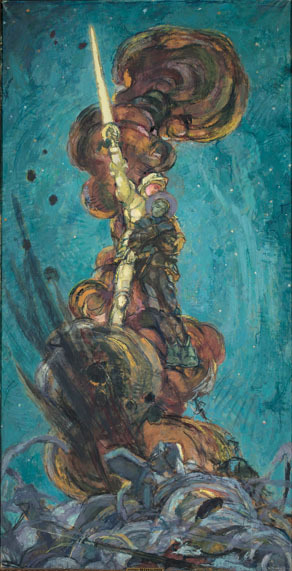
L’Ascension du poilu (French WWI infantryman), 1922, George Desvallieres
Source: http://www.georgedesvallieres.com/actualite2011_10_12_orsay_en.html

Wonderful site, lately I'm discovering all sorts of marvels that have been around, but I missed though my careless searching skills.
Look at this, a perfect Memorial Day, or Remembrance Day  object for meditation and really, devotion.

Oh, hell, perfect today as the entire world is contemplating war, and the possible justice of it.

It's not a style I think I have encountered in Church, (nor would I this painting, it is located in a museum, I believe,)  but it would not be out of place in a chapel, I think.

Where was it, Cardiff? where the cathedral, (C of E,) had great variety in its decoration, ornament and embellishment, much of which co-existed in a way likely to excite top prayer, and some of it just.... well, Jesus on a Spaceship was jarring, beyond ugly.

But I have been doing a bit of soul-searching about beauty and pleasure in regard to the art of the Faith.

I want my positions to be principled, not preference-based.

Someone wants us to help the kids "make their own Mass," and I interrupted to disagree a little too precipitously... okay, a lot too precipitously.
Maybe rudely.

Of course the entire notion of  "creating" the Liturgy, rather than receiving it is problematic, and I don't think the person doing the suggesting knew enough about the subject to be aware of that.
The message that even talking in such terms send is dangerous.

 But I'm also cognisant that the Mass should be "attractive" and different people are attracted by different expressions of beauty.

Here's the thing -- say you're a searcher, a lurker, a fallen-away, a youthful rebel, whatever....
Say you are not a regular, committed believer.
And say something is designed with bringing you in to Mass in mind.

The art, whether visual or musical or oratorical, that lures you in to the Holy Sacrifice of the Mass must then convince you, not to like it, not to say to yourself, wow, I'd come to hear/see this again.

It must help convince you that you can do without it, that even in the complete absence of what you "like", even in the presence of something that you hate, that actively repels you -- that even then, the Mass itself is something you can not do without, that you will not let your preferences deprive you of it, that you would come no matter what.

If it doesn't point you towards this truth, that the Mass is so important, so life-giving, so necessary --  that even with having to tolerate the My Little Pony Mass, or the world's ugliest felt banners, or the priest who thinks he's auditioning to replace Seth McFarland on Comedy Central's roasts, or a choir singing dismally flat Gregorian chant, or a neighboring pew sitter with B.O., or the loudest drummer in seventeen states assaulting -- even then, you must have it, you must go, you cannot do without the Mass, the Mass itself. -- if it doesn't form you such that you would forgo your preferred music or style rather than forgo the Mass, that you would brave things you despise and hurt your head and make your teeth itch in order to have the Mass, then it is bad and inappropriate, no matter how much you "like"  it.

And not just the Mass, but the part of it, the essence of it that you can get there and only there, you must be brought to understand and believe fervently that you would put up with anything in order to have that aspect of it.

And that is why, since fellowship, music, preaching, even -sorry, but I have come to believe this - even the scripture readings, since all of that is something you can get or do somewhere else - if any of those don't point you toward Christ in the Blessed Sacrament, they are useless, worse than useless, they are a distraction.

And for too long, Catholics have been acting as if we were Tiffany's trying to lure in custom with "Free Coffee and Donuts!"
We have a precious jewel, and we've been shrieking like barkers, and passing out popcorn.

Christ in the Eucharist is that precious jewel, the Pearl of Great Price for which we should be willing to do and dare anything.
And we cannot have Him so completely, so intimately any other way.


Friday, 20 November 2009

Like a Buzz in the Blood? Great, Evocative Phrase

Sometimes I miss living in New York-land...... not that Chicago-land doesn't have its charms.

I would love to see this exhibit:
At monasteries on Mount Athos in northern Greece, you wake in the night to the sound of Greek Orthodox monks chanting Byzantine prayers. It’s an unforgettable sound, distant and unearthly, but also inside you, like a buzz in the blood.

The painter Domenikos Theotokopoulos, better known as El Greco, almost certainly heard it growing up far to the south on the island of Crete. You can hear it today when you visit “The Origins of El Greco: Icon Painting in Venetian Crete,” a lustrous exhibition at the Onassis Cultural Center in Midtown Manhattan
With its extraordinary ensemble of almost 50 religious images, most of them painted on Crete — seven by El Greco and some of the rest by artists whose names are not known, ...it roughs out the texture of a specific, cosmopolitan, East-meets-West island culture.
Most of the population was Greek Orthodox, but economic power was in the hands of a Roman Catholic minority. Local artists necessarily catered to both, turning out Byzantine-style icons for one, late Gothic devotional paintings for the other and, increasingly, synthesizing the two modes....
By the 15th century, painting in Crete had moved far beyond categories like Byzantine and Gothic. Artists had absorbed Renaissance naturalism and were pushing toward Mannerism, inventing, stealing and collaging motifs as they went.


Wonderful writing by Holland Cotter:
a 1603 oil study for a “Coronation of the Virgin” ... The composition has an iconlike symmetry. The figures, in their expressive abstraction, are as much Byzantine as Mannerist. And the picture scintillates with light, illusionistically painted rather than reflected from gold. Even cherubs tumbling around like kittens can distract from the picture’s nuclear focus: this is an image meant to promote, as music can, time-suspending, space-vivifying contemplation.

Exactly this psycho-sensual dynamic lies at the heart of how icons, as spiritual utensils, function. I wish the exhibition made something of this; had taken, as its third theme, the reality of these objects, not just as historical artifacts illustrating the progress of a culture or a famous career, but also as living and interactive energy sources, designed to embody and radiate charisma.

But that’s a major subject. It needs a full-dress show of its own. Maybe some day we’ll get it.... Miraculously, admission to all of this is free.


Saturday, 31 October 2009

Pssst.... Credo in...

When I was planning our wedding, and hanging out a bit on wedding planning blogs and boards, one of my (numerous.... and you thought I didn't like animals!) betes noires was a fad, (happily short-lived,) of celebrants insisting the couple memorize their vows.

I suggested young people so beset tell the priest they'd try to do it if he would also commit to say the entire Mass without a Missal.

It was just a stupid idea.

We were professional actors yet neither Himself nor I would have dreamt of such a thing. With the nerves and heightened distractions of a wedding day, why give yourself the additional worry? especially since memorizing something to say in public is torture for the average person.

In fact, the prosepct of even reading in public alarms many, many people.

The ritual would not suffer one whit for being read, or, if need be, prompted silently by the one officiating.

In a funny synchronicity, the NY Times has run an article on the scandal or necessity, (depending on your point of view,) of mnemonic cheats and prompters in the theater, only a few days before The New Liturgical Movement informs us of the availability of "altar cards" for the Ordinary Form.

I had never thought much about them, before I knew that there were such things as canon laws and liturgical legislation about Missals, upon seeing such relics of the old Mass I assumed they were a substitute for a large, heavy, expensive book; or perhaps in larger print than the book which might be read from in the perfect world where we all have perfect eyesight.

It seems from the comment box, though, that some object to the use of these cards, at least in the OF, as being a violation of the rubrics.

But since the Vatican Press itself offers an altar card for the Novus Ordo, I think we can say that in some instances the cards are, in effect, the "Missal" that is among the items that "may be placed on the mensa of the altar."

I know in my parish there are pick-a-little-talk-a-little moments from time to time over the use of looseleaf notebook or, horrors! single sheets of paper at the ambo.
Often these are ostentatiously drawn from a groom's man's pocket, or laborioulsy unfolded and smoothed after being clutched in a second-grader's grimy hands.

But people unused to serving in liturgical ministries need to practice, and often write notes, pronunciations, or accent marks in the actual text from which they will proclaim, and surely we don't want them taking red crayons to the itcostsHOWmuch lectionary.

And that's not even getting into what the psalmist needs to be looking at to proclaim his assignment from scripture.... but I digress.

Since it seems that altar cards are indeed "permitted" in the Ordinary Form, my question is, can they be made by anyone?
Are they like the liturgical books, and ought to be produced only by publishing concerns with some sort of explicit commission, or at least permission, from TPTB?

It seems to me that creating altar cards would be a worthy project for an artist, and a wonderful gift, especially for a priest whose eye sight was ... well, doing what all our eyesight does.

Of course, the multiple Eucharistic Prayers, choices of acclamation, etc -- those could be an issue.

In the Era of Bad Liturgy and Bad Liturgical Art from which we are emerging such a suggestion would have been dangerous -- would we really have wanted the people responsible for tie-dyed vestments and bus station-worthy altar furniture to have been turned loose on altar cards?

But I believe object of great beauty might be made now -- I would love to commission a Daniel Mitsui, or a Matthew Alderman to design Altar Cards. (Yeah, when I win the lottery...)

Ooooh, but now that I think of it, though, what would prevent those with a ... well, let's say, "Hello Kitty aesthetic" from attempting the same endeavor?

Remembering those Precious Moments figurines, (I won't tell you where, even those with execrable taste are entitled to their good names, and that goes double for holy religious, I suppose,) I now see my idea needs a little more deliberation.

Incidentally, the reason for the title of this post? A priest I know, at his first Mass told the deacon to be sure to hand him a missallette at the presider's chair, so that he could read the Creed, he didn't trust his memory on a day so fraught with emotion.
He should have just asked for a whispered prompt -- when the moment came, missallette in hand but so filled with confidence that he felt no need to glance down at it, he boomed out, "I confess to Almighty God, and to you...."

Friday, 31 July 2009

If not for the eyeliner...

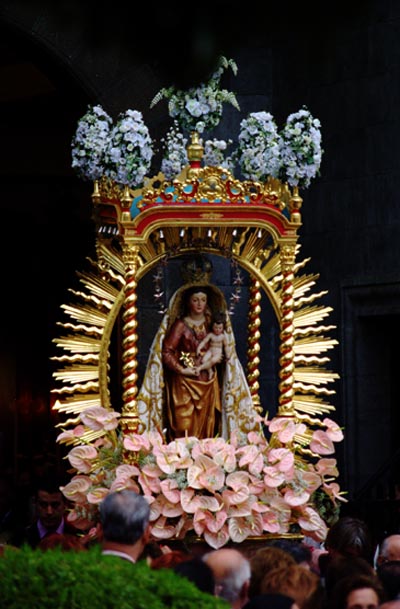
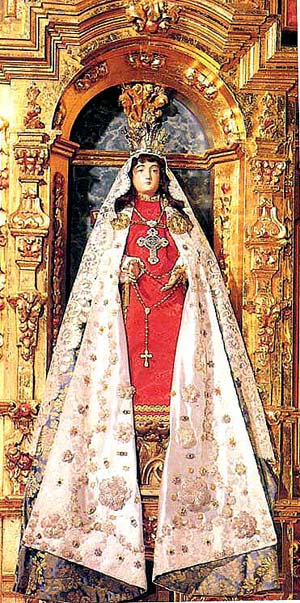
.... wouldn't this haute couture bride bear more than a passing resemblance to any number of folk and art images of the Blessed Mother?

[Picture+5.png]
http://www.catholicexchange.com/wp-content/uploads/2008/08/maryinside.jpghttp://lapalmaisland.sheilacrosby.com/uploaded_images/sauces/virgen56.jpg A008-1_Conquistadora.jpg - 103800 Bytes


But now that I think of it, even the eyeliner isn't too much of a stretch -- there is a painting of the Theotokos in a Los Angeles Orthodox church (cathedral?) that is so OTT pretty, almost glam, that Himself and I referred to it "Mary's headshot."

http://muddywater.net/SophiaMary1_edited.jpg

Friday, 26 June 2009

Really?

Sometimes I miss my hometown, and its proximity to NYC, and I grow nostaligic for the days when at the drop of a hat I could go to see the latest movie, the opera, the latest museum exhibit, the...

And other times, not so much.
There's one of the works of this guy, f'rinstance:


I never cared much for pickled herring, myself.

Sunday, 17 May 2009

A Child is Born!

Always a cause for joy -- but often a challenge, too, for course.
I doubt anyone reads this blog, who would not also have read the blog on which I learned of this, but on the off chance...
My son, Benedict Amadeus Mitsui, is now more than a week old. As I type this, he and his mother are napping on the couch in the sunlight. Ben had his first appointment with the pediatrician this week, and appears to be in excellent health. My wife will likely be recovering for a long time, but her energy seems to wax as the days pass. Te Deum Laudamus...

Michelle started to have regular contractions on the afternoon of Sunday, May 3rd. Her labor lasted seventy-two hours, the first sixty unmedicated. After a final three hours of hard pushing, the doctors declared that the baby was showing signs of distress, and that a caesarian section was the only remaining option. Thusly our son was born, just after 4 o'clock on Wednesday afternoon, May 6th. In all the history of laboring women, few have suffered more pain and disappointment than my poor wife, or done so more gracefully and selflessly. She is the strongest, bravest, most wonderful woman I have ever known. [ Scelata says: She has a lvoley voice as well, she is an artist in her own right] I love her. ...
It is likely, even with insurance my wife and I have, that the hospital bills for so difficult a delivery will destroy us financially. The one asset that I can hope to convert to money is artwork - and I have a lot of it. In the coming weeks, I will be posting several notices of sales on my existing artwork. If you have contacted me in the past about buying a drawing, only to find it too expensive, please contact me again. All prices are open to negotiation.

In addition to the works displayed on my website, I have many drawings, prints and paintings in storage from the years 2000-2005, which will be offered for sale here for the first time. My artistic principles have developed significantly over the past five years, so some of these older pieces may look strange to those of you who have only seen my recent work (indeed, they sometimes look strange to me as well). But they were all carefully and lovingly made, with exceptional attention to detail - I am sure that someone somewhere will like them. They will be sold at prices far below their usual value.

I will also offer for sale limited edition fine art prints of a few of my best works. Please keep your eye on this blog in the coming days for details about all of this.

---

Aside from the sale of artwork, the only way I can think of to raise money through my website is simply to ask for it. Although I have long had a Paypal account linked to this web log for donations, I have never demanded remuneration for my work here, or hosted advertisements. But time has come for me to call in all favors and appreciations. Since December of 2005, I have devoted countless hours to this web log - writing original essays, researching obscure topics, transcribing rare books, editing beautiful pictures. This is probably one of the highest-maintenance web logs in existence, and the time that I spend on it is time that I do not spend on more lucrative pursuits. And the server space needed to host so many pictures as I post here is not free. But I continue to maintain this web log because I believe that I am doing something important - I am showing people good, true and beautiful things that they would never otherwise encounter, and I am sharing a knowledge about sacred art and iconography gained from long study and experience. So I ask you, dear readers, if you appreciate what I have done here, what I have shown you, what I have taught you - and if you wish for me to continue to devote my time to The Lion & the Cardinal - please show your appreciation by purchasing artwork or making a donation.

Kind Regards,

Daniel Mitsui
The work that Mr Mitsui does is brilliant.
BRILLIANT. He deserves your support.

A Rule of Thumb for Catholic Artists

Intended, I suppose, as an instruction to those in the plastic arts, but the principle applies to composers and other musicians:

The composition of religious imagery is not left to the initiative of artists, but is formed upon principles laid down by the Catholic Church and by religious tradition... The execution alone belongs to the painter, the selection and arrangement of subject belongs to the Fathers.

-- Second Council of Nicaea

Tuesday, 5 May 2009

The Nike Approach to One's Vocation

Just DO it!

I subscribe to a free newsletter devoted to choir masters, and their interests and needs, from Colin Mawby, called Vivace.
Very worthwhile, always interesting reading, often simply the answers of The Guy Who Knows © * to readers questions.
I actually have several month worth saved but unread, (it's been a fraught couple-three months, and even this one sat unopened in my email for several days,) but this one is loaded with food for thought and helpful information.
I only compose out of necessity, (once upon a time school assignments, more recently because nothing pray-able, and learn-able and sing-able, and listen-able, and affordable ;oP-- yes, before the embarrassment of riches offered by Richard Rice, Jeff Ostrowski, various Fords, the Bow-tied One, Raphael Ornes, et al, I used to need to add a "fourth judgement" to liturgically, pastorally and aesthetically appropriate -- do I have the brass to pay for stuff if I don't write itmyself?)
But Mawby offers some very succinct basics on composing in answer to a readers question, (and some of the advice applies to other attempts at "Art") [emphasis supplied throughout]:
Find the right text. It must be one that speaks to me and fires my imagination. I look for spiritual depth and profound feeling. If the words aren’t right the music won’t be either. A dramatic text can be a help although these days I tend to prefer ones that convey peace and prayer.

Texts suggest their own way of setting them – they lead you on. You can paraphrase Newman’s famous hymn: “Lead kindly text amid the encircling gloom, lead thou me on”.

You then need to look at the practicalities of the composition. What choir is it being written for? (This consideration looms large for me -- I am constantly looking for ways to alleviate the lows for my not-really-basses, and hedge on the highs for my not-what-they-think-they-are tenors and not-what-they-used-to-be sopranos - Scelata.) How good are they? How high do the sopranos and tenors go? How many people in the choir and how are they divided? Should I write with accompaniment? How good is the accompanist? There are many practical details to consider, all essential to producing an acceptable composition.

....

Composition is a solitary process that demands great self-discipline. I never write less than thirty bars a day, often many more. If I’m unhappy with what I’ve done, I can tear it up and start again on the next day. Daily composition is essential – a completely professional approach encourages and releases musical ideas. I usually start writing at 05.30 – I love the early morning and don’t need a great deal of sleep.

Do I ever suffer from writer’s block? Not really. When I get stuck I wander off and do something else. I return in about fifteen minutes and I find that in some mysterious way my subconscious has solved the problem.

What about inspiration? I never think about it – I just sit down and write – sometimes it’s good and sometimes it’s bad. I always pray before writing but waiting for inspiration is not my style. It’s a great way of procrastinating and provides the wonderful excuse: "I wasn’t inspired today".

Working as a composer is a great thing, writing for the greater glory of God is an immense privilege. I have the deepest gratitude for the gifts I have been given and try my hardest to use them in the service of the Creator.

Colin Mawby KSG

Useful stuff, especially that part about just sitting down and writing, just DOING it.
The greatest art is produced by craftsmen doggedly going about their tasks rather than creative "geniuses" who wait for inspiration.

(*The Guy Who Knows is something I picked up from Himself)

Sunday, 5 April 2009

A "Dialogue Between Aesthetics and Ethics"

The long tradition of Vatican patronage of the arts has given rise to such monuments to Christianity as St. Peter's Basilica and Renaissance masterpieces including the Sistine Chapel.

Under Pope Benedict XVI, the Holy See is seeking to revive its cultural role, with plans to mount its own pavilion at the 2011 Venice Bienniale, the premiere international contemporary art festival, and start a "dialogue" with contemporary artists that hasn't existed for decades.

"We are reminded of the urgent need for a renewed dialogue between aesthetics and ethics, between beauty, truth and goodness not only by contemporary cultural and artistic debate, but also by daily reality," said Pope Benedict XVI, in a November message to pontifical academies.

Monsignor Gianfranco Ravasi, who heads the Pontifical Council for Culture, said the aim is to re-establish links with the contemporary art world for the benefit of both art and faith.

"The great religious symbols, the great stories and the great figures of spirituality — these can stimulate an art that more and more often lacks any message" — or is blasphemous, Ravasi said in a recent interview.

Ravasi also hopes to inspire art that is appropriate for the many modern churches built in recent decades by such noted architects as Renzo Piano and Richard Meier.

"So far, modern architecture has had very good results in dialogue with the liturgy," he said. "[I'm not sure I would agree whole-heartedly -- Scelata,] But inside these churches, there isn't a dialogue with contemporary artists. There is only folk art."

The Venice Bienniale has featured the world's greatest artists who exhibit in "pavilions" that are erected by individual nations.

And of course the AP illustrates this with a rather crude looking "installation" of the late Pope John Paul being crushed by a meteorite, and quotes from the director of the Andy Warhol museum concerned that due to Benedict's aesthetic sensibilities, the best the serious art world can hope for is that the Vatican's influence on it won't be "hideous."
Ya know, 'cause the art world establishment is all about beauty, truth and goodness.

Saturday, 20 September 2008

From the almost magisterial Sandro Magister, via Catholic Online on the Holy Father, who knows that by transforming the way we celebrate the Liturgy, we can transform our very selves, and ultimately transform the world (a truth that was also known to the "reformers" of the '60s and '70s):

On his trip to France, Benedict XVI defended the ancient rite and explained the authentic meaning of the Catholic liturgy of today.

ROMA (Chiesa) - In the three Masses celebrated during his trip to Paris and Lourdes, Benedict XVI followed the post-conciliar rite. But he intentionally enriched it with elements characteristic of the old rite: the cross at the center of the altar, communion given to the faithful on the tongue, while kneeling, the sacredness of the whole.
The reciprocal "enrichment" between the two rites is the main objective that impelled Benedict XVI to promulgate, in 2007, the motu proprio "Summorum Pontificum," which liberalized the use of the ancient rite of the Mass, according to the Roman missal of 1962.
The opponents of the motu proprio maintain, instead, that the use of the ancient rite does not enrich, but rather cancels out the achievements of Vatican Council II as a whole. The French bishops have been among those most critical of the pope's initiative, before and after the promulgation of the motu proprio.
On Sunday, September 14, meeting the bishops of France in Lourdes, Pope Joseph Ratzinger did not fail to urge them to be pastors welcoming of all, including the faithful who feel themselves most "at home" with the ancient rite. The pope had anticipated these ideas about the two rites of the Mass in responding to journalists during his flight to France, on Friday, September 12.
But Benedict XVI said much more on the subject during the four days of his trip to Paris and Lourdes.
In his lecture on September 12, at the Collége des Bernardins, he explained the emergence of great Western music, in the monasteries of the Middle Ages, in terms that require reflection on the diminishing quality of today's liturgical music, and on the necessity of revitalizing it in keeping with its original meaning.
In his homily for vespers at the cathedral of Notre-Dame, he called for a "beauty" in the earthly liturgies that will bring them closer to the liturgies of heaven. And he exhorted priests to be faithful to the daily prayer of the liturgy of the hours.
In the homily for the Mass on the Esplanade des Invalides, on September 13, he addressed the doctrine of the Eucharist and of the "real presence" of the body and blood of Christ in very demanding words, requiring that the Mass be celebrated with a sense of sacredness that has been largely missing in recent decades.
And Benedict XVI again returned to this "real presence" in the concluding meditation of the Eucharistic procession in Lourdes, on the evening of September 14. With a passage dedicated to those who "cannot – or cannot yet – receive Jesus in the Sacrament, but can contemplate Him with faith and love and express our desire finally to be united with Him." Among these can be counted the divorced and remarried Catholics, to whom the Church does not give communion. But their "desire," the pope said, "has great value in God’s presence."
To these calls to return to the authentic spirit of the liturgy, Benedict XVI also added, on September 14 in Lourdes, an illustration of the profound meaning of the Angelus Domini, the Marian prayer that he recites in public every Sunday.