Universalis, your very own breviary in pixels...

Thursday, 6 August 2009

Will Rome Rescue the Christians?

Damian Thompson, when he's not waxing wrothful and employing his weapon's-grade snark, is a journalist.

A few months ago I witnessed a little miracle: an Anglican friend of mine was received into the Church. It was a miracle because this particular friend had been adamant that he would not become a “Roman”, despite his love of traditional Catholic liturgy. There were many factors in his change of heart, but two words explain why he suddenly took the plunge: Pope Benedict.

At the centre of my friend’s Christianity is public worship, and (so far as I can judge from many conversations with him) the main reason he did not leave the Church of England is that he could not accept the claims of a Church which did not get its worship right. His objection was not to Vatican II, but to a casual approach to the celebration of Mass that made it harder to believe in the unique universal status of the Roman Church.

You'll want to read the rest of it.

When we worship as if we believe what we say we believe, it is powerfully evangelical.
We will begin realizing the goals of the Ecumenical Council when we begin celebrating the Liturgy the way the Fathers of the Council intended.
I would like to believe that we are on the brink of a Great Reconciliation.
That all may be one...

(Another good piece of Damian's in the Herald, about the how the Church can be re-invigorated by refugees from the Anglican Communion.)

Wednesday, 5 August 2009

Well, if it's not likely....

Faced with a dearth a hard evidence that a cure is likely, psychologists officially say they shouldn't bother trying to treat you.

At least, that's what this story says.

"There's no evidence to say ... therapies work, but these vulnerable people are tempted to try them, and when they don't work, they feel doubly terrified," says a psychologist who chaired psychologist who chaired the task force studying certain therapies for the American Psychological Association.

Well, then, let's not bother.

Learn to live with it.

Better yet, avoid people who think that your problem is, well... a problem.

I wonder if these newly formulated principles apply to many areas of the psyche and its workings.

If someone has spent years, sometimes decades in analysis with psychologists -- will he be told that since what's going on doesn't seem to actually work, doesn't improve anything, (other than the psychologist's IRA balance,) he should quit?

A Rival to the "Onion"?

What in the world is Salem News.com and why would they publish nonsense from a blog, past its "sell by" date ?

It's some kind of spoof?

Suspected Mysticism?

I have no thoughts or opinion on this, I know little about Medjugorje, but what does "suspected mysticism" mean in this context?

Fear Not, Moments of Grace and Quoting Myself

I had a actor friend whose conversations, or rather monologues, (for he liked to hold court,) were liberally peppered with the phrase, ".... or, as I like to say...."
Thereby both repeating himself, (since the "...or," naturally always followed him having said THE SAME THING IN DIFFERENT WORDS,) and committing what I recall from The Red and the Black was the cardinal social sin of introducing a pre-fab bon mot into witty conversation.

I loved the guy, but I always thought this was yet more evidence of his pomposity, -- quoting himself.

But here I am, doing the same thing, as if my pronouncements were Bartlett's-worthy.

The new Missal translation, which, like Christmas, "is coming," evokes some fear, -- or rather, not the translation itself, but the fact of its coming evokes the fear: that it may be ignored, distorted, abused to further agendae or drive wedges, etc.

And yes, there is the danger.

But on balance, is it not a marvelous opportunity? and should not Catholic people of good will, whether they like it or not, want it or not, even previously fought against it or not -- are they not bound to set about with humility and charity to make the translation transition, * WORK?
If a pastor with the right attitude has a musician with the right skills, the introduction of the new English texts can be a moment of great grace, when the Faithful take back, or rather, are given back the Mass.**

It is an opportunity to re-focus on the Word of God, on the Universality of His Church, and on the inestimable treasure that is Christ, giving Himself and giving of Himself in the Eucharist.

It is a chance to cut away deadwood, and strip away distractions.

I refuse to be fearful.

*hereinafter referred to as Tran-Tran... or would tran2 be better?

** It occurs that some may feel this is a slur on the Mass as it now stand. It is not so intended, but refers to the use of other texts than those in the Missal, and the fact that at a moment when we are focusing on the words both of the Ordinary and of the Orations which are proper to each Mass, we can also highlight the actual words of the other Propers, the processional antiphons, and scraping off the barnacle-like accretions of the various ditties making up the first 3 slices of the Four Hymn Sandwich, give them back the true and authentic words of the Mass.

Retired Cardinal's Summer Gig

Helping teach Latin.
A lecturer priest says he is pleasantly surprised to see an unexpectedly high number of people enrolling in his summer course in classical Latin at a government-funded university.

"I'm so glad to see so many applicants," said Father Louis Ha Keloon, the course's main instructor. It "reflects a growing interest and cultural quality here that some people are attaching importance to the Latin language when they want to deepen their understanding of Western civilization," he said.

... "Most of [the students] are not Catholics." ...
Due to the large number of participants, Father Ha has sought help from three other instructors.

To arouse the students' interest further, Father Ha has invited Cardinal Joseph Zen Ze-kiun, retired Bishop of Hong Kong, who has taught Latin and is fond of Gregorian chants, to be the guest speaker at an open lecture on "Latin Chants" and to introduce several medieval Gregorian hymns on Aug. 6-7. The prelate celebrates the Latin Mass occasionally.

Some of the students shared why they want to learn the ancient language:

"The Nuns Had Me Pegged"

My Mom and I were talking.
In earlier generations, it would have been unthinkable that devout as she and my Father were, and with so enormous a brood, none of her children would have even thought of becoming a priest or religious.

Why didn't we? -- not, thinking about it as objectively as I am able, that any one of us would have discovered a true vocation to the priesthood or religious life -- but why did we never even consider it? (In the interest of full disclosure, I should say that I did think about becoming a priest, positive that by the time I was ready for a graduate school or seminary, the seminary would be ready for me; my ovaries and XX chromosomes would be no impediment whatever.)

The preceding generation had one failed vocation on each side, a permanent deacon who seemed to be a transitional deacon, who left the seminary two days, literally two days before ordination. On the other it was laicization and marriage, I was too young to know in which order, and it wouldn't do to ask now, "kids" don't need to be told such things, doncha know...

But being more conscientious about praying for vocations during this Year for the Priest, I am giving thought to some of the boys or young men I know who might have a vocation.

Think about it, you probably know one or two.

Have you ever said anything to encourage them, asked anything to get them thinking?

Ask your priest what set the wheels in motion for him.

"We moved to the second floor of a three-family house, and on the first floor lived [another future preist] and his family. He and I used to concelebrate long before it was permitted; we were only little kids. We offered Mass impromptu in the front hall of the house. [His]mother made little chasubles for us. We had a white piece of candy for the host. …

There are all kinds of connections. God certainly worked continually through all the years. I’ve never wanted anything else."

"I became an altar boy in fourth grade, which was the earliest you could do it because you had to learn the Latin. I was very interested in this priest who had a DeSoto. It was really flashy. I sort of liked that little car that he had because it was different from all the others; it had an odd shape. That was not the thing, of course, but I thought it must be nice to be a priest, to be able to celebrate Mass and help people. But it was the nuns. They had me pegged."

"I think it was the good example I had at home. We never said private prayer. In fact, I remember saying morning prayer with my mother and dad. At night we always closed with night prayer. I used to call it ‘my mother’s breviary.’ Even if we were going out for the evening, say during high school, we gathered to pray the rosary."

"I liked what I saw the priest do and felt that that is what I wanted to do when I saw them interact with us kids and the parish. When I finished eighth grade, I wanted to go to [a minor seminary?]. I was a day-hop. My parents were a little hesitant about me going in at that young age, but they saw it as a good education and our pastor reassured them."

"We had a curate... He was a big, tall, good-looking Irish guy. I just thought I’d like to be like that. Of course that was hero worship, but he taught me the Latin to be an altar server. He was a great man and he gave me a good example. That was the seed. Of course, I soon developed better reasons than that, but the seed grew from there."

Oh, no! Not Depth, Reverence and Beauty!

Mr Sam Schmitt, on of the most knowledgeable and circumspect posters at the Musica Sacra boards is heavily quote in this article on "that thing that there's not much interest in anyway".

Parishes attract new people with old Mass

By Tanya Connor

A desire to attend Latin Mass – and belong to a parish – is bringing new members to Immaculate Conception Parish in Fitchburg and St. Paul Parish in Warren.

The Masses, like those before Vatican Council II, benefit newcomers and long-time parishioners, those involved say. They do not replace, but are in addition to English Masses.

Father Daniel J. Becker, St. Paul’s pastor, said that last spring he started celebrating Latin Masses there at 10:30 a.m. Sundays, and also celebrates them at 8:30 a.m. Monday through Friday. Starting Aug. 16 the high Mass, which is sung, will replace the low Mass on Sundays, he said.

Parishioners wanted these Masses and they are getting youth involved and saving people long trips, said Steven Rust, a member of St. Paul’s.

On June 28 Immaculate Conception Parish started a Sunday Latin Mass at 8 a.m., preceded by confessions and the rosary, and followed by refreshments, said Father Thien X. Nguyen, pastor. People there say the Masses are bringing new life and hope for preserving the parish.

Two years ago, in an apostolic letter, Pope Benedict XVI cleared the way for wider usage of this “extraordinary form Mass.” The ordinary form Mass is what most Catholics have attended for nearly 40 years.

Extraordinary form Masses used to be held in basements or chapels, but since the pope’s letter they are coming to parishes, said Sam Schmitt, who has played the organ and directed the choir for the Latin Masses at Immaculate Conception.

“I’ve seen changes in attitude, where people thought, ‘That’s not mainstream; you’re cutting yourself off from the Church,’” but now have started to see it as a regular part of the Church, he said.

The resurgence of the Latin Mass can benefit even those who don’t attend, Mr. Schmitt said. English Masses might incorporate more of the Latin Mass music and priests who have celebrated the Latin Mass say it has influenced their reverence at English Masses.

“Everybody’s welcome to attend,” said Father David Phillipson, of the Archdiocese of Santa Fe, New Mexico. He celebrates Latin Mass at Immaculate Conception and, since last January, for the Slaves of the Immaculate Heart of Mary communities in Still River.
These Masses fulfill the Sunday obligation, he said. Translations and explanations are provided in missals and he preaches and reads Scripture in English.

“It will strike one as being very different from the ordinary form,” he said. “But, if you give it time, there’s a good chance a person can come to appreciate its depth, its reverence, its beauty.”

“I’ve got to try it,” said Immaculate Conception parishioner Donald Dufault, after the 10 a.m. Mass that follows the Latin Mass. He said he was looking forward to reliving old memories.

“I thought it was a beautiful Mass, back when I was in my 20s,” said parishioner Robert Belanger after the English Mass. “But then I guess they said times were changing. People didn’t understand Latin.” He said he didn’t think the Church would return to all Latin, but if some younger people are brought up with this Mass, they may want it in the future.

“My oldest son made his first Communion this year,” Mr. Rust of St. Paul’s said. “He wanted to start serving Mass the day after.” He said Peter, 8, knew the Latin Mass parts; he’d been watching.

“I wanted to be on the altar,” Peter explained. He said he likes “getting the water and wine and ringing the bells.”

Mr. Rust, who is director of St. Thomas Aquinas School at St. Paul’s, said Peter and other students attended the daily Latin Mass.

“They liked the beauty of it,” he said. “Each hand gesture and word is saturated with meaning. They liked learning about it.”

Father Becker is teaching the students Gregorian chant so they can be in the Sunday choir with the adults, Mr. Rust said.

Father Becker took two weeks of training in celebrating the extraordinary form Mass from the Canons of St. John Cantius, a religious community, at Mundelein Seminary near Chicago.

Many parishioners hadn’t ever attended Latin Masses and some resisted because they don’t understand Latin, Mr. Rust said. Once they learned there was an English translation available and that even saints without Latin training understood and appreciated the Mass, they accepted it.

For some locals, having Latin Mass at St. Paul’s means they now can be involved in the parish, instead of spending their time traveling far away just to attend Mass, Mr. Rust said. Father Becker said that about eight new families have joined the parish because of the offering of Latin Mass.

In Fitchburg, a wedding and the need to record baptisms birthed the idea for Immaculate Conception to host the Latin Mass, Father Nguyen explained

Ted Turner said his daughter, Anne, and her fiance, John Triolo, from Virginia, wanted an extraordinary form Mass for their wedding in August 2007. Immaculate Conception’s church was recommended for the setting because of its great organ and acoustics.

Mr. Turner said his family didn’t belong to a parish; they have been attending extraordinary form Masses at St. Ann’s House in Still River with the Slaves of the Immaculate Heart of Mary.

Mr. Turner has worked with Father Nguyen and parishioner Joseph Brisebois to bring the extraordinary form Mass and the “extraordinary form community” to Immaculate Conception in an attempt to bolster the parish.

Father Nguyen said about 14 new families have joined the parish and membership continues to increase each week.

Mr. Turner said the sisters in Still River are happy that some of the laity are joining Immaculate Conception, because “Catholics belong in parishes.” The sisters helped with the transition by loaning liturgical items such as vestments and patens. Father Phillipson said permanent donations of these items are welcome.

Father Nguyen said baptisms which took place at St. Ann’s House had to be recorded in a parish, and parents asked him to do it at Immaculate Conception. He asked Bishop McManus about recording the baptisms. The bishop in turn asked him if Immaculate Conception would host the Latin Mass these Catholics wanted.

Father Nguyen said he could not celebrate the Latin Mass without training. But he agreed to host the Latin Mass, after securing the support of the parish finance committee, a focus group and getting the bishop’s approval for Father Phillipson to celebrate it.

Father Ngyuen said this benefits the parish too; it brings young members and financial support to a community where, “I bury more people than I baptize.”

Immaculate Conception parishioner Lucille Lamarine said she was impressed by the many, well-behaved children at the June 28 Latin Mass. Fellow parishioner Linda Bourque said they’re thrilled with the new members, who help support the parish.

Preparations to host the Mass predate current discussions about closing Fitchburg parishes, Father Nguyen said. He said he does not know what will happen to the parish through the pastoral planning process.

He said he asked Bishop McManus if he could take the Latin Mass community with him if Immaculate Conception closes and laughed about the bishop’s response: “Are you Moses?”

Latin Mass attendees expressed gratitude to Father Nguyen and the bishop and pope.
“Our hopes were high, but we were entirely unprepared for the palpably sacred ambience that persisted in the church,” John Mick said of Immaculate Conception’s June 28 Latin Mass. “I had the distinct impression that Father, the altar servers, and the choir were actually praying (not acting out roles).”

“I teared up a bit,” Barbara Meier said of that Mass. “I couldn’t help but think, ‘We’re in a parish now.’” She said they’re very grateful to the sisters at St. Ann’s too.
Mr. Turner said the pope spoke of the ordinary and extraordinary forms as mutually enriching.

“The extraordinary form Catholics are being enriched by having the advantages of full parish life,” Mr. Turner said. “And the ordinary form Catholics are being enriched by the sudden occurrence of this beautiful liturgy with full sung Masses.”

“We just want to bring people in and have them experience it,” said Mr. Schmitt. “It’s part of the heritage of the Church.”

Tuesday, 4 August 2009

"Favourites such as the 'Clap-Hands Gloria' will remain in use"?!?#??

Okay, other than that dumbfounding phrase, I can't see that much in the Tablet piece to go all black belt snarky on, as some denizens of blogdom have done. And even that, silly as it is, is a quote from an interviewee, not an editorial statement by the Tablet.
Music settings for the new English translation of the Missal reveal a greater use of plainchant [but only because they reveal a greater use of music generally, no? I mean, any official-in-the-sacramentary music in the last Missal was also "plainsong," was it not?] and the altered wording may require composers to re-work their settings or write new versions of the Mass.

On restricted-access pages of the website of the International Commission on English in the Liturgy (ICEL) seen by The Tablet [and anyone else who wants to ask for the passowrd, no? perhpas it's different in the UK] are pages of sheet music for the Order of Mass, the four Eucharistic Prayers and various other chants. An introduction to the pages notes says that ICEL aimed to “preserve and recover the tradition of unaccompanied singing in the Roman Rite” and “facilitate full and active participation by all the people”.

A spokesman for ICEL said that while the text had to be approved by the Vatican, it would be for ICEL’s various member conferences to decide what was musically acceptable for parish use. [again, isn't that essentially the same sitch as now? the USCCB COULD give guidance, if they cared to...] Mgr Anthony Sherman, executive director of the Office of Divine Worship at the US bishops’ conference, said that the uploaded examples aimed to ensure there was something immediately available when the Vatican approves the translations, and to give guidance to composers and publishers. [wouldn't that be swell if the Sacramentary chants became the default English-language setting, rather than, say, Cremation, or even Community?]

UK music publisher Kevin Mayhew said his firm would be commissioning many new Masses, but said worshippers would take months to learn new settings, and felt sure that favourites such as the “Clap-Hands Gloria” and the “Israeli Mass” would remain in use. He said they would immediately revise Hymns Old & New to include the new Mass texts but he thought parishes may be reluctant to buy new sets of books during the recession. [and where is the need? they can get oodles of good music FOR FREE]

Randall DeBruyn, executive editor for missals and hymnals at the Oregon Catholic Press, said composers were split “50-50” between those planning on writing new compositions and those who think they will be able to adapt Mass settings they have already composed. “The next couple of years will have a pretty heavy workload,” Mr DeBruyn said. [at the rate some from the OCP stable have been churning out stuff, again, no change... and it's not like this heavy workload is off the clock, for to speak, for you guys. I mean, you are in the business, right?]

...In many instances the melodies suggested for the new English phrases are those used for centuries with the traditional Latin translation. These include the new response “And with your spirit”, the Preface “It is truly right”, the Sanctus and the Memorial Acclamation. One promiment British composer said this was problematic. “The translations follow the Latin syntax, and that’s not how English is spoken,” he said, and questioned whether churchgoers might “forget about the new texts and just go on auto-pilot” [auto-pilot? you mean by just using the old words, I assume -- which they don't think about?
In that case, even if the new translation stunk, if the people and priests say the Mass now on auto-pilot, any change must be for the good. It would force the "C" of F'CAP.
The current contempt bred by familiarity, the existence of which the "
promiment British composer" let out of the bag?
Not a good thing]

or whether the un-familiarity of the new Missal would demand people follow the Mass in the book and miss out on its visual aspects. [you mean the way insisting the PIPs sing during all the processions does now?]

... Archbishop Mark Coleridge of Canberra and Goulburn said ... that he hoped three or four settings of the Mass would emerge that would “engage in a conversation with Gregorian chant [nice phrase, "engage in conversation with chant",] to produce music which is both contemporary and traditional”. [an outcome devoutly to be wished]

This reminds me of another blogger quoting a priest friend, not without sympathy, to the effect that oh, darn, the new prayers mean I'm actually going to have to read them ahead of time and think about what they mean, rather than than laying eyes on them for the first time when the server holds the book up in front of me for the collects.

You mean, issums gonna hafta wead howwible compwicated new pwayews , and do some pwepewation?

One last thought, the headline was "Composers face dilemma as plainsong suggested for new Missal."

What dilemma is that, exactly?
Seriously, no snark, what dilemma is meant?

Holy Hour

We had perhaps 85 people for the Holy Hour with Exposition and Benediction for the Year for Priests, on the Feast of St John Vianney.
85? I don't think that's bad at all.
I butchered, of all things, Holy God We Praise Thy Name.
Could have been worse, I could have screamed out loud, (and almost did.)

I've never had a charley horse before, and I didn't know it was possible to have on in your toe.

As we finished the Divine Praise and I swung back around on the bench -- zing! my big toe, by which of course, since I am descended from the High Kings, I mean my second toe, suddenly jerked to one side at a horrific angle shooting an electric current through the rest of my foot that could have lit up an airfield.

I didn't even know my name, much less what key I was playing in.

So it goes.... sorry, Lord.

I'm glad I didn't bother formatting additional verses of HGWPTN, and sending them to TPTB. I had had started on it, because with a "worship aid", (a rare bird in our anti-deforestation-paper-saving community,) we were not limited to the few in the hymnal, and some of the less-used verses seemed particularly pertinent, and besides wouldn't we want to sing a complete, albeit paraphrased, Te Deum?

Apparently not, the program provided words and music for 3 verses, with a big note -- we will only sing the first two.

And the Holy Spirit can just go soak His head?

So it was laziness, or defeatism, or something, but I knew any work I put in on it would be wasted, right?

Except why would that have mattered, I should have done the work and offered it to them anyway, no?
Why should the fact that my efforts would be wasted, my contribution ignored, play into my decision?
I wouldn't have been doing it for them, (despite their being in the position to accept or reject my offering.)

The humility of St John Vianney fascinates me. And shames me
.St. John Mary Vianne

Another Wonderful Opportunity for Chicago Music Lovers

Organ Recital by Br. Jonathan Ryan, SJC
Aug. 30, 2:00 pm
Organ Recital by Br. Jonathan Ryan, SJC

Music by Frescobaldi, J.S. Bach, Mendelssohn, Karg-Elert, Ligeti, and Conte.
St John Cantius
825 N. Carpenter St., Chicago, Illinois 60642-5499


St John Cantius is one of the treasures of the Catholic Church.
(And I don't think it would be stretching a point to say that Br. Jonathan is one of the treasures of St John Cantius.)

Wow, Durufle!

I don't know that I've ever caught a broadcast of any Mass from Phoenix before, or any liturgies for the K of C, so maybe all this is typical, but listening to Himself dialing past EWTN, (no, I couldn't watch the whole thing, anyway,) I heard the General Intercessions chanted in Latin, (from the Litany of the Saints?) Ubi Caritas, a bit of polyphony (for the Kyrie maybe?) and think I saw that although it's in a convention hall or meeting room, there is a spectacular drop with an enormous, commanding icon of Christ behind the altar.

Wow.

Thank you, all you who have a hand in the Reform of the Reform in general, and this Liturgy in particular.
Thank you, thank you, thank you.

And of course, especially Deo gracias!

There will be melons and onions in the Promised Land, too, Monseigneur, we are not whining to go back to Egypt.

(Oh, and especially thanks for the kick in the pants I needed, to remind me to watch the vibrato.)

Anyone reading this know that the organ music at Offertory was? It sounded French.

Monday, 3 August 2009

Until I regain my usual sunny demeanor....

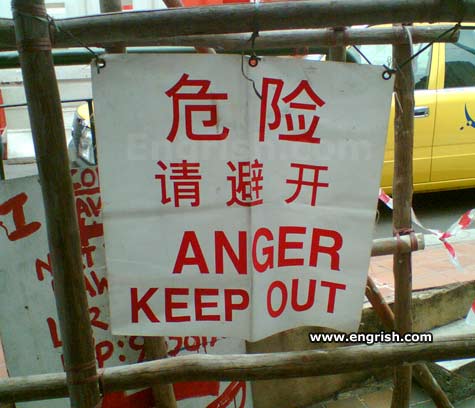
... and zen-like composure, I feel people should be warned that I am in a snit and finding fault with everyone and everything that I deem responsible for.... oh, well, for Everything That's Wrong With The World.
Engrish, ever at the ready, provides the graphic.

Maybe I'll print this out and put it on my notebook before the upcoming Liturgy Committee Meeting.

Achieving Liturgical Musical Literacy

You need to read the documents? A question, (or sales pitch? "But wait, there's more!")

You need to read the documents. A statement.

Okay, here's someone who knows the difference between engaging in a Music Ministry and a musical APOSTOLATE.*

I don't know who eft is, someone I met at a colloquium or class? someone from whom I took a class?
In any case, God bless him and prosper him in his work, (in His work.)

Here are the preparatory actions:

(*) go to your nearby office supply store and purchase
a 2-inch binder
a set of dividers (5 tabs to start, probably will need 15 or more)
a ream of paper (500 sheets)
a set of hilighters

(*) pick the language citation best suited to your needs, print the document, three-hole-punch, put into binder

Here is the challenge:

(*) read the documents in historical order (old to new)

(*) a document must be skim-read in one sitting
use a [highlighter] to place a mark [punctum?] at each music word (chant, sing, instrument, ...)
maybe use different colors for different words or purposes
(e.g., orange for ordinary-related [kyrie,gloria,...], purple for proper-related [introit/entrance,psalm,...])
the marks will help whenever you re-visit the document in the future

(*) visit this discussion and post your status and thoughts on the doc you just read

Here is the document list (so far):

1903-nov-22 Tra Le Sollicitudine

[English, no Vatican website translation]

1928-dec-20 Divini Cultus Sanctitatem

[Latin]
[English, no Vatican website translation]

1947-nov-20 Mediator Dei

[Latin]

[English]

1955-dec-25 Musicae Sacrae Disciplina


[English]

He will update this as time goes along.

I am not suggesting you take it so much as a challenge, but as a study method, particularly if you are at that moment of realizing, "Gee, golly, gosh almighty, why didn't anyone tell me that we don't have to keep re-inventing the wheel, er, I mean buying 'guides' to planning the liturgy, we don't need any one of the (Big :oD) Three Initialed Entities† that's a component of the LIC ‡ telling us the Church's mind on these matters, the Church has already told us Herself."

Because its all there.
(I have reformatted to "quicken" the links, and removed vernacular links other than English.)
The one suggestion I would make, is that if you can, is that besides printing yourself a hard copy, you leave them in an accessible electronic state, so that they are most readily searchable, for reference purposes.
And a word of warning -- you will discover that there are those who will not welcome your attempts to share any of newly-discovered truth with them.

Now sure, it may be because you are too zealous, that you have the excessive enthusisiam of the newby or convert; or because you are an unpleasant, and confrontational piece of work like me; or because you caught them on a bad day; or because there are extenuating circumstances that you don't know about.

But there are others whose resistence to the truth is less benign.
They don't wanna know, they don't care, they wish you would shut up and just program All Are Welcome; or even worse, they do know and don't care and have a stake, for whatever reason, in assuring that the knowledge you are acquiring does not become universal.

But I've seen enough Saturday morning cartoons to know that the Good Guys always win eventually.


* "A person is not a minister simply in performing a task, but through sacramental ordination."
† Hereinafter referred to as TIE.
‡ You know what that's short for, but I don't want to hurt anyone's feelings.

Sunday, 2 August 2009

Yeah, we got cable, so what?

Himself's "weekend" having commenced an hour or so ago, he suggested and I agreed and we opened a bottle.
And not Three-Buck Chuck this time, no, no.
What does Clos du Bois mean, anyhooo?
I am so much more accustomed to Carton du Bois. Or would that be Chateau boîte en carton?
Sum'n......
Anyway, can a wine really have mocha, berry and smoke flavors, all rolled into its onesome?
But in any case, it was delicious. Is delicious, I have a sip or two left.

It was not altogether a bad thing to waste money going up one level on our cable. (I admit that right off the bat, getting EWTN was a kick.)

We have heaps of movie channels, they appeared all of a sudden. Not premium, not freshly on cable and DVD, but recentish, and of the sort that don't often appear at our small town theater, or in the red boxes, (not that the most skin-flintish woman on earth would rent a DVD...)

But not being quite the addict that.... well, other adults, who live in the same house as I are, I don't keep track of what's on, so films I might have wished to see often surprise me when I come across them in mid-showing.
I caught part of Picasso, I'll look out for the rest, (I'd watch Anthony Hopkins doing his laundry....), but the real prize was Diving Bell and the Butterfly.

I'm trying to remember, I can't place any of Schnabel's (sp?) paintings, but I have this nagging memory that I hate them.

But then I know nothing about art.

Anyway, Diving Bell was moving, beautiful, witty, thought-provoking.... and my heart ached when Jean-Do, listening to the reviews began to, well -- not see out of his left eye.

Really lovely. Excellent movie.

To use the buzzword I most despise -- it was ever so uplifting.

So I'm going to stop sneering at the fact that we pay so much for cable, you know, because it wasn't my idea.

I'm going to stop.

No, really.

I'm going to try to be reasonable.
In fact, in general I'm going to try to be kind and nice to the people who have to deal with me, most especially, Himself.

Say a prayer for me, if you think of it.
Or rather, for the poor guy who puts up with me..

An Apologia, of sorts, Prelude to a Kvetch...

In my own defense, in light of what I just wrote, and in light of what I'm about to write, I wish to protest, that I do not go about looking for things to which to object at Mass.

If people are doing their best I am infinitely flexible and forgiving.
I don't electively attend liturgies that I know will set my teeth on edge.
I don't scour the internet for what I have read described as "liturgical porn."

But if they make no effort to be informed except 3rd or 4th hand, yet presume to instruct others, or if they present opinion as fact, they deserve censure; if redeemed from blasphemy only by their sheer wrong-headed ludicrousness objects or activities present themselves, and all but send up flares to get attention, they are fair game; and unique events, that are generally important, marred by absurd and individualistic approaches that were particularly arrived at?

Well, just give me a moment while I sharpen my tongue.

Anyway, I wasn't googling for an object of ridicule, I was googling for information, and came across a diocesan organ, quoting a diocesan director, of a diocesan office of worship, who.... well, either the reporter/editor is incompetent and inaccurate or this person does not know whereof he or she speaks, yet felt him- or her-self competent to teach the PIPs.

The new GIRM (when it was new,) was the subject, and the faithful of his or her diocese were at his or her mercy....

The most common concerns raised were exactly when to bow their heads after receiving Communion, and what to do about parishioners who insisted ...
[Hmmm... "insisted."
"Insisted"?
The word has an editorial effect, doncha think? but we won't blame the subject for the journalist's choice of word]

... on continuing practices like genuflecting after receiving Communion.

["What to do"? Why must anything be "done"? What's it to anyone else?]
People should bow their heads as they say "Amen" after having taken the host.

[What's the word I'm looking for? Oh, yeah, that's it -- "whaaaa?" They are to reverence the Christ's Body and Blood BEFORE they receive Him, not after. "The faithful are not permitted to take the consecrated bread or the sacred chalice by themselves...
When receiving Holy Communion, the communicant bows his or her head before the Sacrament as a gesture of reverence and receives the Body of the Lord from the minister."
See GIRM 160. The only possible reason I can imagine for disseminating such misinformation is that reversing the order, trying to make people pronounce their "amen" and execute their bow after they receive -- not "take" -- the Host, would discourage reception on the tongue.
It would also preclude utterly receiving under both species, except amongst Catholic ventriloquists.]


The director reports that one positive comment often heard in parishes that have already implemented the liturgical changes, is that people appreciate the periods of silence during Mass.
[In what sense are any silences required by the rubrics part of the "changes"? GIRM 1975 said, "Silence should be observed at the designated times as part of the celebration. Its function depends on the time it occurs in each part of the celebration. Thus at the penitential rite and again after the invitation to pray, all recollect themselves; at the conclusion of a reading or the homily, all meditate briefly on what has been heard; after communion, all praise God in silent prayer." The Vatican II instruction on Sacred Music told us that "at the proper times all should observe a reverent silence," back in the '60s.]
The director cites the General Instruction for the Roman Missal (the book that contains the order of the Mass), which says that "any semblance of individuality is to be shunned. We come together to form the body of Christ, and that should be our goal."
[Um, okay.... that may be a laudable goal, but the GIRM doesn't actually say that. The director apparently says that. And in fairness, at the time of this writing the dubium regarding the right of the faithful not to be forced or badgered to assume identical postures may not have been answered, or even asked yet. And finally:]
The list of changes includes longer periods of silence, notably, after the readings, homily and Communion; carrying the Book of the Gospels, not the lectionary in the entrance procession; the congregation's bowing from the waist during the Profession of Faith and when the priest genuflects after the Consecration; Catholics bowing their heads when Jesus' name is said and after receiving communion; and different directives on when to stand, sit or kneel. Singing is also emphasized.

Ummmm....? No.
Except for the singing, I think a case might be made that that was given greater emphasis in the latest GIRM, (although the word sing occurs with greater frequency in the previous General Instruction, a quick word count informs.)


But all the rest of that? the "changes", the new stuff?

Of long standing.

What's my point?
Besides exercising my body's kvetchoids and niggleceps?

That if you are in the position of instructing, either because you have chosen it or because it has been thrust upon you you have an obligation to be instructed first.
You have an obligation to get the real skinny on things, not just what you might have gleaned from skimming a hand out at a workshop facilitated by another such as yourself.

You have an obligation to go to sources, either human or print or electronic, but sources, primary sources.
And since very few dicastery muckie-mucks or congregation honchos have time for the likes of you or me, that means you READ THE DOCUMENTS.

Not a committee's take on the documents, not your chancery mate's recollection of what he read once upon a time, not the commercial church music publisher's handy-dandy-all-in-one-simple-to-read-pamphlet interpretation of the documents.

The documents.

All the pertinent ones are relatively comprehensible, and readily available, they needn't even cost you anything but your time.
There are wonderful people all over the interent who have graciously gathered the links you need.
Some have constructed searcheable databases.

The Vatican website is very generous with the authoritative documents, (albeit slow with the translations, sometimes.)

So if your job is to tell me what's in the documents, go read the dang documents.

Read the documents.

"In the name of, hey! how're ya doin'?"

When Himself has a gig, he often finds himself in different parishes, at different times for Sunday Liturgy.
He forgets how changed is his level of concentration when he is neither chanting/song leading, nor singing in a choir, and thus how much more easily he is distracted by occurrences, or rather practices to which he objects -- he came home absolutely livid over a jolly "let's all turn and say hello to our pew mates, and if you don't know them, ask their name, see how they're doing!" beginning to the Holy Sacrifice of the Mass.

I hope this isn't my fault.
I hope I am not infecting him with my too great a readiness to criticize, to nit-pick -- or even just to note idiosyncrasies -- or idiot-syncrasies?

It's not fair of me, he is much in general more generous-hearted and easier-going, (and more oblivious,) than I, but once having his back is up, it stays up, he cannot let go of things, so this will affect him more.

Am I remembering right, was it Mosebach who wrote something like, "the problem with the reformed Liturgy is that we are all positively obliged to talk about the liturgy now, we go to Mass to talk to God but come away theatre critics"?

See?
See what I've done, or at least am trying to do?
That's me all over, I never accept blame for anything.

Oh no, it can't be my griping that's at fault, it's the mucking around with the ritual that others presume to have the right to do, that's responsible.

Saturday, 1 August 2009

The Blessed Mother for Baptists

Interesting.
I've always thought that many Protestants actually betray their own sense of fidelity to Scripture when they bend over backwards to ignore the major female figure of the entire Bible.
Scholar says Baptists neglect lessons from Virgin Mary

A Latina theologian says overreaction to Catholic veneration of the Virgin Mary has caused Baptists to miss important biblical teaching associated with the mother of Jesus

Nora Lozano, associate professor of biblical and theological studies at Baptist University of the Americas, found potential liberation for women -- both Protestant and Catholic -- in Latin America and elsewhere by taking another look at the biblical story of Mary, Jesus' mother.

Lozano, a participant in theological conversations between the Baptist World Alliance and the Vatican, made the remarks in a presentation to the BWA Commission on Doctrine and Interchurch Cooperation at a meeting of global Baptists in the Netherlands.

She noted the Mexican story of the Virgin of Guadalupe -- a purported apparition of Mary to an indigenous peasant in Mexico City in the 16th century -- and how closely it ties the identity of the nation's Catholicism with Mary, who serves as a sort of "demi-goddess."

There are analogous Virgin Mary cults of devotion in other Latin American countries.

Lozano said Mexican Baptists and other Protestants, meanwhile, actively ignore Mary, to the extent of giving the biblical character short shrift.
"It seems that there is a consensus among these Baptists to disregard, neglect or reject the Virgin Mary," Lozano said...

Lozano said that embracing the "life-giving" aspects of Marian veneration can be both healthy for all women and a bridge between Latin American Protestants and Catholics, she contended.

Lozano pointed to two passages dealing with Mary in the Christmas story as recorded in Luke's Gospel: The angel's announcement to Mary that she would bear Christ (Luke 1:26-38), and Mary's song of praise to God, often called the Magnificat (Luke 1:46-55).

Mary is not a passive presence in those stories, Lozano pointed out, but an active and willing participant in God's work who was "well aware of social injustices," she said.

"She is subject with a strong will and a social consciousness," Lozano noted.
http://inlinethumb35.webshots.com/42786/2831782950053082619S600x600Q85.jpg

Fantasizing

No, don't worry, G-rated.
They're fantasies of how I would program for my parish, were I free to do what I think ought to be done.
But no, alas, the "G" does not stand for "Gregorian."
I laugh ruefully to myself when I read derisive comments directed at parish music programs that inflict yet another de angelis on the assembly, or contemptuous pleas, to please -- not limit yourselves to a single Gregorian credo.

If only!

They don't realize what a leap forward a single movement from a single Gregorian Ordinary would me for the vast majority of parishes at this point, and how little control is in even the most well-meaning musicians' hands, all too often.

But from where I am now, from where my parish is now, from where my volunteer musicians are now, there are things I would like to do, things we could do.
But there are... obstructions? Yes, le mot juste, for they, (the obstructions,) are very much like the wooden saw horse-shaped barricades one sees.

Any way, were there not....

My first positive change when I began here, (as opposed to the negative ones-- simply forbearing to program the worst, kitschiest, most theologically suspect of our parochal favorites, or at least, programming them less frequently,) was to do the appointed psalm from the lectionary.
Period.
Further, the most egregiously paraphrased contents of what the editors of Gather laughingly think constitutes a psalter were eliminated, and others less... creatively worded? were brought gradually in line with a licit translation, any licit translation. (A lot of this was nothing more than daring to use pronouns, of course.)
And over the course of several cycles, most of the musically silly verses were replaced with chanted verses, so the people were not deprived of beloved ditties, (such as, "If today you hear HIS voice?") for their response.

At the earliest Sunday Mass I finally convinced people that if we were going to sing hymns we really had to also sing the psalms and various acclamations.

I refused utterly to use settings of the "Mass" that were no such thing, that did not respect the integrity of the text of the Missal. Eliminated "tropes" from the Agnus Dei. Used only correctly arranged Gospel acclamations, with the correct verse. (These all had the other advantage of putting the kibosh on some of the silliest musical settings.)
But I cannot extend these strictures to school or youth Masses.

At funerals we sing the In Paradisum, and, despite funeral directors urging the bereaved to "pick their favorites," only psalms for the psalm -- no, "You are Near," or "Amazing Grace" after the OT reading.

For Advent, instead of the oddity of a silent procession, I persuaded TPTB to let us chant the Introit in English, and on the principle that it is easier to ask for forgiveness than permission began doing the same, at choir Masses only, during Lent.

I instructed the cantors to bow profoundly during the Creed, and at the elevations.
After five years it finally caught on with at least some other ministers; a bow of the head at the Holy Name is taking longer. (If this were done by all it would also force a more appropriate tempo for various Glorias, etc., but I am not holding out much hope there...)

And we are allowed to sing the Sequence, (albeit in English,) on Easter and Pentecost, though only at choir Masses.

From after the Gloria on Holy Thursday until the Gloria at the Paschal Vigil all instruments are silent, (except guitars, over which I do not have dominion,) and the actual Litany of Saints is chanted, as well as a simplified chanted setting of the Reproaches.

As a choir we sing two Gregorian propers, communions, a year, (though only after the assembly has sung the more vastly important Well-Loved Hymn or Carol,) and I have pretty much, (though not entirely,) won the choir over to thinking that a setting of the proper or an anthem that approximates the propers is a more appropriate choice than Old Favorites.

But that is it.

I can go no further. (And we've even gone backwards in a few minor details, additional intrusive announcements, for instance.)

And it's a shame, because we, as a parish, as musicians, are capable of much more.

But either I have tried and been quashed, or know not to try the greater when the lesser has already been forbidden.

I do not foresee anything, opening up any possibilities for a greater liturgical maturity.

I don't think it's laziness on my part.
Not that I'm not plenty lazy, but I'm also pretty cheerfully confrontational, so if there were any chance of succeeding at anything, (beyond the aggravating of Father's ulcer....) I'd go for it.

But there's nothing.

Except dreams.

And oh, can I dream!

http://medusaeyes.com/blog/wp-content/uploads/2006/10/dreams.jpg

"Lifted Up Between Heaven and Earth"

A lovely reflection on the elevation by Fr Ray Blake at the St Mary Magdalen blog.

As a young Protestant child taught "Divinity", as my school pretentiously called "RE", by a Methodist minister, I was taught that one of the main differences between the Protestant communion service and that "Romish fable" the Mass was the elevation. We weren't taught in a bitter polemical way but merely presented with historical facts. Indeed, I became intrigued by the tremendously high, and difficult to comprehend Catholic notion of transubstantiation.

So, the first time I went to Mass I was fascinated by the elevation and what it signified: notions of being "lifted up", being "between heaven and earth"; ideas of the exaltion on the Cross or Ascension, the lowering of the host too evoked ideas of Incarnation, kinosis, descent into hell. I remember being a little shocked by reading the rubric in the GIRM, which merely said, "the priest shows the host to the people". What was the cause of so much division between Catholic and Protestant for centuries, seemed to be about merely saying "look". All that talk about the "gaze that saves", those recussant cries at illegal, secret Masses of "hold, sir priest" became reduced to a merely practical showing of the consecrated elements.

Obviously any reading of the connection between the "elevation" and "Corpus Christi" devotion would indicate our forefathers understood a deeper connection, the Protestant hatred and elimination of the "elevation" too, indicates more than a utilitarian presentation for viewing.

The Bugnini rubric allows a great deal of interpretation of "shows the people", from the casual one-handed elevation, an elevation just a few inches above the corporal, the elevation of the pale host against the equally pale face of the celebrant, so actually nothing is seen, to the abrogation by simple priests of the papal prerogative of elevation to the cardinal points of the compass.
Despite participating in a great deal of dysliturgy, I had never encountered the casual one-handed elevation he rightly deprecates until recently.

And now I've seen such carelessness several times in short order.

O the times, O the mores...

And O God, thank you for such priests as Fr Blake. (I don't think I knew until this that he was a convert. Interesting, interesting...)