

One of your better known Catholic "composers" feels pretty strong that we ought to move beyond singing an occasional "token" song in a different language.
He accuses himself of ignoring liturgical music published under such headings such as “Hispanic,” “Latino,” “African American,” or “Vietnamese,” partly because he is "not adept in any of these languages."
I believe there are parishes that actually invite this guy to give workshops...
We all know that Dan Quayle didn't really say that he couldn't understand the people of Latin America because he didnt study Latin, so I'm going to assume this was just an editing error, and this liturgist/musician doesn't really think that some language other than English, (the one in which he wrote his essay, so I'm pretty sure he's somewhat "adept at it,) that African Americans speak.
Interestingly, though, the reader is left with the impression that he sees no reason at all that congregations should not sing and pray and hear scripture in a language the majority of them don't understand.
Sound like he and the SSPX are on the same page there....
But what in the name Monty Python does "embrace a new chapter of infusion and interconnectedness in our worship" mean?
That's one language I HATE:
FacilitatorSpeak.
Universalis, your very own breviary in pixels...

Sunday, 15 November 2009


What is this place?
Is it a place made by God, a mystery beyond measuring and beyond reproach?
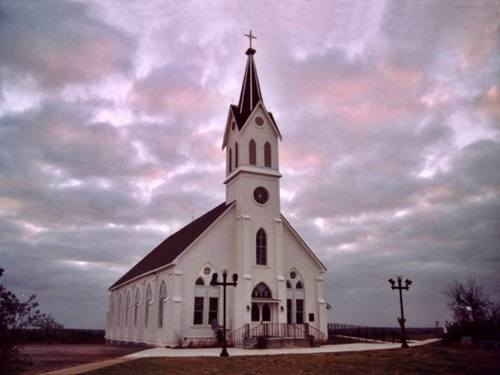
Or is it only a house, the earth its floor? walls and a roof sheltering people, windows for light, an open door?
Does it become a holy place, a sign of grace, a sacrament, a mystery only "when we are gathered here, and know" .... something?
Is it only when we are there to "know God is near" that it acquires some stature beyond that of any other conglomeration of bricks and beams?
The latter take on it is the one that, judging by their behavior within it's confines, most erstwhile Catholics whom I encounter actually espouse.
But the former is the only one possible for anyone who believes in Christ's Eucharistic Presence within the tabernacle.
What is this place where we meet?
And will our demeanor and attitude when we are here give evidence to the unbeliever that we actually believe what we claim to believe?
Or is it only a house, the earth its floor? walls and a roof sheltering people, windows for light, an open door?
Does it become a holy place, a sign of grace, a sacrament, a mystery only "when we are gathered here, and know" .... something?
Is it only when we are there to "know God is near" that it acquires some stature beyond that of any other conglomeration of bricks and beams?
The latter take on it is the one that, judging by their behavior within it's confines, most erstwhile Catholics whom I encounter actually espouse.
But the former is the only one possible for anyone who believes in Christ's Eucharistic Presence within the tabernacle.
What is this place where we meet?
And will our demeanor and attitude when we are here give evidence to the unbeliever that we actually believe what we claim to believe?
Heading Back to Conservatory...
... to get me one o' these (not):
And also that, speaking as a Catholic, I feel that Minnesota already had a lot to answer for in music...
McNally Smith College of Music is proud to announce a new three semester Diploma program dedicated to hip-hop studies.I am reminded suddenly, that a friend from college, basically a budding opera coach, applied for some major music grant "to study with the great page turners of Europe."Our new Diploma program in Hip-Hop Studies is for prospective students who want to explore and develop in a cross-departmental curriculum that covers music, recording technology, language, music history, and music business. [What? no marksmanship?]
You’ll get hands-on technical training on recording and mixing music in a studio. You’ll take part in a three-course history sequence that grounds hip-hop in its cultural origins. You’ll learn the fundamentals of language through creative writing and performance. You will take part in a hands on introduction to deejay techniques and hip-hop music production
And also that, speaking as a Catholic, I feel that Minnesota already had a lot to answer for in music...
Thursday, 12 November 2009
The "U" Word
As Mother Church prepares to welcome (at least a few) poping Anglicans, the parallels with Byzantine Rite Catholicism, and the situation our Eastern Brethren once faced has been noted by more than once commentator.
At one time I lurked for a bit on a newsgroup or board about equally divided between Roman and Byzanine Catholic. (Well, actually the latter made up only about a third of the denizens, but a single Ruthenian seemed responsible for half of the posts all on his lonesome....)
I read more than one flame war begun by arguments over the word "uniate."
Some used the word without affect, of themselves, while others, of both rites, acted as if "uniate" was the ecclesialogical equivalent of... nope, I can't bring myself to type it, or rather, can't steal myself for the reactions using the word "n*****" might earn me.
But let me just say that some were rabid.
Anyway, "uniate" has been used in some of the discussion I've read, certainly in blogs, and even in the MSM, IIRC.
It appeared on description cards for works in an exhibit at one of the top five museums in the nation, that I attended.
So am I correct that the war of that word has been fought and an armistice achieved?
That the word "uniate" is right and proper? (It seems such an excellent and precise descriptor.)
Kind of like the quondam insult "methodist" proudly taken up by those who were the word's intended target?
Or did it go the other way, like "whore," where the corruption of a euphemism acquired the power of the word it use sought to avoid?
Or is it only objectionable applied to members of the Eastern Churches, and just hunky-dory for former Anglicans?
Or is it like "scotch" permissible when applied to a thing but not a person?
In any case, ut unum sint.
Hmmm, now that I think of it, is "poping" a rude word? even when used by such an unabashed papist, not to say papolater, as myself?
At one time I lurked for a bit on a newsgroup or board about equally divided between Roman and Byzanine Catholic. (Well, actually the latter made up only about a third of the denizens, but a single Ruthenian seemed responsible for half of the posts all on his lonesome....)
I read more than one flame war begun by arguments over the word "uniate."
Some used the word without affect, of themselves, while others, of both rites, acted as if "uniate" was the ecclesialogical equivalent of... nope, I can't bring myself to type it, or rather, can't steal myself for the reactions using the word "n*****" might earn me.
But let me just say that some were rabid.
Anyway, "uniate" has been used in some of the discussion I've read, certainly in blogs, and even in the MSM, IIRC.
It appeared on description cards for works in an exhibit at one of the top five museums in the nation, that I attended.
So am I correct that the war of that word has been fought and an armistice achieved?
That the word "uniate" is right and proper? (It seems such an excellent and precise descriptor.)
Kind of like the quondam insult "methodist" proudly taken up by those who were the word's intended target?
Or did it go the other way, like "whore," where the corruption of a euphemism acquired the power of the word it use sought to avoid?
Or is it only objectionable applied to members of the Eastern Churches, and just hunky-dory for former Anglicans?
Or is it like "scotch" permissible when applied to a thing but not a person?
In any case, ut unum sint.
Hmmm, now that I think of it, is "poping" a rude word? even when used by such an unabashed papist, not to say papolater, as myself?
Wednesday, 11 November 2009
Flattering...
I hope the fellow got an "A."From a blog combox:
I used the theme of ‘save the liturgy, save the world’ for one of my major essays in my theology course this semester! (It was for a Christian spirituality course – I wrote the paper on St John Vianney and the Mass.)
Comment by BLC — 10 November 2009
Tuesday, 10 November 2009
Interesting point
A friend of Fr Ray Blake's pointed out to him:
The poor widow gave away her last two mites to the Temple treasury, not to the poor; to support the worship of God not to alleviate someone else's need.
"Reclaiming the Treasure"
NCR has a very good piece on the Stonehill Symposium of late last year, and what part it may have played in the timing and focus of the Vatican interventions in American communities of religious sisters.
What is NOT so good?... the level of animus displayed in the combox.
Hatred of the Vatican. Hatred of feminists. Hatred of men. Hatred of obedience. Hatred of the Second Vatican Council.
(Incidentally can we declare a moratorium on the word "flip-flop" which seems to have devolved to mean, "stopped agreeing with me"? in the combox an obedient sister is accused of "flip-flopping" on the question of the ordination of women. Aren't people supposed to grow? aren't their opinions and judgment supposed to evolve? did anyone of her supporters note that the.... um, well-known Sister Laurie Brink seemed to have "flip-flopped" on the Church, and "even [on] Jesus"?)
Anyway, courtesy of Whispers in the Loggia, here is Sr Sara Butler's address from the symposium, (what was Rocco trying to say by calling Cardinal Rode the "Religious CZAR," do you think?
(This is just some snippets, read the entire address at Whispers.)
What is NOT so good?... the level of animus displayed in the combox.
Hatred of the Vatican. Hatred of feminists. Hatred of men. Hatred of obedience. Hatred of the Second Vatican Council.
(Incidentally can we declare a moratorium on the word "flip-flop" which seems to have devolved to mean, "stopped agreeing with me"? in the combox an obedient sister is accused of "flip-flopping" on the question of the ordination of women. Aren't people supposed to grow? aren't their opinions and judgment supposed to evolve? did anyone of her supporters note that the.... um, well-known Sister Laurie Brink seemed to have "flip-flopped" on the Church, and "even [on] Jesus"?)
Anyway, courtesy of Whispers in the Loggia, here is Sr Sara Butler's address from the symposium, (what was Rocco trying to say by calling Cardinal Rode the "Religious CZAR," do you think?
(This is just some snippets, read the entire address at Whispers.)
Religious life belongs unquestionably to the life and holiness of the Church, although it is a “charismatic” rather than a “structural” element; one could even say it is an essential expression of that holiness.
It is a gift by which God the Father through the Holy Spirit animates and refreshes the Church with an outpouring of grace that calls forth communities distinguished by their courageous faith, steadfast hope, and passionate love for Jesus Christ and the world he came to save.
Consecrated religious have a place in the heart of the Church because, by leaving all to follow Christ, they announce with their whole lives that God has made us for himself and our hearts are restless until they rest in him.
We who accept the vocation to religious life make profession of the poverty, chastity, and obedience of Jesus Christ “freely, willingly, and purely for the love of God.” In fact, our freedom must be assured; our vows are invalid if we have been subject to any alien pressure. We ask to be admitted to public vows in response to a deep personal experience of being loved and chosen, and in the light of a strong attraction to the charism of a particular institute. This impulse to “sell everything” to buy the field in which we have found the “treasure” (Matthew 13:44) is from the Holy Spirit. If our request is accepted, we commit ourselves to observe the evangelical counsels, to live in community, and to carry out a particular mission in the name of the Church—according to the charism and constitution of our institute. Because our witness arises from a free personal gift of self, lived according to a way of holiness approved by the Church, it possesses moral authority—the kind of authority, in fact, that is indispensable for transmitting the faith and accomplishing the Church’s mission.
We are here to reflect on our vocation. Most of us are aware that all is not well, that something has been lost and must be reclaimed.
What is this “treasure” that needs to be reclaimed?
The problem is not only that so few are joining our ranks. It is that the current polarization and division in the Church at large is found among us as well. It exists in the uneasy and even fractured relationships among our apostolic institutes, within many of our institutes, and—for many—in the relationships of religious with the diocesan clergy, the bishops, and the Holy See.
The reality of this polarization is more than regrettable; it is a cause of scandal, a counter-sign.
Our way of life was born from the ardent desire to reproduce the apostolic ideal in which “the company of those who believed was of one heart and one soul,…had everything in common, [and] devoted themselves to the apostles’ teaching and fellowship, to the breaking of the bread and the prayers” (Acts 4:35; 2:42)......
Spiritual Renewal according to the Founding Charism
There was one more challenge the Council put to apostolic religious, namely, the challenge to spiritual renewal according to the Gospel, the legacy or charism of the founder(s), and the authentic traditions of each institute. We may have taken this up years ago, but perhaps the only way to reclaim the treasure now is to return to that task with fresh vigor and determination. If we want to regain the moral authority once enjoyed by apostolic religious, if we long for that “full participation” in the Church’s life which is identical with holiness, the perfection of charity, let us “start afresh from Christ” and from the charism of our founders, free of “politically correct” considerations. Why did our founders request canonical status? What is the ideal that attracted us to this institute? How faithfully are we expressing it? What is it our institute continues to offer the Church today?
Let us study, along with our founding stories and documents, the many exhortations addressed to apostolic religious by the Holy See—from Perfectae caritatis to the most recent instruction on Authority and Obedience. Let us really study them, and use them for individual and communal self-examination. Are we still willing? Do we still desire to profess the poverty, chastity, and obedience of Jesus Christ “freely, willingly, and purely for the love of God”? Shall we help each other to do this?
The “treasure” many of us would like to reclaim, perhaps, is the possibility of living the religious life fully, in peace, according to the charism of our communities, in communion with the hierarchy and collaboration with the laity, that is, according to the ecclesiology of communion, “one in heart and soul” with the Church. Beyond that, the “treasure” might be the confidence that our consecration makes a difference; that we belong to Christ and to his Church in and through the mediation of our religious institute, and that our charism and mission are valued by others in the Church—laity and hierarchy—as a gift of the Holy Spirit. We would like to get beyond the stress of being suspicious and being under suspicion, and enter into a realm where we are recognized as a resource, where we are needed and wanted, where we can make a corporate impact through ministerial service that is coordinated with or supplements diocesan plans.
Those of us who choose to remain, and who embrace the obligation to live the religious life as the Holy See defines it, long for the rebirth of relationships in which our place in the Church is clear and unambiguous, and in which we can ask of one another the witness of holiness according to the nature, purpose, and spirit of our institutes. We desire to develop apostolic initiatives that will allow us to live and work together so that our efforts will build up the Church, give striking witness to her mission, and attract vocations so that our charism will continue to be a gift to the Church. Let us keep our eyes on the “treasure.” Let us renew our willingness to “sell everything” to possess it.
Seeking Advice on "Monastery Gifts"
In giving little gifts at Christmas time I would like to spend my money where it will benefit causes and concerns in which I believe. (I mean, I like Target and all, but I'd rather, say, The Rosary Shrine get what little lucre I have to spend.)

Generally, the recipients are of an age when consumables are best, (either because they are middle aged and have everything they need, or young and living in tight quarters.)
I have given people the Parish Book of Chant and the Adoremus Hymnal in the past, and St John Cantius CDs were found under many a Christmas tree over the past two years.
But this year I'd like to stick with edibles, or other consumables.
So, Mystic Monk Coffee, I know about, and practically having grown up in then nuns' back yard, everyone in my family already is familiar with the treasures of the Dominicans of Summit gift shop.
But not everyone drinks coffee, and you can't give someone soap every year or they'll start to think there's an ulterior motive.
And, this is going to sound odd, but if I am contributing in any way to a religious community, I want to know that they are not, well... whackjobs.
Anyone know about Genesee Abbey? The cakes look wonderful, but does anyone know anything about the monks? Are there practices orthodox and their cakes delish?
How about candy?
Anyone care to recommend some good, solid bunch of nuns who make chocolates?
Generally, the recipients are of an age when consumables are best, (either because they are middle aged and have everything they need, or young and living in tight quarters.)
I have given people the Parish Book of Chant and the Adoremus Hymnal in the past, and St John Cantius CDs were found under many a Christmas tree over the past two years.
But this year I'd like to stick with edibles, or other consumables.
So, Mystic Monk Coffee, I know about, and practically having grown up in then nuns' back yard, everyone in my family already is familiar with the treasures of the Dominicans of Summit gift shop.
But not everyone drinks coffee, and you can't give someone soap every year or they'll start to think there's an ulterior motive.
And, this is going to sound odd, but if I am contributing in any way to a religious community, I want to know that they are not, well... whackjobs.
Anyone know about Genesee Abbey? The cakes look wonderful, but does anyone know anything about the monks? Are there practices orthodox and their cakes delish?
. 
How about candy?
Anyone care to recommend some good, solid bunch of nuns who make chocolates?
Monday, 9 November 2009
Cartoonist Needed
The investigation of US Catholic religious sisters has inspried me with a wish to draw.
But I can't draw... well, I can draw, pretty well actually, but I can't cartoon, and I think someone needs to do a cartoon, of religious sisters... of a certain age? clad as might be expected, perhaps caught in a moment immediately post-terpsichorean? confronted by a circle of sad, serious, habitted sisters and other Catholic officials with looks of kindly consternation on their faces, speaking the language of the intervention: We love you, and don't want to lose you, you have to get help.
Because that is the real context of these investigations -- family and friends seeing communities with an addiction to secular values, vocations anorexia, spiritual unhealthiness, and wanting, NEEDING to help before its too late.
But I can't draw... well, I can draw, pretty well actually, but I can't cartoon, and I think someone needs to do a cartoon, of religious sisters... of a certain age? clad as might be expected, perhaps caught in a moment immediately post-terpsichorean? confronted by a circle of sad, serious, habitted sisters and other Catholic officials with looks of kindly consternation on their faces, speaking the language of the intervention: We love you, and don't want to lose you, you have to get help.
Because that is the real context of these investigations -- family and friends seeing communities with an addiction to secular values, vocations anorexia, spiritual unhealthiness, and wanting, NEEDING to help before its too late.
How very dependant on your point of view your.... well, your point of view is
Today the apostolic constitution Anglicanorum Coetibus was released by the Vatican.
When the special structure for Anglicans who wished to enjoy full communion with the Church was announced in mid-October, it was made clear that an apostolic constitution, which would, (juridically, I believe,) detail the new structure was undergoing revisions but would be published within the next fews weeks.
So today the document appeared, and why does the religion writer for the Paper of Record think it was published?
Only someone so self-centered as to be unable to imagine that the Catholic Church's "aims" could possibly differ from his own.
Yeah, the Pope must have decided to do what he had already announced he would do several weeks ago because of the way I and my colleagues have gotten our knickers in a twist over it all since then, by focusing on what is among the least important aspects of the whole magilla, and, readily available facts to the contrary, insisting we knew the real reason the decision had been made in the first place.
Yeah, that's it.
When the special structure for Anglicans who wished to enjoy full communion with the Church was announced in mid-October, it was made clear that an apostolic constitution, which would, (juridically, I believe,) detail the new structure was undergoing revisions but would be published within the next fews weeks.
So today the document appeared, and why does the religion writer for the Paper of Record think it was published?
The announcement seemed aimed at dampening recent debate about whether in creating a new Anglican rite within the Roman Catholic Church, the Vatican had brought in a kind of Trojan horse — married former Anglican clergy — a practice that might someday normalize the acceptance of married Catholic priests.To WHOM would it seem so?
Only someone so self-centered as to be unable to imagine that the Catholic Church's "aims" could possibly differ from his own.
Yeah, the Pope must have decided to do what he had already announced he would do several weeks ago because of the way I and my colleagues have gotten our knickers in a twist over it all since then, by focusing on what is among the least important aspects of the whole magilla, and, readily available facts to the contrary, insisting we knew the real reason the decision had been made in the first place.
Yeah, that's it.
Sunday, 8 November 2009
Go, or don't go if you don't wanna, the Mass is ended, but feel free to stay and make some noise
Today was not a good day for me to read this, a plea, or at least a suggestion that Catholics not hightail it out of church before the postlude.
Really?
I can only dream of having the congregation leave.
The rudeness, the noise level is not to be believed.
And I don't mean to me, (although I feel bad for the choir,) I couldn't care less whether people listen to me play.
I refer to the disrespectful and irreverent demeanor in the Presence of the Blessed Sacrament, in God's holy tmeple.
The Bow-tied One offers that "it would only take one or two announcements in the homily to make the difference."
Ah, well, first it would take the homilist thinking that respectful silence was a good thing, or at least a better thing than never risking alienating parishioners by admonishing them, however gently.
And he himself would have to be a practitioner.
Once this weekend I was aware of extremely loud laughing and talking, (and by "aware", I mean I could hear and understand every word of the joke being told,) while I finished up, (half a verse of the final hymn and 35 seconds of organ voluntary.)
I went down stairs and whispered to the priest in the vestibule that I though his mic' was still on.
"Yes, probably," he waved me off nonchalantly and continued his conversation.
And that was the quiet Mass, not the one that had me contemplating how suitable the Missa Sousa would be for this bunch.
Really?
I can only dream of having the congregation leave.
The rudeness, the noise level is not to be believed.
And I don't mean to me, (although I feel bad for the choir,) I couldn't care less whether people listen to me play.
I refer to the disrespectful and irreverent demeanor in the Presence of the Blessed Sacrament, in God's holy tmeple.
The Bow-tied One offers that "it would only take one or two announcements in the homily to make the difference."
Ah, well, first it would take the homilist thinking that respectful silence was a good thing, or at least a better thing than never risking alienating parishioners by admonishing them, however gently.
And he himself would have to be a practitioner.
Once this weekend I was aware of extremely loud laughing and talking, (and by "aware", I mean I could hear and understand every word of the joke being told,) while I finished up, (half a verse of the final hymn and 35 seconds of organ voluntary.)
I went down stairs and whispered to the priest in the vestibule that I though his mic' was still on.
"Yes, probably," he waved me off nonchalantly and continued his conversation.
And that was the quiet Mass, not the one that had me contemplating how suitable the Missa Sousa would be for this bunch.
Letter to the Editor
Part of a letter, from a formerly Anglican priest, that ran in the N Y Times last week:
Nice to have someone who actually made the jump testify to the reasons driving the decision, (even if they aren't the sexy ones the paper wanted to use as the peg on which to hang their story.)
[The Time] describes Anglicans attracted to Rome as being against women’s and homosexual ordinations.It is so easy to caricature positions with which one disagrees by pretending that the straw that broke the camel's back was the entire load, and sound bite journalism will always go for the glib half-truth.
But this does not describe the real motivation for why priests like me reconcile with the Roman Catholic Church.
The main issue is the fact that the Anglican Church has no consistent doctrinal authority and often acts independently from the historical positions of the universal church.
In light of this, the ordination of women and practicing homosexuals is merely symptomatic of much more fundamental problems
Nice to have someone who actually made the jump testify to the reasons driving the decision, (even if they aren't the sexy ones the paper wanted to use as the peg on which to hang their story.)
Small Victories
Catholics actually banded together to help acheive something that is actually consistent with Catholicism.
Pelosi, the first woman speaker and an ardent defender of abortion rights, had no choice but to do the unthinkable. To save the health care bill she had to give in to abortion opponents in her party and allow them to propose tight restrictions barring any insurance plan that is purchased with government subsidies from covering abortions.
The restrictions were necessary to win support for the overall bill from abortion opponents who threatened to scuttle the health care overhaul.
The results of that fight, waged heavily over two days, were evident as one liberal Democrat after another denounced the health care plan because of abortion restrictions, even though they were likely to hold their noses in the end and vote for the bill itself....
The fight over abortion foreshadows difficult soul searching in the months ahead as Democratic lawmakers confront deepening divisions among their caucus on issues like abortion rights and gun control.
Through the 1980s, the Democrats struggled over abortion. But by the 1990s, the share of Americans supportive of abortion rights had grown. Democrats lost their majorities for 12 years, leaving the most liberal and pro-abortion rights members in office. As a result it seemed to fade as a public issue. Now, however, Democrats once again have a large and diverse House majority, with more members from conservative-leaning districts where anti-abortion rights groups are active....
The sensitivity around the abortion fight — and the likelihood that it would not disappear from the health care debate — was evident from the start of floor proceedings on the health care bill on Saturday.
And it was part of the drama outside the Capitol as well. Roughly 300 protesters who rallied against the health care bill included a number of anti-abortion demonstrators with large placards showing grisly photos identified as aborted fetuses. Inside the building, House Democratic leaders had hoped to spend the day rallying their members around a historic vote. ...
Instead, Ms. Pelosi found her caucus caught up in the fierce dispute over abortion.
First, Ms. Pelosi met with leaders of the Pro-Choice Caucus, then she huddled with staff members from the bishops conferences, and with Mr. Stupak and two other leading Roman Catholic lawmakers, Representative Mike Doyle, Democrat of Pennsylvania, and Representative Brad Ellsworth, Democrat of Indiana.
The representatives of the nation’s bishops made clear they would fight the bill if there were not restrictions on abortion. In an extraordinary effort over the last 10 days, the bishops conference told priests across the country to talk about the legislation in church, mobilizing parishioners to contact Congress and to pray for the success of anti-abortion amendments.
The bishops sent out information to be “announced at all Masses” and included in parish bulletins, and urged priests and parishioners to tell House members: “Please support the Stupak Amendment that addresses essential pro-life concerns.” They added: “If these serious concerns are not addressed, the final bill should be opposed.”
In the end the abortion opponents had the votes, and Ms. Pelosi yielded, allowing Mr. Stupak to offer his amendment.
Wednesday, 4 November 2009
All God's Children Got "Special Anxieties"
The California bishops passed a resolution affirming... er, thanking... well, maybe supporting...
What does "supporting" mean -- agreeing with? siding with? providing coffee and blankets?
It could mean so many things, it may end up meaning nothing.
Um, yes.
And that relates to what members of those orders as they exist today are doing, exactly how?
I was pretty sure we don't hold people responsible for what their predecessors did, for good or ill.
What does "supporting" mean -- agreeing with? siding with? providing coffee and blankets?
It could mean so many things, it may end up meaning nothing.
The California bishops voted last week to pass a statement of support on behalf of U.S. women religious who are facing a Vatican investigation....
In the letter addressed “Dear Sisters” the cardinal writes:
“We are all aware of the special anxieties which surround our women religious these days,” wrote Mahony, “and I am writing to offer you my prayers of gratitude and my support for all of your members. The bishops of California met last week and passed a statement of support for all of you, and I am pleased to send a copy of that statement to you.”
He praises “the historical presence” of women religious in California beginning back in the 1800s. “I can honestly state that there would not exist our Catholic schools, hospitals, and social service outreach apostolates without you.”
The cardinal goes on to write that women religious in Los Angeles “opened the first hospital, established the first schools, and provided the first social services to those most in need.” He added that our “church’s history of outreach after the example of Jesus Christ and the Gospels would not exist today without your initiatives and creativity.”
Um, yes.
And that relates to what members of those orders as they exist today are doing, exactly how?
I was pretty sure we don't hold people responsible for what their predecessors did, for good or ill.
...then they came for the crucifixes?
I can not, of course, fully understand comprehend the manner in, and the the degree to which Christianity is part of the national psyche of Italy, but the outrage over a European court ruling against crucifixes in Italian schoolrooms seems genuine, principled and possibly useful, if it stirs Europeans Christians to deeper consideration of, and a resolve to strengthen their identity as, a society, a civilization whose roots are Christian.
I feel something of the sort in the American experience of Catholicism. Our nation's birth being so different, its experience of religions has been different, but I don't think it can be argued that while various branches of Christianity had more to do with our founding than secularists would like to admit, the Catholic Church has always been Other.
And the less Other it becomes, the less Catholic it becomes.
Sometimes Catholics have done it to themselves, so eager to kiss the the hindquarters of various goddesses: Prosperity, Political Power, Fame, Popularity...no, no, I'm just like one of you, I don't take orders from a foreign power, I don't let my club membership in the Catholic Club affect my judgement or opinions, I don't need time off on a Thursday to go to Mass, I don't need to forfeit the game on Sunday morning, I don't snap mackerel....
And sometimes it's done to us -- no, you can't say that at graduation, run an adoption agency that way, have a permit for that gathering, expect us to change the date for you, refuse to sell that, ....
I wonder at the locus of the tipping point, exactly when do we notice and protest? (Niemöller would know how to word the answer memorably.)
We so casually allow "superfluities" to be whittled away, picked away, bargained away.
Bit by tiny bit we acquiesce to the removal of what we might once have unquestioningly held to be an essential part of ourselves, but now seems mere ornamentation...
What a surprise, to sit in the chair at the salon, expecting a little trim to update our look, and in place of the hairdresser with his little scissors see the headsman approaching with his axe.
I feel something of the sort in the American experience of Catholicism. Our nation's birth being so different, its experience of religions has been different, but I don't think it can be argued that while various branches of Christianity had more to do with our founding than secularists would like to admit, the Catholic Church has always been Other.
And the less Other it becomes, the less Catholic it becomes.
Sometimes Catholics have done it to themselves, so eager to kiss the the hindquarters of various goddesses: Prosperity, Political Power, Fame, Popularity...no, no, I'm just like one of you, I don't take orders from a foreign power, I don't let my club membership in the Catholic Club affect my judgement or opinions, I don't need time off on a Thursday to go to Mass, I don't need to forfeit the game on Sunday morning, I don't snap mackerel....
And sometimes it's done to us -- no, you can't say that at graduation, run an adoption agency that way, have a permit for that gathering, expect us to change the date for you, refuse to sell that, ....
I wonder at the locus of the tipping point, exactly when do we notice and protest? (Niemöller would know how to word the answer memorably.)
We so casually allow "superfluities" to be whittled away, picked away, bargained away.
Bit by tiny bit we acquiesce to the removal of what we might once have unquestioningly held to be an essential part of ourselves, but now seems mere ornamentation...
What a surprise, to sit in the chair at the salon, expecting a little trim to update our look, and in place of the hairdresser with his little scissors see the headsman approaching with his axe.
There's a Valid Reason for Attacks Against the OHC & A Church
Archbishop Dolan of New York blogs on the anything-but-even-handed manner in which the New York Times "reports" and opines on Catholicism.
He correctly names the "selective" outrage, and correctly declares that Orthodox Judaism, Islam, historically Black protestant denoms, etc. would never be subjected to such lop-sided scrutiny, and even, at times, such sheer, malicious, meretricious ugliness as the Catholic Church has been.
But there is a reason, Your Excellency.
Good people in search of the truth, and evil people in the employ, (whether they know he's their employer or not,) of the Enemy -- they all have good reason to focus on the Catholic Church.
Catholicism matters.
And it matters in a way that no other belief system does, or can.
He correctly names the "selective" outrage, and correctly declares that Orthodox Judaism, Islam, historically Black protestant denoms, etc. would never be subjected to such lop-sided scrutiny, and even, at times, such sheer, malicious, meretricious ugliness as the Catholic Church has been.
But there is a reason, Your Excellency.
Good people in search of the truth, and evil people in the employ, (whether they know he's their employer or not,) of the Enemy -- they all have good reason to focus on the Catholic Church.
Catholicism matters.
And it matters in a way that no other belief system does, or can.
Monday, 2 November 2009
All Souls
St John Cantius was packed, overflowing really, for the All Souls Mass, Extraordinary Form..
Fr Regis Barwig (sp?) was a stirring homilist.
He had a lovely point about how death is "passing over" not "passing on", and how in this life, music, (referencing the Mozart Requiem sung and played so well,) being the vehicle that helps us "pass over" into the presence of God.
I was there early, (went to Vespers, which reminds me, there was a marvelous hymn, have to look it up in the Hymnal 1940 tmw,) and shortly before Mass began I found myself surrounded by four or five dozen students from Notre Dame. There were also college groups from Wisconsin, and seminarians from Mundelein. Many large families with tiny but wellish behaved children...
So encouraging.
In the year since my brother died, it had somehow never occurred to me before, but as the Barber Adagio for Strings sounded after Mass, (it was played at my Father's funeral when I was a kid,) it struck me that they, he and my Father, were together.
And I though of a very sentimental poem I had heard recited once, where Christ, when He descends to the dead is greeted by one soul -- "How's Your Mother, Son?"
And I wept uncontrollably.
I'm glad I chose to spend the day as I did, I have great hope.
I wondered, would the Canons Regular, or any other Roman Catholic priests, for that matter, be entitled to celebrate the Anglican Use Rite? (probably not the correct terminology...)
Sadly, I am possessed of neither the equipment nor the skills, did not take, and cannot send, photos to TNLM of the black velvet shrouded catafalque and the orange-gold candles...
Fr Regis Barwig (sp?) was a stirring homilist.
He had a lovely point about how death is "passing over" not "passing on", and how in this life, music, (referencing the Mozart Requiem sung and played so well,) being the vehicle that helps us "pass over" into the presence of God.
I was there early, (went to Vespers, which reminds me, there was a marvelous hymn, have to look it up in the Hymnal 1940 tmw,) and shortly before Mass began I found myself surrounded by four or five dozen students from Notre Dame. There were also college groups from Wisconsin, and seminarians from Mundelein. Many large families with tiny but wellish behaved children...
So encouraging.
In the year since my brother died, it had somehow never occurred to me before, but as the Barber Adagio for Strings sounded after Mass, (it was played at my Father's funeral when I was a kid,) it struck me that they, he and my Father, were together.
And I though of a very sentimental poem I had heard recited once, where Christ, when He descends to the dead is greeted by one soul -- "How's Your Mother, Son?"
And I wept uncontrollably.
I'm glad I chose to spend the day as I did, I have great hope.
I wondered, would the Canons Regular, or any other Roman Catholic priests, for that matter, be entitled to celebrate the Anglican Use Rite? (probably not the correct terminology...)
Sadly, I am possessed of neither the equipment nor the skills, did not take, and cannot send, photos to TNLM of the black velvet shrouded catafalque and the orange-gold candles...
"Let us die with Christ, to live with Christ"
From today's Office of Readings:
This is from St Ambrose's writings on the death of his brother Satyrus.
The resonance for me is obvious.
Michael, you have my prayers today, if you need them, but if you don't -- intercede for me?
We see that death is gain, life is loss. Paul says: For me life is Christ, and death a gain. What does “Christ” mean but to die in the body, and receive the breath of life? Let us then die with Christ, to live with Christ. We should have a daily familiarity with death, a daily desire for death. By this kind of detachment our soul must learn to free itself from the desires of the body. It must soar above earthly lusts to a place where they cannot come near, to hold it fast. It must take on the likeness of death, to avoid the punishment of death. The law of our fallen nature is at war with the law of our reason and subjects the law of reason to the law of error. What is the remedy? Who will set me free from this body of death? The grace of God, through Jesus Christ, our Lord.We have a doctor to heal us; let us use the remedy he prescribes. The remedy is the grace of Christ, the dead body our own. Let us then be exiles from our body, so as not to be exiles from Christ.
This is from St Ambrose's writings on the death of his brother Satyrus.
The resonance for me is obvious.
Michael, you have my prayers today, if you need them, but if you don't -- intercede for me?
What did you go out to see?
What do you expect?
What are you seeking?
What do you hope to "get out of Mass"?
Bishop Vasa has a solid column on assimilating the coming changes to the Mass by finally assimilating the Mass, the essence of the Mass.
The people will accept and benefit from the linguistic enrichments of the Liturgy.
If the Bishop Ts and Father Rs and musician Cs and catechist Ps of the world choose to work against that acceptance and those benefits, their dissent will have more impact on themselves than on the People of God as a whole.
What are you seeking?
What do you hope to "get out of Mass"?
Bishop Vasa has a solid column on assimilating the coming changes to the Mass by finally assimilating the Mass, the essence of the Mass.
If there is one factor for the laity which will impact on the ease with which changes are accepted or the strength with which they are resisted it is our fundamental understanding of the nature and purpose of the Sacred Liturgy.
The frequency with which comments are heard such as, “I really like Father X’s Mass,” or “I find it very difficult to go to Father Y’s Mass,” or “That Mass did not do anything for me,” or the most common, “I don’t get anything out of the Mass” are all indicators of a certain understanding of the nature and purpose of the Sacred Liturgy.
Underlying these comments, and many more variations thereof, is a certain concept of the liturgy.
The proposed changes present us an opportunity to reflect, even in a significantly self critical way, on our understanding, or misunderstanding, of the meaning and purpose of the Sacred Liturgy....“Sunday is the pre-eminent day for the liturgical assembly, when the faithful gather ‘to listen to the word of God and take part in the Eucharist, thus calling to mind the Passion, Resurrection, and glory of the Lord Jesus, and giving thanks to God who ‘has begotten them again, by the resurrection of Jesus Christ from the dead’ unto a living hope.’” (CCC, 1167) ...
the reason we gather is to “listen to the Word of God.” There is thus an importance placed on what God gives to us, His Word. We gather to hear it. We also gather to “take part in the Eucharist.” This involves much more than simply being present and receiving Holy Communion. Centrally, it involves “calling to mind the Passion, Resurrection and glory of the Lord Jesus” and giving thanks to God for the salvation which Jesus has won for us.
... it is not only the reader or the servers or the extraordinary ministers of Holy Communion who participate in the Mass but rather everyone is able to fulfill the mandate of the council about “full, active and conscious participation.” This is so because an essential part of the “activity” is listening, offering, remembering, rejoicing, thanking. These are all interior actions. Without a doubt the participation also includes responding, singing, standing, kneeling, et cetera but these are to be external manifestations of the fact that we are participating interiorly because simply doing these things is not necessarily the same thing as actively participating. [emphasis added]
“The Eucharist is ‘the source and summit of the Christian life.’ The other sacraments, and indeed all ecclesiastical ministries and works of the apostolate, are bound up with the Eucharist and are oriented toward it. For in the blessed Eucharist is contained the whole spiritual good of the Church, namely Christ himself, our Pasch. The Eucharist is the efficacious sign and sublime cause of that communion in the divine life and that unity of the People of God by which the Church is kept in being.
The people will accept and benefit from the linguistic enrichments of the Liturgy.
If the Bishop Ts and Father Rs and musician Cs and catechist Ps of the world choose to work against that acceptance and those benefits, their dissent will have more impact on themselves than on the People of God as a whole.
Sunday, 1 November 2009
Protestant Atheists
I read somewhere that there has been a "debate" or two lately ,(more likely, a "face-off,") between Christians and Professing Atheists, (or do I mean "professional atheists?").
Even devout believers in the former class feel their representatives were bested in the verbal battles, and some have called on the Holy Spirit for the rise of a paladin along the lines of G K Chesterton.
Clearly Father Hunwicke is the man for the job, erudite and posessed of a wit with which you could slice tomatoes, a killer instinct, and a stand-up's contempt for hecklers.
Some have seen in the most vocal of the professional atheists a reflection of the character Sandra Bullock or Reese Witherspoon, (or Doris Day, for that matter,) play(ed) in most of their comedies, that is the adult version of the second-grader who throws rocks at a boy in her class with such energy and persistence, that it is clear the emotion driving it is love.
So, will Richard Dawkins end up in a clinch with Rock Hudson... oops, I mean, the OHCAC by the last reel?
Fr Hunwicke takes a less romantic view:
I suppose I should have looked up "obelise" BEFORE I posted, but there you have it -- I am a rebel.
I might do something really out there today.
Like squeeze the toothpaste tube from the middle.
Oh yes, I'm bad.
Even devout believers in the former class feel their representatives were bested in the verbal battles, and some have called on the Holy Spirit for the rise of a paladin along the lines of G K Chesterton.
Clearly Father Hunwicke is the man for the job, erudite and posessed of a wit with which you could slice tomatoes, a killer instinct, and a stand-up's contempt for hecklers.
Some have seen in the most vocal of the professional atheists a reflection of the character Sandra Bullock or Reese Witherspoon, (or Doris Day, for that matter,) play(ed) in most of their comedies, that is the adult version of the second-grader who throws rocks at a boy in her class with such energy and persistence, that it is clear the emotion driving it is love.
So, will Richard Dawkins end up in a clinch with Rock Hudson... oops, I mean, the OHCAC by the last reel?
Fr Hunwicke takes a less romantic view:
Dawkins represents all that is most traditionally and quintessentially English. Other cultures have their atheists, but we are the only race, the only culture (if American readers try to horn in on my proud boast by claiming that they do to, I shall delete the comments) that has Protestant atheists.
In 1928, during the Prayer Book Revision Crisis, two Communist MPs, proud Marxists, consistently voted against the Proposed Book. When asked why it was a matter of such concern to atheists whether or not Anglican priests had the Blessed Sacrament reserved upon their Altars, the two replied that they were of course Protestant atheists.
(Stuart specialists will recall also the delightful vignette of Dear Nell leaning out of her carriage and crying to the rioting mob "Peace, Good People: I am the Protestant Whore".)
Because Protestantism is the ultimate, the fall-back superstition of the English; what really lies at the pulsating heart of our national identity. Atheism, like Theism for that matter, is only superficial; something that a Dawkins only wears to go to Church or for Encaenia; the tie you put on when your girl-friend invites you home to meet Daddy.
Deep down, we English couldn't care less whether God exists or not. That's just an arid question for philosophers and intellectuals. Dawkins himself thinks that "the Anglican Church", although it believes in God, is actually rather a nice organisation with "Christ-like compassion" and with a "saintly" Archbishop. No; what we English really hate - and hate with every fibre of our being - is CATHOLICS.
[A footnote in the field of textual criticism, which I am proud to have learned at the feet of the great George Kilpatrick, Dean Ireland Professor in this University: in the superb passage " that disgusting institution, the Roman Catholic Church, is dragging its flowing skirts in the dirt and touting for business like a common pimp", "pimp" is clearly a scribal corruption because pimps, as every feminist knows, are exploitative males, and males do not wear flowing skirts [we clergy do, but as we mince along in our homophobic yet pederastic quest of Altar Boys we always make sure that our soutanes never trail in the mud]. And the traditional topoi of the Scarlet Woman and the Whore of Babylon are clearly echoed here. Clearly one should emend to either "tart" or "whore". Since the passage is faintly archaic in its rhetoric and imagery, I prefer to conjecture "whore". At the very least, critical texts should obelise "pimp".]
I suppose I should have looked up "obelise" BEFORE I posted, but there you have it -- I am a rebel.
I might do something really out there today.
Like squeeze the toothpaste tube from the middle.
Oh yes, I'm bad.
Subscribe to:
Posts (Atom)